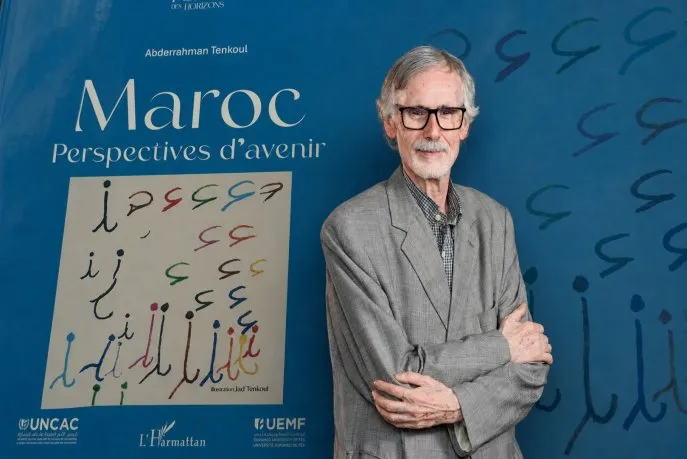

Understanding the Complexities of Morocco's Future
Abderrahman Tenkoul, a prominent academic and dean of the EUROMED Faculty of Humanities and Social Sciences, presents an intriguing exploration of contemporary Morocco in his latest work, Maroc Perspectives d’avenir. Rather than providing a comprehensive analysis, Tenkoul adopts an essayistic approach characterized by thematic 'tables' and 'perspectives'. This methodology facilitates a multi-layered examination that encompasses various spheres, including political, cultural, economic, and geopolitical dimensions, inviting readers to engage with the complexities of Morocco’s future.
Navigating Contradictions and Strategic Challenges
From the outset, Tenkoul's work is anchored in intellectual inquiry, favoring skepticism and questioning over definitive assertions. He portrays Morocco as a nation marked by contrasting dynamics: on one hand, significant advancements in economic and technological sectors, and on the other, enduring vulnerabilities exemplified by social and regional inequalities. This duality is pivotal to Tenkoul’s argument, underscoring the necessity for a holistic understanding of the tensions between growth and stagnation. His focus on the role of intellectual elites, particularly those from the post-independence era, highlights foundational debates that continue to shape contemporary discussions surrounding national development and governance.
A key contribution of Tenkoul's analysis lies in its incorporation of geopolitical dimensions, particularly the relationship with regional neighbors, such as Algeria. He emphasizes that understanding these relationships is crucial for contemplating Morocco's potential trajectories. Additionally, he addresses the importance of knowledge-based economies, asserting that higher education and research are vital for Morocco's integration into global transformations. This perspective extends beyond national borders, encompassing the Mediterranean region as a space of interaction and potential. Tenkoul's analysis addresses the complexities of migration, identity crises, and health emergencies that characterize this geopolitical landscape.
In conclusion, Tenkoul refrains from predicting Morocco's future; instead, he aims to identify markers that may guide understanding of its possible directions. His work encourages readers to consider the future as an ongoing process influenced by collective choices, global challenges, and the nation’s adaptive capacities. By advocating for a nuanced approach that transcends simplistic narratives, Tenkoul invites an open-ended dialogue about Morocco's future, one that prioritizes inquiry over conclusive answers.
As reported by quid.ma.