
Climbing and trekking have positioned several Moroccan valleys on the global adventure map. However, what unfolds when inhabited mountains become the backdrop for athletes from afar? Through his research on "sporting mountains" in Morocco, anthropologist Thomas Fouquet reveals the blind spots of outdoor activities, which often regard themselves as neutral but climb upon a lengthy history.
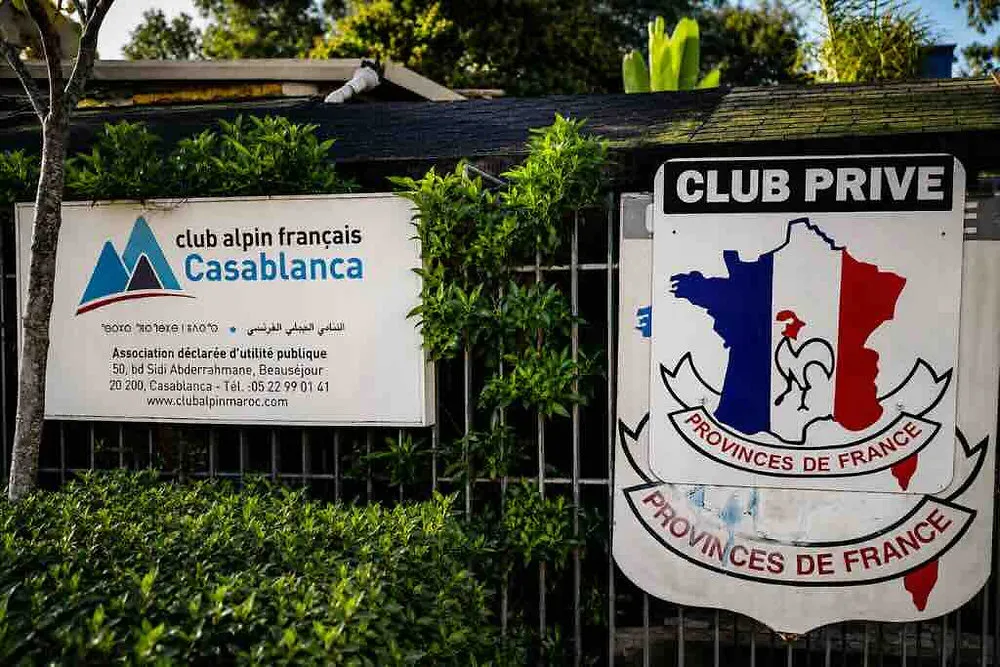
Morocco's mountains are not just scenic; they are vibrant, inhabited, and majestic. Yet, the sports practiced today have been heavily influenced by external models. The story begins during the French protectorate, established in Morocco in 1912. Ten years later, the French Alpine Club opened a section in the High Atlas, with its annual congress held in Marrakech in 1923 under the honorary presidency of Marshal Lyautey. Thus, Moroccan mountain sports originated in a peculiar partnership, where European actors equipped and constructed the first shelters, trained guides, and projected a European alpine imagination onto the Atlas mountains. The cliffs may be Moroccan, but the narrative surrounding them has long been French, steeped in themes of mountaineering, exploration, and conquest.
In an interview with Vertige Media, Fouquet succinctly encapsulates this narrative: “In the eyes of Moroccans, mountain sports represent a kind of foreign space at home.” Even though the mountains are national, they remain partly foreign in their codes, institutions, narratives, and practices. The term “postcolonial” is not merely a slogan; it is a description of visible realities on the ground. Fouquet emphasizes that mountain sports were introduced and developed through the lens of colonization in Morocco.
The Imported Mountain
This historical lineage continues to leave its mark. A significant portion of climbing routes remains equipped by Europeans, whether residing in Morocco or merely passing through. Certain clubs still bear the legacy of these historical codes, while Moroccan climbers often come from privileged urban backgrounds. However, changes are afoot. Fouquet observes a genuine resurgence of interest in climbing among young urban Moroccans. In cities like Rabat and Casablanca, climbing sections are fully booked, with some even turning away new members. While this could be interpreted as democratization, the anthropologist is cautious: “There is mass participation, but not democratization in climbing.”
The predominant demographic consists of young individuals from urban middle and upper classes, often with international experiences or education in Europe. Many discover climbing abroad before realizing it also exists in their home country, as if traveling abroad allows them to see their own territories with fresh eyes. Fouquet cites a young Moroccan climber who began climbing during high school at a French institution in Casablanca. Initially, his experience with climbing was confined to resin on a concrete wall, but he later discovered local rock, leading to a realization: “Oh yeah, we Moroccans can climb too; we have this for real [laughs].”
Social or geographical detours sometimes reveal that one’s country is not merely a destination for others. The material divide also persists. The climbing market in Morocco remains nascent. “Today, there isn’t an equivalent of a ‘Vieux Campeur’,” notes Fouquet. Gear like climbing shoes, chalk, tape, and repairs quickly becomes a matter of luggage and collective resourcefulness. “I constantly share my chalk and tape,” he confesses. He adds, “The Moroccan population is not targeted by the outdoor market; however, Moroccan territories are indeed sought after by outdoor practices.”
Authenticity's Double Edge
The Moroccan valleys are enticing because they appear to offer what many Europeans believe they have lost at home: a more rugged, less developed, and less saturated mountain experience. Yet, authenticity often comes with hidden implications. What travelers perceive as charm—seclusion, the absence of heavy infrastructure, and a timeless atmosphere—can be experienced locally as concrete constraints: insufficient roads, limited access to healthcare, education, employment, and electricity. In Fouquet's article, he references geographer David Goeury, who states, “Enclavement, a constraint on a national scale, could then be considered a resource on a global scale.” In other words, what hinders a territory can become its strongest selling point.
Fouquet discusses a profound disconnect where “the aspirations and desires of some starkly contrast with those of others.” The trekker desires an untouched village, free from excessive electric poles in the frame, while the resident simply wants light. A formula from studies in the Aït Bouguemez valley captures this dilemma: “To attract tourists, heritage must remain intact, but for residents to stay, heritage must evolve.”
In Imlil, the last village before Toubkal (the highest peak in Morocco, reaching 4,167 meters), this misunderstanding manifests clearly. Fouquet describes an “outdoor bazaar”: guides, accommodations, second-hand equipment, old ice axes, worn-out skis, a commerce of adventure, and a resourceful economy. It resembles a Chamonix of the Atlas, albeit lacking the sheen of an alpine resort. “It’s an hypertrophy of consumerist and capitalistic logic that gradually takes hold of the mountains in Morocco,” he observes.
Climbing adds an even more sensitive layer. While trekking merely traverses, climbing transforms landscapes. It drills into rock, installs bolts, names routes, and maps cliffs, leaving its marks on the environment. Fouquet does not aim to vilify foreign climbers; many are deeply attached to Morocco, familiar with the locales, and establish sincere connections with locals. Nevertheless, the act of claiming a portion of territory and naming it carries significant symbolism, considering the country's history and the presence of foreign influences.
“We come, we practice, we consume, and we leave,” summarizes Fouquet sharply.
In response, a more mindful approach to outdoor practices is emerging, one that pays attention to the places and people involved. The anthropologist speaks of a “politics from below,” emphasizing the importance of being considerate about how one arrives in a village, the names given to routes, and the impact of activities beyond merely checking off items on a list.
The long-standing story is now accelerated by social media. Platforms like YouTube and Instagram, along with narratives of personal challenges, make mountains more visible to urban Moroccan youth. This new entry point is potentially valuable but often prioritizes imagery over cultural understanding.
Fouquet recounts an instance where a mountain guide encountered young Marrakchis attempting to summit Toubkal in winter attire—jeans and sneakers—after watching online videos. “Young Moroccans are interested in the mountains, yet there exists a massive gap between the produced images and the concrete knowledge of the populations,” he explains. The summit becomes a backdrop for online stories before it is understood as a living environment. Many seek an image of themselves before learning about cold, altitude, snow, slowness, and risk.
However, this narrative of dispossession through imagery does not encompass the entire picture. In Taghia, young locals have emerged as excellent climbers. Fouquet describes them as “a link between this inhabited mountain and this sporting mountain.” This might represent a part of the future: the ability of Moroccan climbers to create their narratives, images, and ways of engaging with the cliffs.
Morocco is not an exotic exception. This is one of the study's significant insights: examining a specific case sheds light on a question that permeates contemporary outdoor activities. “It’s not about claiming that Morocco has a unique situation; these are Moroccan modalities of a very global issue,” emphasizes Fouquet. How can one traverse a natural space without consuming it as a disposable product? And how can we consider vast spaces without forgetting they are already inhabited, named, worked, and contested? The anthropologist does not advocate for boycotting the Atlas. Rather, he rejects the comfortable stance of a judge. “My question isn’t to criticize the fact that foreigners come to climb in Morocco, but rather how they do it, with what ethics and mindset.”
Ultimately, the challenge lies in this statement made at the end of our conversation: “It’s more about the rhythm than the distance.” The modern trap is not about traveling far; it’s about arriving too quickly, prioritizing the cliff over the village, the line over the place, and the wild adventure over the history. Thomas Fouquet’s study serves as a stark reminder that the outdoors often forgets a fundamental truth: vast spaces are never empty. Even in silence, the cliffs always have a story to tell.