
Melodies Interwoven with Morocco's Rich Tapestry
Morocco is a land where music resonates deeply with its varied landscapes, from the intricacies of urban life within stone-walled cities to the expansive sounds carried by the winds of the desert. This vibrant journey traverses four unique musical realms, each intricately linked to its geographical context, revealing how sound shapes and reflects the lives of its people. One of the most notable musical traditions stems from Fès, a city steeped in history, where centuries of cultural exchange between North Africa and southern Spain have birthed a rich Andalusian art music tradition.
Fès and the Enchantment of Andalusian Art Music
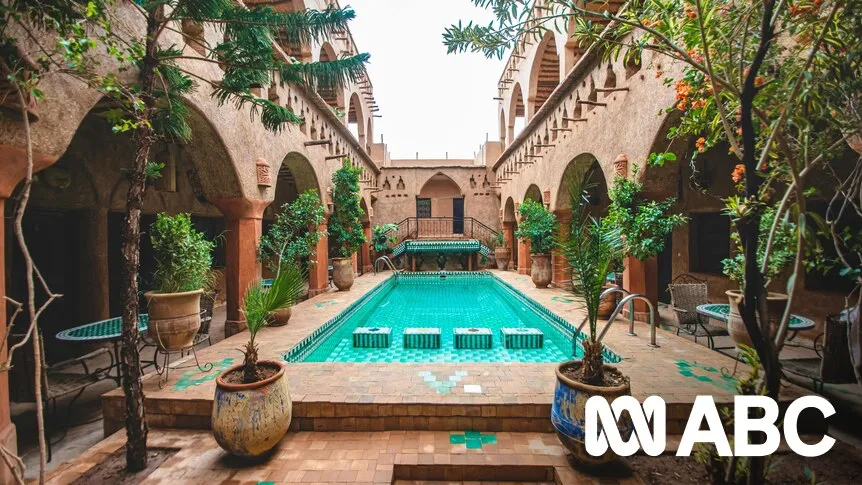
In the heart of **Fès el-Bali**, the ancient walled city, the streets twist and turn, leading to hidden riads—traditional homes built around serene courtyards. Here, the pale stone pathways and stunning _zellij_ tiles, adorned in deep greens and cobalt blues, create an atmosphere steeped in history. The gentle sound of water flowing from a central fountain adds to the tranquil ambiance, making it the perfect backdrop for the refined Andalusian art music that has flourished here. A contemporary embodiment of this rich lineage is found in the composition _**Romance sans paroles**_, crafted by the talented Moroccan composer [**Nabil Benabdeljalil**](https://nabilbenabdeljalil.com/), who skillfully blends Arabic modal traditions with Western classical music. This piece is performed by the acclaimed pianist [**Rebeca Omordia**](https://www.rebecaomordia.com/), recognized for her dedication to showcasing African and diasporic composers within the classical repertoire. The performance continues with _**Semaï Atta'yr**_, a composition by the esteemed oud player and composer [**Said Chraibi**](https://playingforchange.com/artists/said-chraibi), who preserves and extends the classical traditions of this iconic instrument.
Moving to Marrakech, the bustling atmosphere at Jemaa el-Fnaa opens up an entirely different chapter in Morocco's musical narrative. Here, the heat of the day lingers in the ground while aromatic smoke wafts from food stalls, filling the air with the enticing scents of cumin, grilled meats, and fresh mint. As night falls, the square transforms into a vibrant hub of activity, where performers, spectators, and traders create ever-shifting circles of engagement. Unlike the structured performances of Fès, music in Marrakech thrives on repetition and communal participation, blurring the lines between artist and audience. The **Halima Chedli Ensemble**, led by a Tunisian vocalist renowned for her Sufi repertoire, captivates listeners with _**Mohammed Rasoul Allah**_. The music seamlessly transitions into the deep, resonant sounds of the Gnawa repertoire through _**Rihlat Essayf**_ and _**Guafla**_, performed by **Groupe Sidi Mimoun**, a collective that embodies the spiritual musical practices of West African communities in North Africa. In this vibrant tradition, the _maâlem_, or master musician, orchestrates the rhythm and pacing, utilizing the _guembri_, a three-stringed bass lute, alongside the _qraqeb_, hand-held metal castanets that punctuate the cycles of sound, inviting listeners to immerse themselves in the evolving rhythm.
Traveling further south, one encounters the majestic **High Atlas Mountains**, where the landscape dramatically rises. In the vicinity of Imlil, nestled at the base of Mount Toubkal, traditional stone homes cling to steep slopes, and the terraced fields flourish with walnut trees, barley, and wild herbs. In these communities, Amazigh music serves as a vital conduit for cultural transmission, deeply embedded in the daily lives and ceremonies of the people. The works _**Nida Insan**_ and _**Salaam**_ performed by **Hassan Erraji**, reflect the rich heritage of Amazigh traditions while also embracing contemporary performance contexts. The performance continues with _**Tazalit**_, by musicians Raiss Brahim, Larbi Bakchich, and Nour Eddine Fatty, who utilize the _ribab_, a one-string bowed instrument, to deliver melodic lines that resonate through the open air, embodying the spirit of their heritage.
Finally, at the edge of the Erg Chebbi dunes near Merzouga, the landscape reaches its fullest expression. Here, the endless sands form undulating ridges of gold and burnt orange, where movement is slower and sound travels unconfined. Emerging from this vastness is _**Arrahmane**_, performed by **Yemdeh Selem**, who draws upon Hassani traditions that reflect the poetic and cultural life of the desert. Accompanied by **Hassan Haddad**, a guitarist who blends traditional forms with modern interpretation, this performance encapsulates the essence of Hassani vocal traditions, reminiscent of artists like **Dimi Mint Abba**, who brought this rich repertoire to global attention. In this expansive environment, melodies extend outward, shaped by the vastness rather than confined by walls.
In summary, Morocco's diverse musical landscapes—from the intimate courtyards of Fès to the boundless dunes of the Sahara—demonstrate a profound connection between music, movement, and space. These musical worlds not only reveal how individuals navigate their environments but also how their surroundings, in turn, shape their artistic expressions.
As reported by abc.net.au.