
Unveiling a Journey Through Art
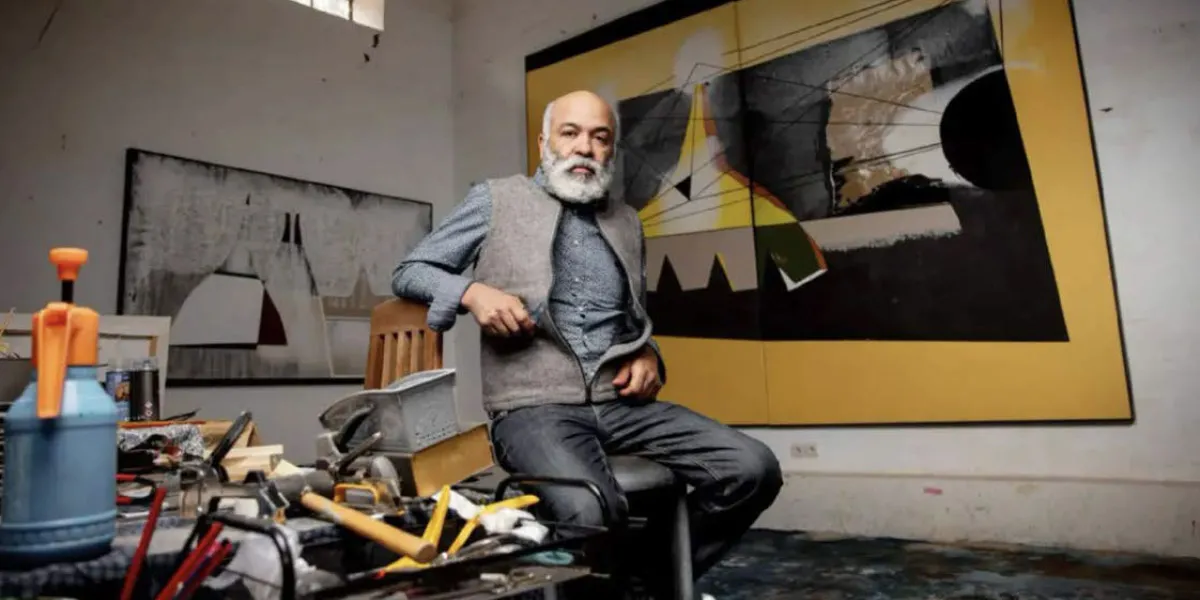
Beginning on October 15, La Galerie 38 in Casablanca will host a captivating retrospective dedicated to the renowned artist Mohamed Mourabiti. Titled "Mohamed Mourabiti: Nearly Four Decades of Painting," this exhibition showcases a diverse collection of works created between 1988 and the present day. It highlights Mourabiti's artistic journey, where earth, memory, and territory converge to explore the unseen dimensions of existence. The event promises to provide an insightful glimpse into how the artist's creations have evolved over nearly forty years, transcending mere chronological representation to reveal the gradual development of a unique artistic language. This language emerges from tangible reality and materiality, gradually transforming into more essential forms.
Mourabiti's artistic roots trace back to Marrakech, where he was born in 1968, and extend to Tahannaout, situated at the foothills of the Atlas Mountains. Here, the earth and traditional adobe structures significantly influence his perspective. However, Mourabiti's work is not merely about representation; instead, he extracts shapes, materials, and symbols from their original contexts, reassigning them new meanings. Over the years, elements such as the parabola, the "koubba," and the circle have evolved into autonomous, almost abstract forms that transcend their descriptive functions, becoming profound symbols in their own right.
From Earth to the Invisible
In Mourabiti's oeuvre, spirituality is not an overlay imposed upon the paintings; rather, it emerges organically from the forms themselves. Elements such as walls, earth, mausoleums, and the "koubba" are drawn from a tangible environment, then gradually stripped of their original purposes. As his works progress, motifs evolve into signs, and landscapes transform into mental spaces. This search for deeper meaning finds a powerful expression in Mourabiti's relationship with the philosopher Ibn Arabi, whose ideas resonate with an intuition already present in the artist's work: the notion that the visible world is merely a threshold, and that materials can embody alternate realities. His journey to Damascus, where he encountered the legacy of Ibn Arabi, marked a pivotal moment in his artistic evolution, transforming the mausoleum from a mere architectural observation into a space that embodies both presence and absence.
Edmond Amran El Maleh, a literary figure who has closely followed Mourabiti's work, recognized this intrinsic dimension early on. He spoke of "tassawof"—the Sufi spiritual path—distancing it from decorative temptations and emphasizing it as a "lived experience" intricately linked to the artist's freedom. In Mourabiti's world, spirituality is woven into the act of painting itself; it involves making a form appear and then disappear, working with materials until they become almost silent, and granting equal presence to both emptiness and fullness. This philosophy aligns with El Maleh's belief that "freedom is the only space of painting."
Remarkably, Mourabiti's quest for the invisible never diverts him from the material world. The more his paintings seek the unseen, the more they return to the earth, pigments, tar, and the ochres and reds of Marrakech, as well as the walls and adobe structures of Tahannaout. For him, the spiritual does not exist in opposition to the sensory; it is derived from it. The circle, in this context, assumes a special significance. As a continuous form with no beginning or end, it spans his recent explorations, including tondi where the map of Africa appears, liberated from conventional borders. In his work, the territory becomes both geographical and symbolic, as well as an internal landscape.
Maps frequently recur in Mourabiti's creations, featuring fragments of plans, journals, and traces from various cities including Marrakech, Paris, London, Dubai, and São Paulo. His travels do not sever his ties to his place of origin; rather, they seem to expand those connections. This interplay between rooting and openness is reflected in the artist's own journey. As a self-taught individual, Mohamed Mourabiti has forged his path outside traditional academic trajectories, learning, experimenting, and engaging with artists, writers, and thinkers. This independence culminated in the establishment of Al Maqam, a space he founded in Tahannaout in the early 2000s, which has become a hub for residency, transmission, and encounters, frequented by notable figures such as Adonis, Mohamed Bennis, Michel Butor, Dia Azzawi, and Edmond Amran El Maleh.
By bringing together both youthful works and Mourabiti's most recent pieces, La Galerie 38 not only celebrates a remarkable career but also unveils the patient construction of thought and inquiry through painting. From Marrakech to Tahannaout, from walls to parables, from mausoleums to circles, and from earth to maps, the artist has pursued the same quest since 1988: to begin with the tangible world and question what lies beyond it. His work is deeply rooted in the earth while constantly reaching towards the invisible.
As reported by leseco.ma.