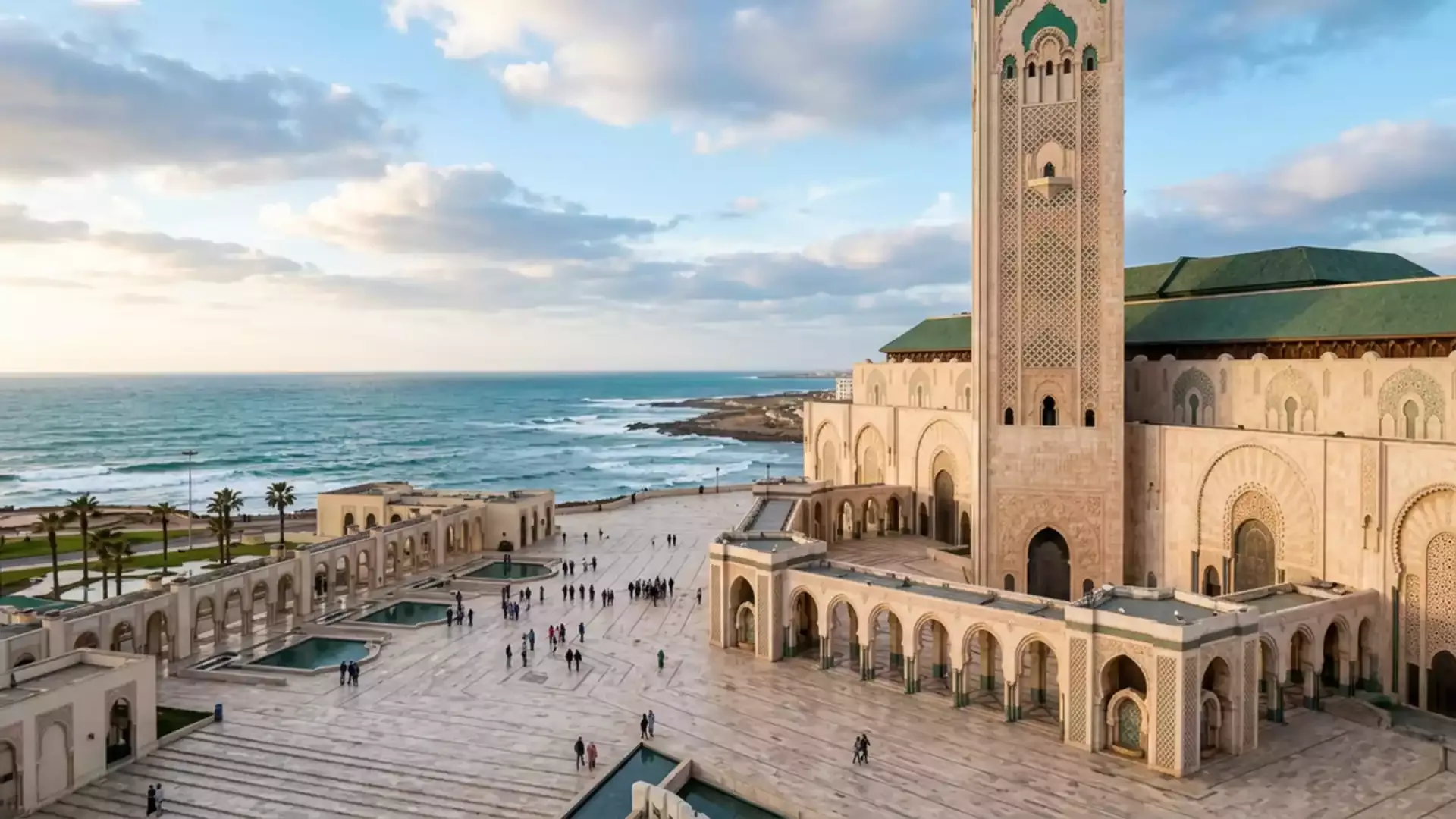

The Hassan II Mosque, perched majestically on the Atlantic coastline in Casablanca, is a stunning architectural marvel that seamlessly blends modern engineering with the rich tapestry of Moroccan craftsmanship. Completed in 1993 during the reign of King Hassan II, this monumental mosque was brought to life by the French architect Michel Pinseau, employing the intricate motifs of Islamic architecture that have been honed over centuries in both Morocco and al-Andalus. Its soaring minaret and expansive prayer hall dominate the landscape, making it a symbol of both faith and national pride.
An Ocean-Front Architectural Marvel
Situated prominently along Casablanca’s waterfront, the Hassan II Mosque is strategically located on a platform that extends towards the Atlantic Ocean, nestled between the bustling harbour and the El Hank headland. The mosque complex is flanked by Boulevard Sidi Mohammed Ben Abdallah, which integrates this grand religious structure into the urban environment of Morocco's largest city. The main prayer hall is elevated above a series of terraces, creating a multi-layered design that harmoniously faces both the city and the vast ocean. A significant portion of the mosque complex is built on land that has been reclaimed from the sea, allowing the structure to appear as if it bridges the terrestrial and aquatic realms, with its stone surfaces reflecting the shimmering Atlantic light while its open courtyards invite the refreshing sea breeze.
Architectural Scale and Exquisite Craftsmanship
The architectural heart of the Hassan II Mosque is its massive prayer hall, which measures approximately 200 meters (656 feet) in length and 100 meters (328 feet) in width, soaring to a height of 60 to 65 meters (197 to 213 feet). Beneath the hall lies a basement featuring ablution facilities and a public hammam, while the surrounding complex boasts gallery-like cloisters and various service areas. Notably, the mosque's minaret rises to an impressive height of 200 to 210 meters (656 to 689 feet), ranking it as one of the tallest religious structures built in the late twentieth century. This slender tower is adorned with a green-topped crown and intricate geometric designs, while a laser beam at its peak is aligned with Mecca, serving as a guiding light for worshippers.
The mosque is designed to accommodate over 100,000 worshippers, with the prayer hall alone capable of housing tens of thousands, complemented by an esplanade ideal for large gatherings. Although the Hassan II Mosque epitomizes late twentieth-century architecture, it draws heavily from traditional Moroccan and Moorish styles, skillfully translating these elements into contemporary materials like reinforced concrete and steel. Its façades and interiors are adorned with a rich assortment of materials, including granite, marble, intricately carved stone, and exquisite timber and metalwork, showcasing a blend of titanium and bronze in select exterior details. Inside the prayer hall, visitors are greeted by mesmerizing _zellige_ mosaics, meticulously hand-carved plasterwork, and gilded cedar ceilings, all arranged in repetitive geometric patterns that are hallmarks of Islamic art in the Maghreb region.
Beyond the prayer hall, the mosque complex includes a madrasa, library, museum, and an academy dedicated to traditional arts, underscoring its significance as a religious and educational hub in Casablanca. Visitors seeking to explore the Hassan II Mosque will find it conveniently located along the seafront, easily accessible via urban roads and close to main railway stations. The extensive complex features broad terraces and paved walkways, though navigating the various levels may require traversing large stone surfaces and staircases.
As you plan your visit, it's essential to be aware of the local customs, as Arabic is the official language and the local currency is the Moroccan dirham. Entry requirements may vary depending on your nationality, so travelers from the UK should consult the FCDO travel advice, while Irish travelers can refer to the Department of Foreign Affairs for updated information.
As reported by ad-hoc-news.de.