
Unveiling the Stories Behind Monochrome Cities
While luxury hotel lobbies may exude opulence, the true essence of a city often lies within its colors, which unveil rich histories, cultural heritage, and even mythical tales. In the vibrant landscapes of the Middle East and North Africa, architecture transcends mere aesthetics, emerging as a dialogue between humanity and the natural world. This interaction gives birth to captivating hues shaped by local materials, climatic conditions, and spiritual beliefs, each telling profound stories of identity. In this imaginative journey, we envision a world free from borders and political strife, where we are free to explore these colorful narratives. The monochromatic cities of this region stand out as destinations that deserve our exploration.
A Journey Through Monochrome Cities
Commencing our exploration, we find Al Quds, the capital of Palestine, presenting a stunning aerial view that predominantly showcases a white palette, punctuated only by the vibrant blue and golden dome of Al Aqsa Mosque. This unique color scheme originates from Al Quds stone, a pale limestone that darkens with exposure to the elements, developing a soft, creamy-yellow hue that epitomizes the city’s architectural identity.
Next, we travel to Busra Al Sham in Syria, renowned for its remarkably preserved Roman amphitheater. This city reflects a somber yet striking palette of deep ashy grey, a result of the local volcanic basalt stone that has been integral to its architectural legacy for centuries.
In the heart of Egypt, Siwa Oasis emerges from the Western Desert, showcasing architectural tones that resonate with its natural surroundings. The traditional karshef building technique, combining salt crystals with clay and sand, results in a palette that ranges from yellowish-brown to soft beige, reflecting the oasis's commitment to natural materials and cultural authenticity.
In Yemen, the Old City of Sana’a rises gracefully from a mountain valley, characterized by an impressive array of rammed-earth and burnt-brick towers. Each tower is adorned with intricate geometric patterns crafted from fired brick and white gypsum, creating a stunning juxtaposition of earth tones and bright accents. This city is not only a UNESCO World Heritage site but also a testament to a rich religious and political history, boasting over 100 mosques and thousands of ancient houses.
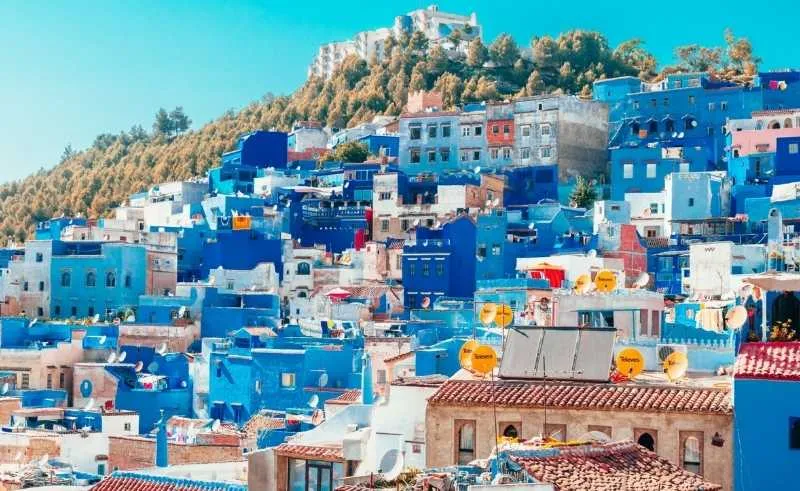
Heading back to Morocco, we arrive in Chefchaouen, a mountain town entirely cloaked in various shades of blue. The city’s signature hue is rooted in local lore, where Jewish refugees painted their homes blue to symbolize their closeness to God during the 1930s. This tradition continues today, as the buildings are repainted annually to maintain the city’s enchanting aesthetic.
Further south in Tunisia lies Tozeur Oasis, a city steeped in history and defined by its yellow-brown brickwork and striking geometric patterns that embellish its buildings. The presence of a sculpture dedicated to the beloved Tunisian poet Aboul-Qacem Echebbi adds a cultural dimension to this unique setting.
Lastly, Muscat in Oman showcases a restrained palette of whites, ivories, and beiges, a design choice made primarily to combat the intense heat of the Gulf sun. This harmonious color scheme not only contributes to the city's aesthetic appeal but also reinforces its cultural identity.
As reported by cairoscene.com.