
Empowering Jerusalem's Children Through Cultural Exchange
Fifty children from Jerusalem, aged between 11 and 14, are participating in the 17th edition of the summer camp organized by the Bayt Mal Al-Quds Asharif Agency. Each child carries with them a story that reflects the rich history of a city that has endured under Israeli occupation for over seven decades. This camp, however, is more than just a recreational and educational experience; it embodies a deep-rooted humanitarian, cultural, and pedagogical significance that transcends the boundaries of a typical summer program.
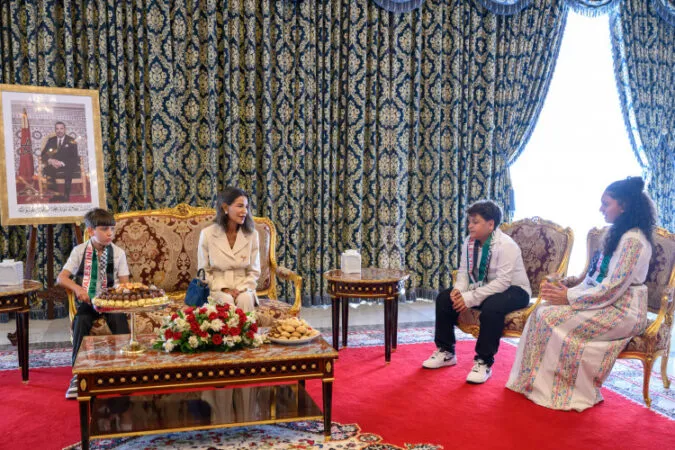
In Morocco, these children are introduced to an alternative life filled with open spaces, excursions, games, sports, city explorations, and interactions with Moroccan peers. Most importantly, they learn that the geographical distance between Jerusalem and Morocco does not diminish the emotional and historical connections they share. On Sunday morning, under the directive of King Mohammed VI, Princess Lalla Meryem welcomed these young Jerusalemites at the Royal Guest Palace in Rabat.
This summer camp initiative is backed by King Mohammed VI, who serves as the President of the Al-Quds Committee, showcasing his unwavering support for the holy city and its residents. The camp aims to reinforce the efforts made by the agency to assist the people of Jerusalem through various tangible projects that have a direct impact on the lives of residents, particularly women, children, and those in vulnerable situations.
Referred to as "Beacon of Peace," this 17th summer camp edition runs from August 12 to 26, 2026. Before arriving in Morocco, the children underwent a preparatory program in Jerusalem that included a variety of sports, artistic, cultural, and educational activities, equipping them for a collective experience that combines learning, recreation, and cross-cultural discovery.
Cultural Exploration and Lasting Bonds
The camp activities commenced at the Summer School in Skhirat, bringing together Palestinian and Moroccan children under the motto that embodies the program's philosophy: "We learn – We create – We aspire with hope for the future." The activities included workshops on safe internet and technology use, in addition to educational and artistic competitions. One of the essential aspects of this camp is the recognition that these children are not merely beneficiaries of a recreational program; they are active participants in an experience that fosters learning, communication, and self-confidence.
In Rabat, the journey took on a clear cultural and educational dimension. The children visited the Mohammed VI Football Academy before heading to the historical Oudayas neighborhood where they were introduced to a part of the capital's history, culminating at the Bou Regreg River, which beautifully encapsulates scenes from both historical and modern Morocco. They also visited the mausoleum of Mohammed V, a site rich in symbolic and historical significance, as they continued their program at various Moroccan institutions and landmarks.
One of the most impactful experiences was a visit to the Royal Guard headquarters in the Mechouar, where they learned about equestrian facilities, sports, and musical training, witnessing horseback riding displays and exploring the Royal Guard Museum, even signing the museum's golden book. The children then transitioned from history to modernity in Casablanca, exploring the Hassan II Mosque, the Hay Mohammadi district, and the economic heart of modern Morocco at the Casablanca Finance City, all while enjoying the scenic coastline at Ain Diab and the green landscapes of Bouskoura.
This journey through Morocco is a multifaceted exploration of the country’s rich history, spirituality, traditional crafts, contemporary urban landscapes, and economic openness. Upon arriving in Tangier, the camp entered its second phase, where the children encountered a city distinct in its nature, location, and memories. On August 18, they engaged in a sports tournament with their Moroccan peers, playing small-sided football and basketball, showcasing how sports can serve as a universal language that fosters friendship and teamwork.
As they toured Tangier in an open-top bus, they discovered the Villa Harris, the international zone, the Perdicaris Park, Cape Spartel, and the Hercules Cave, culminating in a view that represents Tangier's unique identity as the meeting point of the Mediterranean Sea and the Atlantic Ocean. The cultural immersion continued as girls participated in symbolic rituals inspired by Moroccan weddings, donning caftans and traditional attire, while boys engaged in sports and group games. The program also featured performances of Marrakech’s traditional dance and mountain music. The journey then led them to Chefchaouen, with its breathtaking blue hues and mountainous backdrop, adding a new aesthetic dimension to their experience.
Perhaps the most profound aspect of this camp is the connections forged between the children from Morocco and Palestine. The shared activities become a form of silent humanitarian diplomacy, a children's diplomacy rooted in friendship and shared experiences that transcends the need for formal statements or conferences. The camp aims to nurture the abilities of children and youth, broaden their cultural horizons, and enhance communication and exchange with their Moroccan counterparts.
The choice of the name "Beacon of Peace" for this 17th edition is not merely symbolic. A beacon guides through darkness, and peace is what children need most. For the children of Jerusalem, the name carries even greater significance, representing their belonging to a city that encapsulates one of the world's most complex political and humanitarian issues. This naming embodies the values of unity, freedom, justice, and peace that Moroccans uphold.
The summer camp for Jerusalem's children is not a fleeting initiative. Since its inception in 2008, it has become a stable annual event within the social and educational programs of the Bayt Mal Al-Quds Asharif Agency. In previous editions, 850 Jerusalemite children benefited from the program, accompanied by 85 mentors, who explored various regions of the kingdom and witnessed firsthand the solidarity of the Moroccan people with the Palestinian cause. This number does not merely reflect the count of beneficiaries; each child returns to Jerusalem carrying a story about Morocco, a tale of a city they visited, a playground they enjoyed, a friend they made, or a mosque, museum, or historical site they explored.
Over the years, these children have become genuine bridges between two communities and peoples with deep historical and humanitarian ties. From Rabat to Casablanca, and from Tangier to Tetouan and Chefchaouen, these children return with new images of Morocco. When they go back to Jerusalem, they carry with them something that cannot be easily quantified: the memory of a Moroccan summer, new friends, and stories about a country that has shown them, both in words and actions, that it supports and stands with them, both as a king and a people.
Thus, perhaps the "Beacon of Peace" has fulfilled its most crucial role: to illuminate, in the hearts of fifty Jerusalemite children, a promising space of hope.
As reported by alyaoum24.com.