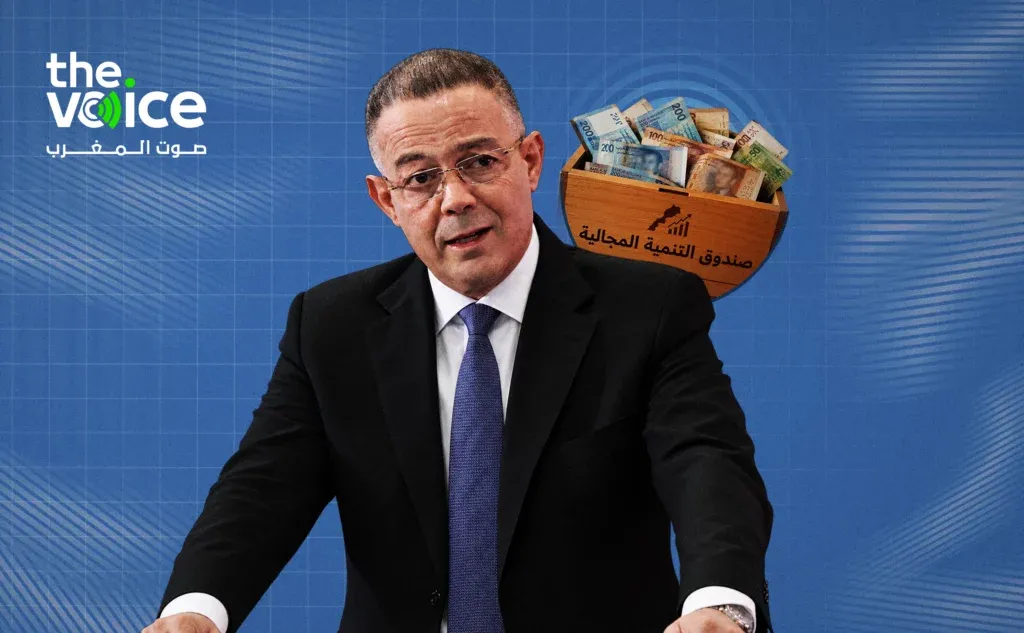

The recently appointed Minister Delegate for Budget and President of the Royal Moroccan Football Federation, Fouzi Lekjaa, has emerged as the actual authority overseeing the "Territorial Development Fund," which finances projects prepared by the Ministry of Interior while other government sectors execute them. This marks an unprecedented position for the fund, established in the 1990s, as previous budget laws granted the expenditure authority to prime ministers and heads of government, with a notable exception in the 2016 budget law when former Prime Minister Abdelilah Benkirane claimed that the Minister of Agriculture, current Prime Minister Aziz Akhannouch, had removed this fund from his control without his consent.
In addition to his role as the issuer of expenditure orders, Fouzi Lekjaa holds comprehensive authority over all government sectors related to this program, facilitated by a National Committee theoretically supervised by the Prime Minister, responsible for coordinating and approving programs. Consequently, Lekjaa is now firmly in control of the upcoming phase leading to elections, as he oversees a fund that will finance a new generation of integrated territorial development programs over the next eight years, with a total cost of 210 billion dirhams. Furthermore, a law issued in the same period last year (2025) assigned him the presidency of the "Morocco 2030" Foundation.
Transitional Appointment and Broad Powers
A decree from Prime Minister Aziz Akhannouch dated August 3, 2026, appointed Fouzi Lekjaa as the Minister Delegate for Budget, indicating that this appointment is “transitional,” suggesting a potential change in the issuer of expenditure orders for this fund. This situation remained unresolved within the 2026 budget law and was the subject of indirect disputes between the Prime Minister's office and the Ministry of Interior, as highlighted by "Voice of Morocco" in a previous report during the discussion of the financial law in Parliament.
Some interpretations link Lekjaa's joining of the Authenticity and Modernity Party to the possibility of his appointment as the next Prime Minister if this party leads the elections. Immediately after officially assuming control of the fund, he issued a series of decisions appointing assistant expenditure officers and their deputies, which included governors and regional officials as assistant expenditure officers, as well as regional directors from the Ministries of Equipment, Transport, and Logistics, some health delegates, and regional officials from agriculture, urban planning, city policy, and education as deputies to the assistant expenditure officers.
Lekjaa also granted signing authority for contracts to dozens of local and regional officials, including governors, regional directors, and heads of departments, while designating a representative within the Ministry to sign or endorse documents related to the fund.
20 Billion Dirhams at the Fund's Disposal with a 210 Billion Dirham Project Ahead
The 2026 budget law revitalized the "Rural and Mountain Development Fund" under its new name, the "Integrated Territorial Development Fund," allocating 5 billion dirhams as performance credits for the current year, alongside 15 billion dirhams as commitment credits that can be pre-committed against the 2027 budget. However, unlike in 2016, the law did not specify the identity of the expenditure issuer, merely stating that the appointment would be made "in accordance with the applicable regulatory texts," leaving this point unresolved until the Prime Minister's decree confirmed the budget minister's authority, albeit temporarily.
The significance of this position is heightened by the scale of the projects the fund will finance, as the estimated cost for the new generation of integrated territorial development programs reaches 210 billion dirhams over eight years, encompassing projects in employment, education, health, water, territorial rehabilitation, and reducing regional disparities.
The Ministry of Interior had previously taken control months in advance concerning the preparation of these programs. On August 15, 2025, Interior Minister Abdelouafi Laftit issued memorandum number 1300 directed at governors and regional officials, initiating the preparation of the new generation of integrated territorial development programs in accordance with the royal directives outlined in the Throne Speech.
In October of the same year, the governor and director general of local authorities, Jaloul Samsem, announced the launch of consultations across the 75 regions of the kingdom, involving elected officials, administrative bodies, civil society, and local actors. This structure was later solidified by assigning local tracking of program preparation to the regional officials, ensuring coherence at the regional level, while a national committee headed by the Prime Minister coordinates and approves the programs. With Lekjaa appointed as the issuer of expenditure orders, the picture has become clearer: the Ministry of Interior handles the project engineering, while the budget minister controls the financial key that allows for their funding.
The debate concerning who controls the fund is not a new issue. Established in 1994 as the "Rural Development Fund," the expenditure issuer was initially the Prime Minister, before being renamed the "Rural and Mountain Development Fund" in 2012. In the 2016 budget law, the expenditure authority was transferred from Prime Minister Abdelilah Benkirane to Agriculture Minister Aziz Akhannouch, igniting one of the most famous confrontations between the two men when Benkirane claimed the fund was taken from him without his knowledge.
The conflict re-emerged within Akhannouch's coalition during discussions surrounding the 2025 budget law, when the Authenticity and Modernity Party demanded shared oversight between agriculture and housing, while the Independence Party insisted on involving the Ministry of Equipment in managing rural road projects, countered by the “Liberals” who wanted the fund to remain under the Ministry of Agriculture's control. Hence, the neutrality of the 2026 budget law regarding the identity of the expenditure issuer reflects the sensitivity of a fund that has long represented, alongside its developmental function, a site of influence within the executive apparatus.
The handover of the fund to Lekjaa adds another political and institutional dimension to his current position; he does not merely oversee the budget of a financial account that will accompany a development program valued at 210 billion dirhams, but also heads the "Morocco 2030" Foundation, responsible for coordinating and monitoring projects related to hosting the World Cup and other major sporting events. Thus, the Minister Delegate finds himself at a unique intersection before the legislative elections, bridging financial decision-making, territorial development, and investments tied to the 2030 horizon.
As reported by thevoice.ma.