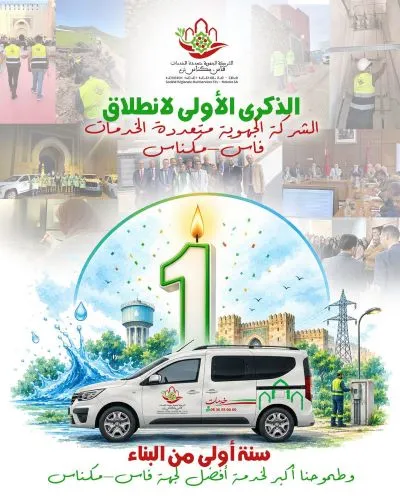

Reflecting on a Year of Transformation
The completion of one year since the official launch of the Fes-Meknes multi-service regional company marks an opportune moment to evaluate the achievements of an institution that emerged from one of Morocco's largest reform initiatives aimed at restructuring the distribution of potable water, electricity, and wastewater management. The establishment of these multi-service regional companies was not merely an administrative or legal change; rather, it was a response to an urgent need for a new governance model that emphasizes unified management, enhances service quality, accelerates investment, reduces regional disparities, and strengthens proximity to service users.
Since its inception, the company has taken on the responsibility of managing three vital sectors within one of the largest regions of the country, which encompasses eight provinces and two prefectures, showcasing a diverse topography that includes plains, mountains, and rural areas. This diversity adds complexity to the management of networks, making it one of the most technically challenging tasks on a national scale.
Emergency Responses and Community Engagement
The company was thrust into action without a lengthy transitional period, facing significant challenges from the outset due to climate fluctuations, increasing pressure on water and electricity networks, and the pressing need to ensure uninterrupted public service delivery. This was coupled with the reorganization of human resources, the unification of information systems, and the establishment of a new management framework.
Despite being a relatively new entity, the organization quickly transitioned from institutional building to active field intervention, relying on technical teams available around the clock and maintaining continuous coordination with local authorities and regional command centers.
The heavy rains and snow that swept through the Fes-Meknes region last winter served as the company’s first real test, resulting in an official report indicating the execution of 11,470 field interventions in a short period. These interventions included repairing faults, restoring networks, ensuring the security of water and electricity installations, and providing emergency responses to flood damage, all in direct coordination with the Fes-Meknes region's governorate and local emergency committees.
These interventions were not merely technical operations; they represented a new model in crisis management, with technical teams stationed in the field day and night, mobilizing human resources and heavy machinery to ensure the continuity of essential services.
Among the significant milestones marking the company's first year were its interventions during the floods in the provinces of Taounate and Taza. The teams worked diligently to repair damage to infrastructure, secure pumping stations, and restore electricity and water networks while ensuring the protection of wastewater facilities from collapses and blockages.
The organization also collaborated with various stakeholders during field interventions, significantly mitigating the impacts of disruptions and restoring services to the affected populations promptly. This demonstrated that public services do not cease even under the most challenging climatic conditions.
Additionally, the heavy snowfall in the Ifrane and Hajjaj regions posed its own challenges, leading to power outages in several areas. However, the company swiftly mobilized specialized intervention teams that worked under severe weather conditions to repair faults and restore electricity, maintaining their efforts despite the treacherous mountain paths and dropping temperatures.
These operations reflected the institution's readiness to address climatic crises and its ability to ensure service continuity even in the most rugged terrains.
In June 2026, the company faced one of its toughest challenges related to water supply during a technical failure in the main conveyance channel from the Idriss I dam. Although this issue was outside its direct jurisdiction, given that the production facilities are managed by the National Office for Electricity and Drinking Water, the company led a wide-ranging field mobilization. It managed water distribution within the networks, reprogrammed supply schedules, and issued continuous statements to inform the public about developments, coordinating technically until the supply was gradually restored. Many stakeholders praised the prompt communication with citizens and the proactive information policy, which helped curb the spread of rumors during the crisis.
From the outset, the company has aimed to forge a new relationship with service users based on proximity, transparency, and responsiveness, modernizing commercial agencies, enhancing digital services, adopting electronic performance metrics, and improving channels for receiving complaints. It has also implemented regular institutional communication through official statements and digital platforms to explain the reasons behind disruptions and faults and maintenance programs.
This transformation has been one of the standout strengths in the first year, as the institution transitioned from a traditional management approach to one characterized by constant communication with the public.
Alongside daily interventions, the company has prioritized investment, unveiling an investment program worth nearly 3 billion dirhams during consultations with local authorities in the Taounate region. This program aims to strengthen water, electricity, and wastewater networks, reduce regional disparities, and enhance service quality, especially in rural areas and emerging centers. This strategic direction indicates that the institution does not merely address daily faults; rather, it operates with a long-term vision focused on modernizing infrastructure and ensuring water and energy security for the region.
After just one year, the Fes-Meknes multi-service regional company has proven itself to be more than just an entity for managing bills or fixing faults; it has become a strategic regional institution that is integral to the water and energy security framework of the region. It has succeeded in navigating difficult field tests, demonstrating a remarkable capacity to mobilize its human and technical resources in response to floods, snow, and significant faults, all while maintaining the continuity of public services and enhancing communication with users.
The next phase depends on continued investment in network modernization, accelerating digitization, and improving service quality so that this foundational year translates into a sustainable path, positioning the company as a national model in regional governance and public service management.
As reported by fes24.com.