Unveiling the Historical Significance of Jewish Practices in Marrakech
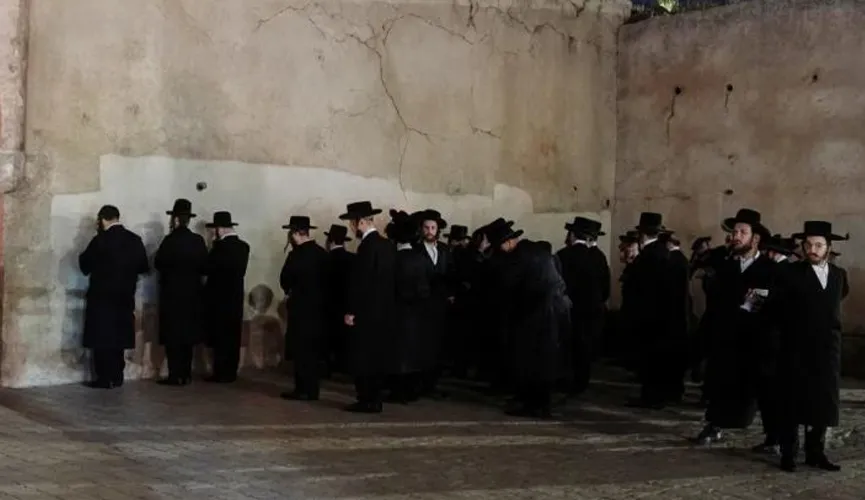
The recent scene of Haredi Jews praying in front of the Bab Doukkala walls in Marrakech during the spring of 2026 transcends mere tourism or spontaneous religious expression. It marks a pivotal moment, a "zero hour," where centuries of political and social engineering converge. This narrative traces back to 1666 when the founder of the Alaouite dynasty, Sultan Rashid, chose to establish his rule from the heart of the Mellah in Fes, taking refuge in the homes of Jewish financial legends. This was not merely a quest for shelter; it was an early declaration of a foundational contract linking the throne's continuity with alliances forged with transnational Jewish financial and security powers, distancing itself from the aspirations of the subjects who were forced into a facade of sanctity and noble lineage to justify their subjugation.
This "historical deception," where religion and lineage were wielded as tools to numb consciousness, allowed the regime (Makhzen) to exercise political and religious oppression in its most egregious forms. It trafficked in the suffering of neighbors by undermining popular resistances such as that of Emir Abdelkader. In the 1950s, Moroccans were asked to believe in fantastical miracles—from the Sultan appearing on the moon’s surface to filling airplane tanks with "blessings," proclaiming freedom through the revolution of the king and the people, and venerating the Makhzen's motto: God, Nation, King. The regime practiced a sinister pragmatism, selling Jewish subjects for dollars to the Zionist entity in the 1960s, surrendering sovereignty to the Mossad at the Rabat summit in 1965, and fabricating crises with a rebellious Algeria to ensure that the "subjects" remained ensnared in ignorance and fear.
The Implications of Current Events in Marrakech
Today, the scenario unfolds in Marrakech, where the alleged folly of Hassan II transforms into a grim reality under his son Mohammed VI. The overt presence of Zionism at the gates of Marrakech, coupled with the protection of Haredi rituals amidst the bustling populace, signifies the actual establishment of a "replacement homeland." It is an announcement that the historical alliance with the Mellah from 1666 has transitioned from shadowy rooms to the public square in 2026, where the Moroccan citizen is expelled from their land and home to make way for investors and settlers from the Zionist entity, under security arrangements that ensure the "subjects" remain unaware, applauding their oppressor while believing that this "occupation of public space" is a strategic victory for the throne.
The Bab Doukkala wall in Marrakech today is not merely a historical edifice but a testament to a political lineage that has chosen to embrace the foreign since 1666, transforming Morocco from a kingdom into a functional fiefdom serving an agenda disconnected from its rightful inhabitants and the sacrifices of its oppressed people. The collective ritual performed by Haredi Jews before the Bab Doukkala walls, reminiscent of the Wailing Wall, epitomizes a profound transformation in the structure of the Makhzen state. The gap between Hassan II's famous assertion about "merging Jewish ingenuity with Arab wealth" and the reality of Morocco under Mohammed VI is no longer just a temporal distance; it represents a radical shift from covert diplomacy to institutional and spatial integration.
Hassan II had constructed the narrative of "exceptional Morocco" that safeguarded his Jewish subjects as international leverage, but the current regime appears to transition from being mere guardians to structural partners, opening historical public spaces as stages for inaugurating a new visual and religious identity. In this context, the "subjects" are no longer mere spectators; they witness how the symbolism of their ancient city walls is being reshaped to accommodate an assumed second homeland, where the tourist becomes a rightful owner, and praying before the wall transforms from a religious act into a political declaration, entrenching a reality where sovereignty belongs to major strategic relationships, while the Moroccan remains trapped under a slogan that venerates the throne and grants it absolute authority to redefine geography and humanity.
The cleansing actions undertaken by the free people of Marrakech following the desecration of the Bab Doukkala walls by Zionists were not mere superficial cleaning; they were essentially a silent indictment and a deafening cry of helplessness emanating from the depths of the subjects whose will has been stolen over centuries. The Moroccan resorting to cleansers to eradicate the traces of Haredi rituals symbolizes the tragic distance between the emotions of the subjects and the overwhelming authority. They wash the pavement because they lack the capacity to cleanse institutions, purifying the stone because they subconsciously recognize that political decisions have been tainted by Zionist dependency, leaving no remnants of Moroccan sovereignty.
This symbolic act confronts us with a bitter truth: the corruption plaguing the body of the Moroccan kingdom is not merely administrative deviations but structural corruption, with the Makhzen embodying both the head and the heart. Since the moment Sultan Rashid’s regime tethered itself to money and narrow interests in the Mellah in 1666, the Moroccan kingdom has morphed into a functional estate where people are herded as "subjects" under the weight of religious sedatives and mythical legends, while real decisions are made in dark rooms to ensure the throne's survival and its dubious alliances. Simply cleansing the pavements acknowledges implicitly that the head of corruption possesses the security power and false sanctity that render it immune to cleansing, as long as collective consciousness remains ensnared between absolute loyalty slogans and the reality of succumbing to Zionism.
The true cleansing Morocco needs today does not begin at the walls of Marrakech but rather from uprooting the roots of tyranny that have rendered Morocco an open space for Zionists and its "subjects" nothing more than mindless beings satisfied with erasing footmarks, while treachery has settled at the peak of the political hierarchy. As long as the Makhzen is the one opening the doors, and as long as it is the one stifling dissenting voices, all efforts to cleanse the space will remain merely attempts to beautify the face of an ugly reality, a reality that day by day confirms that the greatest corruption lies not in remnants of strange prayers but in a regime that has sold its history, neighbors, and sovereignty in exchange for a fictitious "blessing" that nourishes neither hunger nor thirst.
Before concluding, I urge readers to explore the book "Bibiou: Destruction at the Door" by Dr. Ahmed Wihman, the head of the Moroccan Observatory Against Normalization in Morocco. This book provides a critical analytical reading of the political and social reality in the Moroccan kingdom, warning of both external and internal dangers threatening the unity and stability of the country. Here’s a summary of the key ideas presented in the sources:
- Significance of the Title (Bibiou): It is an Amazigh cry for help or a warning issued in cases of imminent danger or disasters threatening the community, requiring immediate intervention. The author uses it as a title to alert readers that Morocco is undergoing very dangerous circumstances.
- Diagnosis of the Regime: The book critiques the structure of the Moroccan state, describing it as "neo-patrimonialism," where the public and private matters intertwine, transforming the state into a semblance of a private political enterprise dominated by the ruler, his entourage, and close associates. This system leads to widespread corruption, favoritism, and a lack of accountability.
- Fragmentation and Division Scheme: The author warns against what he calls a "destructive scheme" led by colonial and Zionist forces aimed at dividing Morocco into smaller entities or "mini-states" based on ethnic and regional grounds. The book points to plans for creating six hypothetical "republics" (such as the Republic of Rif, the Republic of Amazigh, the Republic of Sous) to undermine the unity of the central state.
- Pseudonization Phenomenon and Zionist Penetration: The book intensively focuses on what it describes as the "pseudonization" of society and the state, a term combining Zionism and identity exploitation (whether Amazigh or Hebrew). The author affirms the existence of extensive Zionist infiltrations in agriculture, tourism, education, and even security through what is called the "fifth column" or "hyathim."
- Targeting Identity and Language: The book harshly criticizes what it terms "Aiyashia" (after Nour al-Din Ayoush), a current accused by the author of working to marginalize the Arabic language in administration and education while promoting the dialect and French to sever future generations' ties to their Arabic heritage.
As reported by echoroukonline.com.