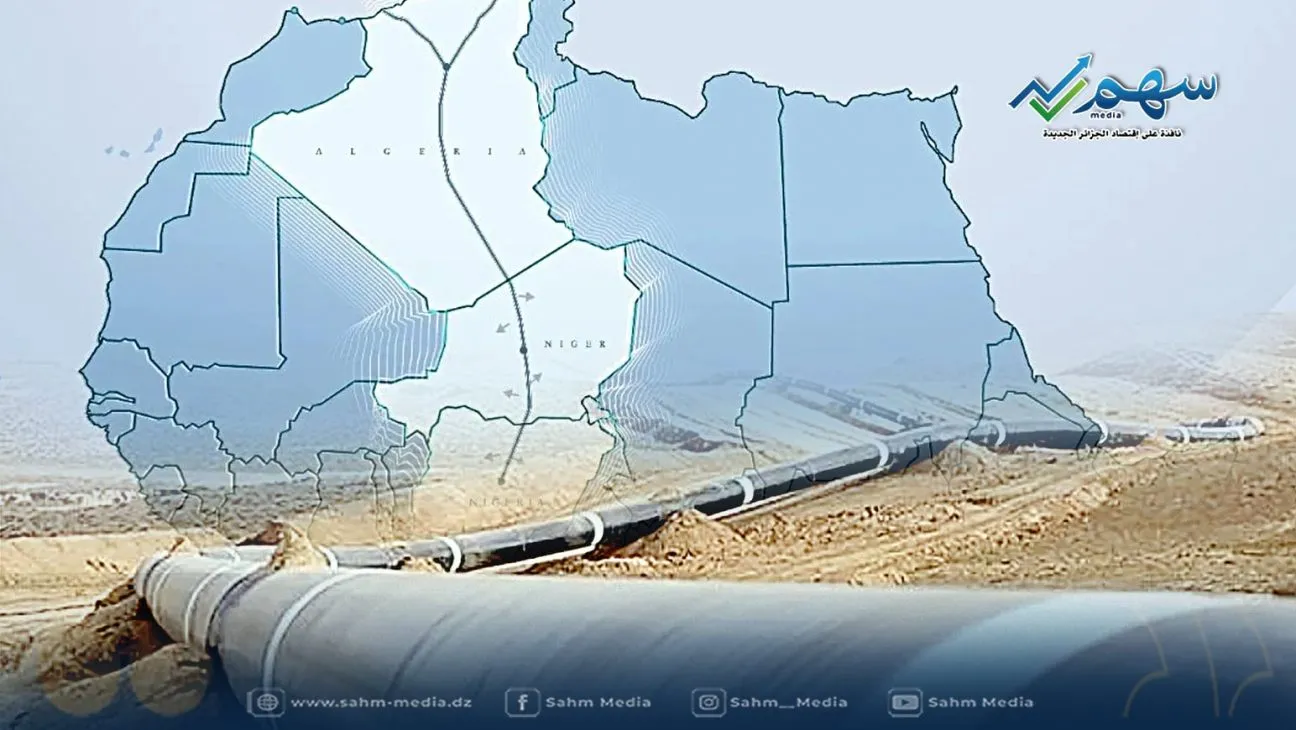

Algeria's Strategic Advantage in Gas Supply
The energy landscape in North Africa is undergoing a significant transformation as a recent German report reveals that Algeria's Trans-Sahara gas pipeline project is gaining a substantial economic advantage over its Moroccan competitor. This shift is attributed to the accelerated pace of project implementation and the presence of favorable technical and financial conditions that enhance the likelihood of its realization in a shorter timeframe. The report highlights Algeria's successful establishment as a central partner in the European energy market, capitalizing on the global supply shifts since 2022. Natural gas has transitioned from being merely an export commodity to a strategic tool for regional influence and balance, intensifying competition for transporting Nigerian gas to Europe.
In this context, the diplomatic rapprochement between Algeria and Niger emerges as a critical factor in reshaping energy pathways. After a period of estrangement, relations resumed their natural course in early 2026, paving the way for enhanced cooperation on strategic projects, with the Trans-Sahara gas pipeline taking precedence. The report also notes that Sonatrach's robust entry into the field, marked by the initiation of exploration activities in the Kafra field near the Algerian border, signifies the project's transition from the planning stage to actual execution. This is particularly promising, given estimates of reserves exceeding 260 million barrels, alongside supporting programs focused on training and building local capacities in Niger.
Comparative Analysis of Pipeline Projects
From a technical perspective, the Algerian project presents a more feasible option, stretching approximately 4,127 kilometers and traversing three countries, with a significant portion of its infrastructure already in place. Current data indicates that around 60% of the pipeline route is operational, which reduces costs and accelerates project completion compared to its Moroccan counterpart. Conversely, the Nigerian-Moroccan pipeline project faces greater challenges, including its length of over 5,600 kilometers, which passes through 13 countries, and high costs potentially reaching $30 billion. The technical complexities associated with the maritime route further complicate its execution, making it a long-term project likely extending beyond 2040.
The report emphasizes that these disparities provide Algeria with a clear economic advantage, especially given Europe's urgent need for swift and secure solutions to compensate for supply shortages. The Trans-Sahara pipeline can be directly linked to the existing Medgaz and Transmed networks, facilitating gas transportation to Spain and Italy without the need for complex additional investments. The ongoing shifts in the energy sector reflect Algeria's strategic repositioning, leveraging its geographic location, infrastructure, and technical expertise to accelerate the project's transition from the study phase to implementation, potentially securing a significant lead in the race to supply Europe with gas in the coming years.
As reported by sahm-media.dz.