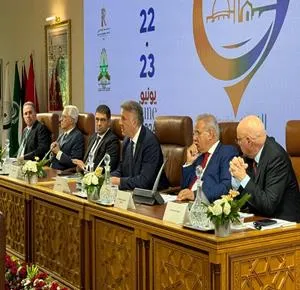

On June 22, 2026, a significant panel discussion titled "Jerusalem: A Global Narrative for Peace" commenced in Rabat, Morocco, featuring prominent figures such as Ahmad Assaf, the general supervisor of official Palestinian media, and Mohamed Mehdi Bensaid, Morocco's Minister of Youth, Culture and Communication, alongside various diplomats and media representatives. This forum is particularly notable as it aligns with Rabat's recognition as the Capital of Arab Media for 2026, emphasizing the pivotal role of the Palestinian issue and Jerusalem in the regional and global media landscape.
In his opening statements, Minister Assaf articulated that Jerusalem lies at the heart of the ongoing conflict and serves as a symbol of Palestinian identity. He underscored that any pathway to peace must acknowledge and address the complexities surrounding Jerusalem and the rights of the Palestinian people, asserting that this issue cannot be overlooked or diminished. Assaf expressed concerns regarding the persistent attempts to distort the Palestinian narrative, advocating for the development of a robust and factual media narrative that can effectively engage global audiences.
He highlighted the crucial role of both Arab and international media in accurately portraying the realities in Jerusalem and Gaza, free from misleading narratives, thereby enhancing global awareness of the situation on the ground. Assaf reaffirmed that Jerusalem will continue to serve as a focal point for responsible media committed to truth, freedom, justice, and peace, reflecting its rich tapestry of diverse religions and cultures that coexist harmoniously.
Furthermore, Assaf pointed out that international law and United Nations resolutions affirm Jerusalem's status as an occupied city. He condemned any unilateral actions aimed at altering its legal status or historical character, emphasizing that such measures are unequivocally rejected by the international community and violate principles of international legitimacy. He identified Jerusalem as a key issue that must be resolved through equitable negotiations that respect the inalienable rights of the Palestinian people, particularly their right to their capital.
The minister also noted the ongoing exploitation by Israel of the conflict in Gaza and the resulting international distractions, which permit the imposition of facts on the ground in Jerusalem. This includes intensifying restrictions on sacred sites and diminishing the presence of Palestinians in the city. Assaf specifically mentioned the adverse conditions faced by worshippers at both the Al-Aqsa Mosque and the Church of the Holy Sepulchre, citing access limitations and attempts to create spatial and temporal divisions at Al-Aqsa.
In conclusion, Assaf emphasized that safeguarding Jerusalem and its holy sites is a collective responsibility that necessitates coordinated international efforts to ensure freedom of worship and to uphold the city’s historical identity. He expressed gratitude towards the Kingdom of Morocco, King Mohammed VI, and the Bayt Mal Al-Quds Asharif Agency for their unwavering support of the Palestinian cause and their role in bolstering the resilience of the people of Jerusalem.
In his remarks, Minister Bensaid reflected Morocco's pride in hosting the forum, which underscores the significant place of the Palestinian cause within Moroccan society, both officially and popularly. He emphasized the need for enhanced Arab collaboration across media, culture, and communication to foster a professional and balanced narrative about Jerusalem grounded in factual documentation, capable of countering misinformation. Bensaid reiterated that Jerusalem's profound religious and historical importance acts as a unifying cause for Arab and Islamic nations, noting Morocco's continuous political, diplomatic, and humanitarian initiatives to support the residents of Jerusalem and protect the city’s holy sites and identity. He concluded by stating that this meeting represents a crucial opportunity to strengthen Arab media dialogue and refine the tools of media discourse in light of global changes, ultimately contributing to the dissemination of the Palestinian narrative across international platforms.
As reported by english.wafa.ps.