
Harmattan AI Initiates Recruitment for Drone Manufacturing in Morocco
On August 24, 2023, the French defense technology firm Harmattan AI announced the commencement of recruitment efforts in Rabat, Morocco, aimed at hiring a manager responsible for overseeing the industrialization and production of its autonomous systems at local sites. This initiative marks a significant milestone in a broader Moroccan project, which also includes the establishment of an engineering team comprising approximately fifty specialists, a network of suppliers, and the transition of drones from qualification to mass production, as detailed in a job listing released by Harmattan AI.
The job announcement outlines the industrial scope of a project whose key elements were initially disclosed two months prior. Harmattan AI is on the lookout for a manager who can design manufacturing processes, adapt them for Moroccan sites, and guide the new systems from initial prototypes to full-scale production. Concurrently, the company is seeking a director for unmanned aerial systems engineering, who will be tasked with creating a completely new organization in Rabat. The firm has emphasized that the site is set to open this year and that this role will be a foundational position.
Building a Skilled Team in Rabat
The anticipated team will comprise around fifty experts organized into six technical modules. The responsibilities assigned to the future director will encompass various domains such as airframe design, propulsion, avionics, launch systems, ground systems, qualification, and flight testing. Moreover, the manager will be tasked with establishing a local supplier network and steering the programs through to mass production, in line with the terminology utilized by Harmattan AI.
The recruitment campaign launched in Rabat underscores the extensive range of roles that the company plans to establish in Morocco. The job portal notably lists vacancies for positions such as aerodynamic engineer, propulsion engineer, electronics engineer, embedded software engineer, guidance-navigation-control specialist, flight test engineer, drone systems validation engineer, quality manager, logistics coordinator, program manager, and product manager. Additionally, Harmattan AI is looking for a head of industrialization and manufacturing to implement automated processes at local facilities.
This organizational framework is a tangible outcome of the strategic agreement signed on June 17 between Harmattan AI and the Royal Armed Forces of Morocco (FAR). At that time, the company announced three key initiatives for Morocco: the establishment of manufacturing capabilities for autonomous defense systems, the creation of a research and engineering center dedicated to artificial intelligence applied to military systems, and partnerships with Moroccan higher education and research institutions. Harmattan AI also indicated plans for Morocco to deploy large-scale autonomous air defense capabilities by 2026. The company's CEO and co-founder, Mouad M’Ghari, described the agreement as the foundation for a long-term partnership, emphasizing that the decision to invest in Morocco was driven by considerations of "strategic autonomy" and "technological sovereignty." No specific investment amount, factory location, or projected production volume was disclosed at that time.
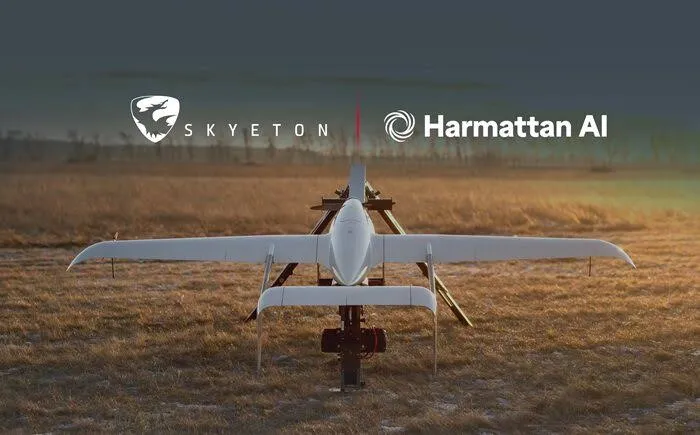
The Moroccan project follows a surge in Harmattan AI's military activities in France, with the General Directorate of Armament (DGA) announcing on June 23 the order of 5,000 Delco combat drones for the army, with deliveries scheduled to commence no later than early 2027. This order followed an initial batch of 1,000 units delivered in January for the Orion 2026 exercise. Harmattan AI refers to this short-range intelligence, surveillance, and reconnaissance system as Sonora, asserting that the order volume from France has increased fivefold within a year.
The group's expansion was preceded by a Series B funding round in January, raising $200 million (approximately 1.85 billion dirhams), led by French aerospace manufacturer Dassault Aviation. Harmattan AI's job postings indicate a valuation of $1.4 billion (nearly 13 billion dirhams). Concurrently, Dassault Aviation established a partnership with the company aimed at integrating "controlled autonomy" and artificial intelligence into future air combat systems. On July 13, both companies showcased their collaborative efforts by announcing a flight involving a Rafale F4 and a drone equipped with Namib, a jointly developed electronic warfare payload. According to Harmattan AI and Dassault Aviation, Namib successfully detected and geolocated a radar situated several dozen kilometers away, transmitting its position to the Rafale, which then simulated an attack. This program began in January, coinciding with Dassault Aviation's entry into the funding round.
Harmattan AI focuses its activities on autonomous military systems, including intelligence, surveillance and reconnaissance, drone interception, precision strikes, electronic warfare, and the execution of autonomous missions. The DGA now recognizes it as the first French unicorn in the defense industry, noting that its microdrones intended for the army are designed and assembled in France, incorporating infrared cameras supplied by the French company Lynred. The establishment of the Rabat facility signifies the transition from the Moroccan agreement announced in June to the formation of engineering, industrialization, quality, and logistics teams tasked with facilitating local manufacturing.
As reported by barlamane.com.