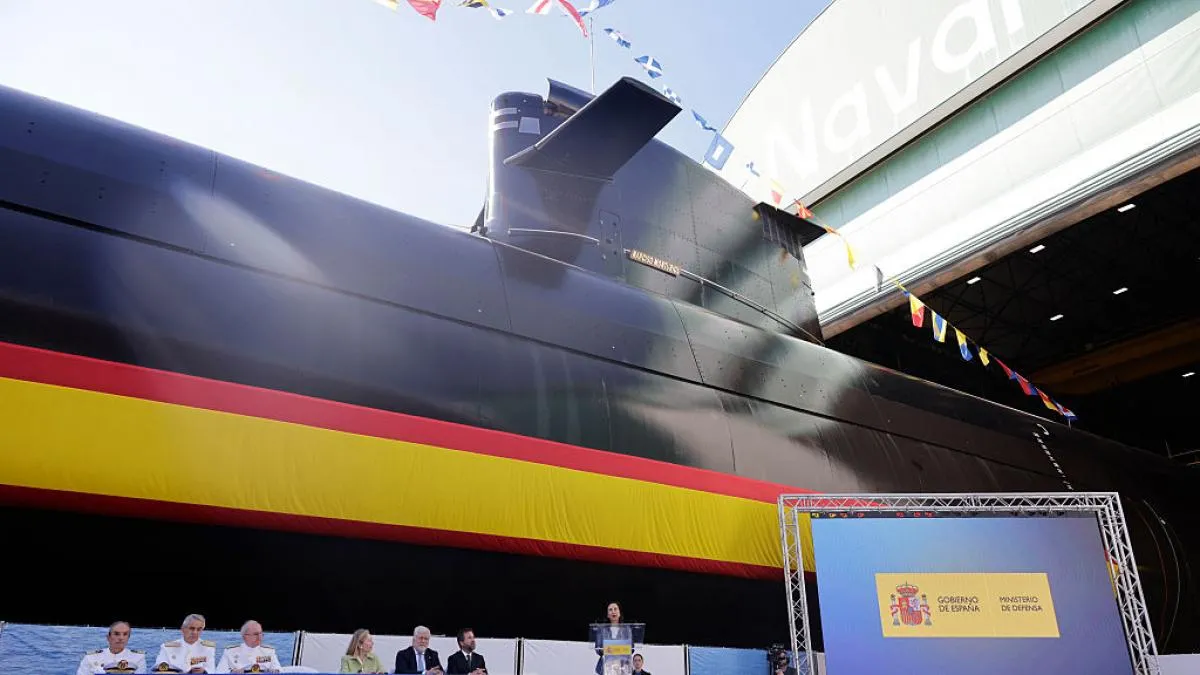
Tramontana's Legacy and Auction Details
The Spanish Navy's historic submarine Tramontana (S-74), renowned for its long service, is now officially up for sale for dismantling after nearly four decades of operational history. This announcement has been published in the Boletín Oficial del Estado, which outlines the disposal procedure authorizing the submarine's transformation into scrap metal. The starting auction price has been set at €138,468.53, with interested parties given a period of 30 days from the publication date to submit their bids. Currently docked at the Cartagena Arsenal, the Tramontana has been retired from active duty and awaits its fate.
Prospective bidders must provide a provisional guarantee amounting to 20% of the base price, which equates to €27,693.70. Should they win the auction, this amount would be converted into a definitive guarantee. The Tramontana is part of the Agosta-class submarines, diesel-electric vessels built for the Spanish Navy during the 1980s. Officially delivered on December 30, 1985, its maiden dive occurred on July 5 of the same year. Throughout its service, Tramontana engaged in various missions focused on surveillance, defense, and international cooperation.
Notable Missions and the Perejil Islet Crisis
Among the submarine's numerous missions, two stand out prominently: its involvement in the Unified Protector operation, which aimed to enforce a naval embargo on Libya during the 2011 civil war, and its participation in Operation Sea Guardian, which centered on maritime security and counter-terrorism efforts in the Mediterranean. One of the most significant events in Tramontana's operational history occurred during the Perejil Islet crisis in July 2002. The conflict ignited when six Moroccan soldiers landed on the islet and raised the Moroccan flag, leading to a diplomatic standoff between Spain and Morocco.
The Spanish government, led by José María Aznar at the time, authorized a military operation to reclaim the islet, known as Operation Romeo-Sierra. Within the naval forces assembled for the operation, the Tramontana was dispatched with a strategic mission: to conduct underwater surveillance, provide deterrence, and offer naval cover against any potential Moroccan response. Military reports indicate that the submarine operated submerged and undetected, reaching the vicinity of the islet with the primary goal of preventing maritime reinforcements and ensuring the operation's safety.
On July 17, 2002, just before dawn, Spanish commandos from the Special Operations Group and the Navy's Special Operations Unit successfully reclaimed the islet. Troops arrived via Super Puma helicopters, supported by Marine Infantry units. The operation was executed swiftly, without gunfire or casualties, resulting in the detention and subsequent repatriation of the Moroccan soldiers. Throughout the entire operation, Tramontana remained submerged, providing a crucial deterrent presence in the region.
The S-74 was equipped with four 533 mm torpedo tubes capable of firing various types of munitions. In addition, the submarine featured sonar-based sensor systems, periscopes, radar, and communication antennas, which underwent multiple upgrades to maintain operational capability over the decades. Following nearly 40 years of service, the fate of the Tramontana now hinges on the outcome of this auction. The BOE announcement even allows for the possibility of up to three subsequent auctions, each offering a 15% discount if the initial auction does not yield a successful bid.
Thus, the story of one of the Spanish Navy's most veteran submarines may soon come to an end, marking the conclusion of its silent participation in military operations and one of the tensest diplomatic episodes between Spain and Morocco in recent decades.
As reported by huffingtonpost.es.