
Commemorating Key Historical Milestones in Morocco
A scientific symposium titled "The Historical Communion Between the Throne and the People: From the Epic of Liberation to the March of Development… Context and Significance" took place on Monday in Tangier. This event marked the 47th anniversary of the recovery of Oued Ed-Dahab and the 73rd anniversary of the Revolution of the King and the People. Organized by the Tangier-Medina municipality in collaboration with the regional delegation of the High Commission for Former Resistance Members and Liberation Army Veterans, this symposium brought together numerous scholars and researchers specializing in historical memory.
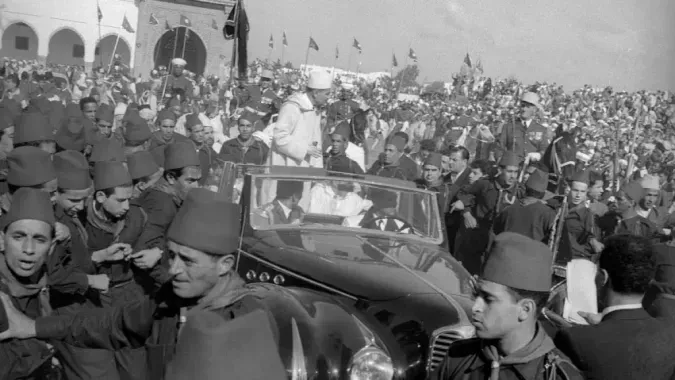
During the discussions, the participants emphasized that the contemporary history of Morocco is characterized by significant events that illustrate the strong bond between the Throne and the People. These events serve as a testament to the ability of Moroccans, both King and People, to confront major challenges and to uphold the nation's sovereignty, unity, and independence. The Revolution of the King and the People was highlighted as a decisive turning point in this journey, showcasing the deep connections that unite the illustrious Alaouite Throne with the Moroccan populace.
Resilience and Unity in Morocco's Historical Narrative
Sanaa El Oussini, a member of the local council of religious scholars in the Tangier-Assilah prefecture, pointed out that the Revolution of the King and the People stands as one of Morocco's key historical milestones in the pursuit of freedom and independence, embodying values of sacrifice and loyalty. She remarked that this event has etched into the national memory the principles of unity and dignity, serving as an inspiration for successive generations to safeguard independence and to strengthen civic consciousness.
Moreover, Badr Eddine Erraouas, a researcher and professor specializing in port geography, asserted that the Revolution of the King and the People represents a foundational phase in modern Moroccan history. It exemplifies the cohesion between the Throne and the People in the defense of sovereignty, freedom, and national unity. He emphasized that the significance of this historical event extends beyond the liberation and independence phase, integrating into a continuous process of national construction and enhancing Morocco's territorial, economic, and strategic strength.
Erraouas further explained that Morocco has gradually transitioned from a phase of defending its territory and safeguarding its sovereignty to a phase of construction, development, and infrastructure enhancement. This evolution has progressed to a more advanced stage, wherein Morocco is leveraging its geographical position to transform it into a source of strength and attractiveness.
In addition, Hamida El Jazi, curator of the Historical Memory Space for Resistance and Liberation in Tangier, highlighted one of the symposium's objectives: to connect the history of the struggle for territorial reclamation and homeland defense with Morocco's current development process under the wise leadership of His Majesty King Mohammed VI. In a statement to MAP, El Jazi noted that the Historical Memory Space for Resistance and Liberation in Tangier, alongside its academic activities, also organizes educational initiatives that occasionally employ artificial intelligence tools to present national history in a modern format, aligning with the thought patterns of new generations and the demands of the contemporary era.
As reported by maroc.ma.