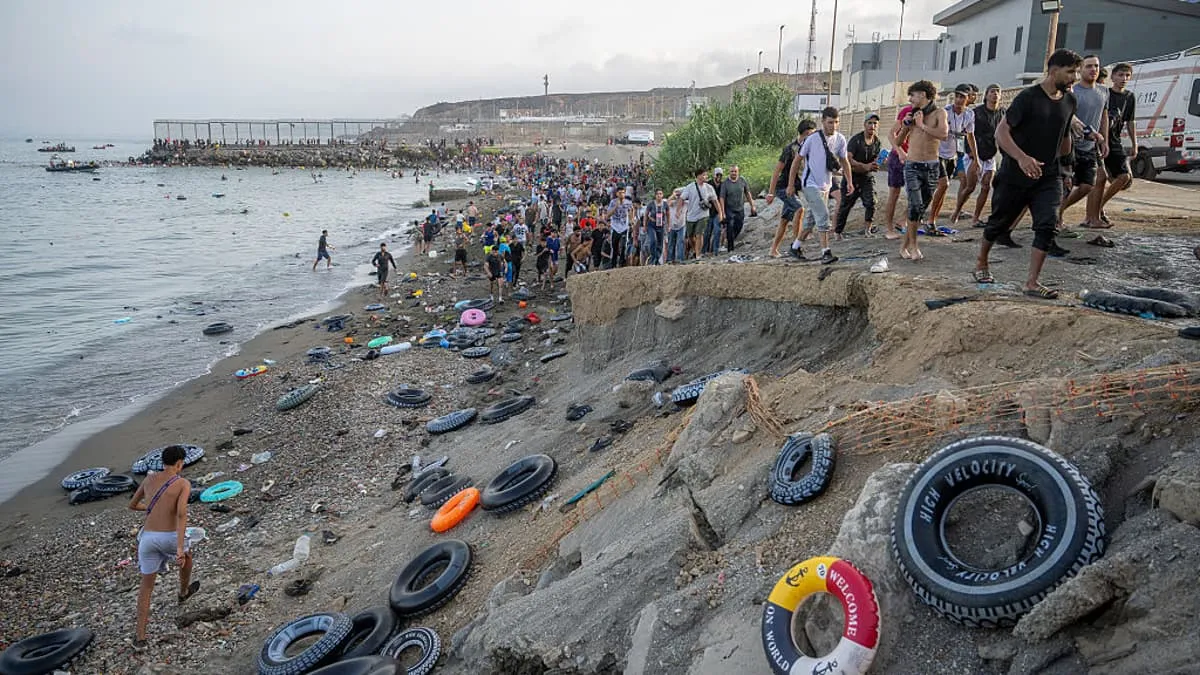

The Spanish exclave of Ceuta, located on the northern coast of Africa, is currently grappling with a dire humanitarian and security crisis as a relentless wave of migrants continues to cross the border from Morocco. Reports indicate that at least 24 individuals have tragically lost their lives amidst the chaos. Recent footage reveals a significant number of migrants, predominantly young men, breaching the Tarajal border fence that separates Morocco from Ceuta, highlighting the urgent need for effective border management.
For years, Ceuta has been perceived as a crucial entry point for migrants aspiring to build better lives in Europe. In response to the ongoing challenge of illegal crossings, the city has consistently fortified its border. However, a recent and unexplained surge has shocked authorities. On Friday morning, Spain’s interior ministry estimated that approximately 49,000 migrants had entered Ceuta within a 24-hour period, although this alarming figure was later removed from the government’s official statements without clarification. The influx has overwhelmed migrant reception centers, leading to crowded parks and streets filled with individuals who have crossed the border in search of safety and opportunity.
The Situation in Ceuta
Juan Jesús Vivas, the President of Ceuta, described the crisis as “a situation of absolute humanitarian and social emergency,” and he has called for the region to be declared under a national emergency. This unprecedented situation has prompted the Moroccan government to encourage its citizens who have crossed the border to return home. Morocco's ambassador to Spain, Karima Benyaich, expressed that the current state of affairs in Ceuta is “not welcomed by the Kingdom of Morocco,” advocating for a more regulated and safe immigration process.
In response to the escalating crisis, Spain has mobilized military forces to support law enforcement efforts in Ceuta. Prime Minister Pedro Sánchez took to social media to affirm that he is in communication with Vivas and is collaborating with Moroccan and international authorities to restore normalcy swiftly. Sánchez is expected to visit the exclave to assess the situation firsthand.
Understanding Ceuta’s Unique Context
Ceuta covers an area of 19.9 square kilometers (7.7 square miles) on Africa’s northern coast and is one of only two Spanish exclaves in Africa, the other being Melilla. This geographical positioning makes Ceuta a significant point of contact between Europe and Africa, representing the European Union’s sole land borders with the African continent. Since its acquisition by Spain in 1580, Ceuta has maintained a diverse population of over 83,000, comprising both Christians and Muslims, along with Moroccan residents and day workers. Historically, the inhabitants of Ceuta have coexisted harmoniously, despite Morocco's ongoing claims of sovereignty over the region.
However, tensions have simmered over the years, with Morocco viewing the exclaves as occupied territories. Diplomatic incidents have arisen, including a notable standoff in 2002 when both nations dispatched military forces to a small uninhabited island near Ceuta. Furthermore, a significant influx of migrants occurred in May 2021 amid a diplomatic spat regarding Western Sahara, underscoring the complexities of the relationship between Spain and Morocco.
Recent developments indicate that the surge in migrant crossings may be influenced by a recent Spanish Supreme Court ruling that restricts the immediate return of migrants arriving by sea. This ruling has reportedly circulated on social media in Morocco, enticing many to attempt crossing into Ceuta by swimming. The economic conditions in Morocco may also be a contributing factor, as unemployment remains a pressing issue, particularly among the youth and women.
The crisis has sparked a political backlash in Spain, with right-wing factions criticizing Prime Minister Sánchez’s administration for its approach to immigration. Despite a broader trend towards stricter immigration policies across Europe, Sánchez has proposed a pathway to legal status for up to 500,000 undocumented migrants already in Spain. Critics argue that this policy has exacerbated the situation at Ceuta’s borders.
As the crisis unfolds, reactions have emerged from various corners of Europe, with Italy's Prime Minister threatening to suspend the Schengen agreement in response to the migrant influx and France reinforcing its border control measures. The situation in Ceuta remains fluid, with international implications that extend well beyond Spain’s borders.
As reported by time.com.