Recent Market Trends in Casablanca
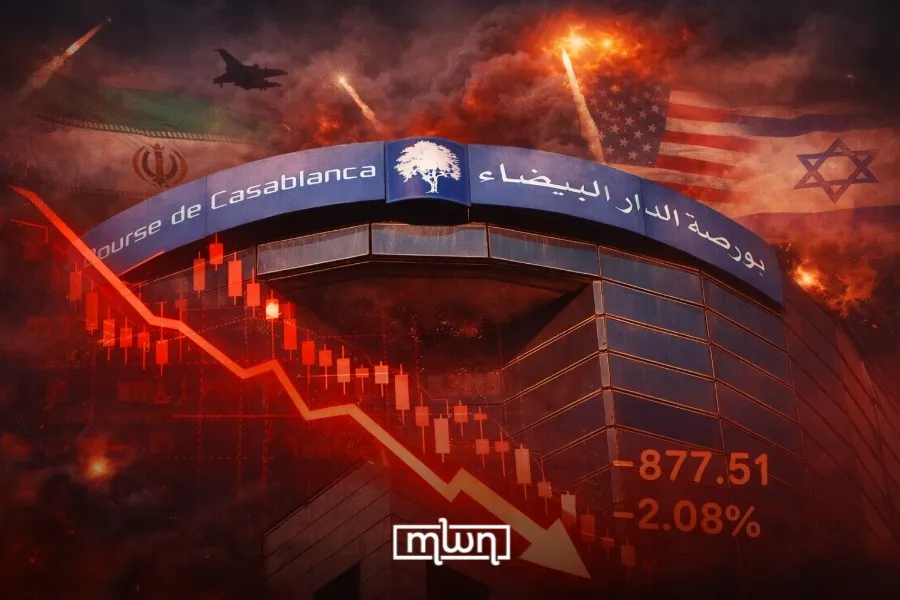
The Casablanca Stock Exchange has recently experienced significant fluctuations, particularly highlighted by a market correction that saw the MASI index decline by approximately 12% between February 20 and March 3, 2026. This downturn has captured the attention of investors and analysts alike, marking one of the steepest declines observed across various African and European markets during this period. The drop in the Casablanca market has been attributed not only to increasing geopolitical tensions, particularly in the Middle East, but also to underlying dynamics within the domestic market that have amplified the impact of these global events.
Geopolitical Influences and Domestic Market Responses
The recent conflict involving Iran, Israel, and the United States has significantly unsettled financial markets worldwide, with the Strait of Hormuz emerging as a focal point of investor anxiety due to its critical role in global oil supply. The fear of supply disruptions has led to sharp spikes in oil prices, with Brent crude briefly exceeding $119 per barrel before stabilizing as discussions surrounding the release of strategic reserves began. This volatility has not only affected oil markets but has also reverberated through global equity markets, with major European indices experiencing declines ranging from 1% to 1.6% in the wake of these tensions. Emerging markets, including Morocco, were not insulated from this wave of market pressure.
However, the research conducted by Attijari Global Research indicates that the magnitude of the decline in the Casablanca Stock Exchange is indicative of deeper shifts within the local market. A notable trend has been the increasing participation of retail investors, whose share of trading volumes has surged from about 12% in previous years to an impressive 28% in 2025. This shift has been fueled by recent initial public offerings and the expansion of portfolio management services tailored for retail clients. Retail investors typically demonstrate shorter investment horizons and higher rates of portfolio turnover, which can exacerbate market volatility during both rallies and downturns.
Institutional investors, too, have modified their strategies in response to changing market conditions. With new financing mechanisms linked to state real estate assets attracting significant capital, many institutional players have opted to allocate funds towards real estate investment vehicles. These instruments often yield annual returns close to 6%, which is substantially more attractive compared to the returns of traditional equity investments. This strategic reallocation has, in turn, weakened the structural demand for shares, leading to pronounced movements in the market during periods of uncertainty.
Despite the recent market downturn, it is important to note that the fundamentals of the corporations listed on the Casablanca Stock Exchange remain robust. Aggregate revenue from these firms reached MAD 98.4 billion in the fourth quarter of 2025, reflecting a year-on-year growth of 12.2%. Overall, listed companies experienced a revenue increase of approximately 10% for the full year. Thus, the market's reaction appears to be more closely linked to shifts in capital flows and risk perceptions rather than any fundamental decline in corporate performance.
As the Casablanca stock market navigates these turbulent waters, the recent volatility serves as a reminder of how global shocks, investor behavior, and evolving market structures can intersect to create sharp market movements, even amid solid corporate fundamentals. Investors and analysts alike will be watching closely to see how these dynamics unfold in the coming months.
As reported by moroccoworldnews.com.