
Major Arrest in Agadir Targets International Criminal Organization
On the evening of September 25, 2026, Moroccan security services apprehended a 31-year-old Swedish national in Agadir, who has been sought internationally and is suspected of holding a central role within "Foxtrot," one of the most notorious criminal networks linked to violent incidents in Sweden. This arrest has raised significant attention regarding the individual’s background and the implications it holds for Stockholm, which views this capture as a strategic blow to the criminal organization.
The operation carried out in Agadir prompted an immediate and strong response from Swedish authorities. In an official statement released on September 26, 2026, at 19:50, the Swedish National Police praised the Moroccan services' effectiveness, highlighting the high-quality security cooperation between Rabat and Stockholm in combating transnational organized crime.
According to the Swedish police, the suspect was already under a warrant for his arrest due to an absentia ruling and was listed in a red notice by Interpol related to two assassination plots. For several years, he had been living outside Sweden, notably in Turkey, until his evasion ended in Morocco. The significance of his arrest is magnified by his high-profile status within the "Foxtrot" network, which is linked to various violent episodes and drug trafficking activities in Sweden.
Strengthened Cooperation between Sweden and Morocco
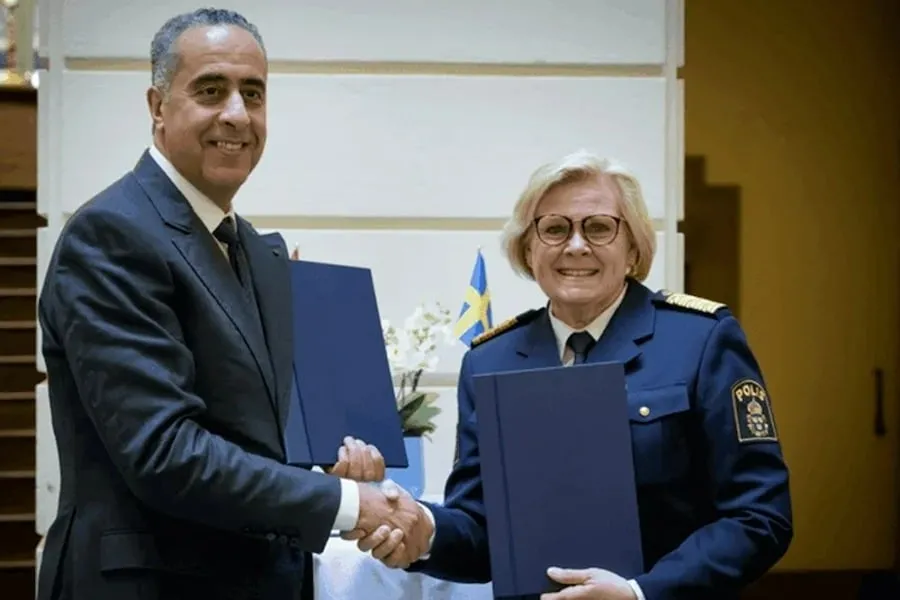
The reaction from Stockholm extends beyond mere satisfaction regarding the apprehension of a fugitive. Stefan Hector, the Deputy Chief of the Swedish National Police, directly emphasized the role of Moroccan services and their leadership. He pointed out that cooperation with Morocco now encompasses various levels in the fight against crime, including political dialogue, diplomatic engagement, and coordination between police services and judicial authorities.
Hector noted that Abdellatif Hammouchi, the Director General of National Security and Territorial Surveillance, along with his team, made a significant contribution to further weakening the Foxtrot network. This acknowledgment is particularly noteworthy coming from a senior Swedish police official, reflecting the high level of trust established in security cooperation between the two nations.
Stockholm also believes that this operation could have direct repercussions on the operational capabilities of Foxtrot. Anders Wiberg, head of the international unit within the Swedish National Operations Department (NOA), described the arrest as strategically important. He indicated that the detention of such a central figure could diminish the network's ability to organize criminal activities related to violence and drug trafficking.
Moreover, Wiberg reminded that this marks the second operation of its kind conducted by Moroccan authorities in less than ten days, following the arrest of another Swedish national linked to violent criminal activities. This series of operations has led the Swedish police to publicly extend their gratitude to Moroccan authorities.
Looking ahead, the next step is judicial. Swedish authorities have announced their intention to request the extradition of the suspect so that he can face justice in Sweden for the charges against him. Beyond just this individual case, the arrest in Agadir underscores the strengthening operational cooperation between Morocco and several European countries against criminal organizations whose influences stretch far beyond national borders.
It also reaffirms the crucial role of Moroccan services within international frameworks aimed at combating organized crime, characterized by a combination of police cooperation, intelligence sharing, and rapid interventions against wanted individuals abroad. For Stockholm, the message is unequivocal: the operation executed in Agadir is not merely the capture of a fugitive; it represents a significant strike against the structure and capabilities of the Foxtrot network.
As reported by lareleve.ma.