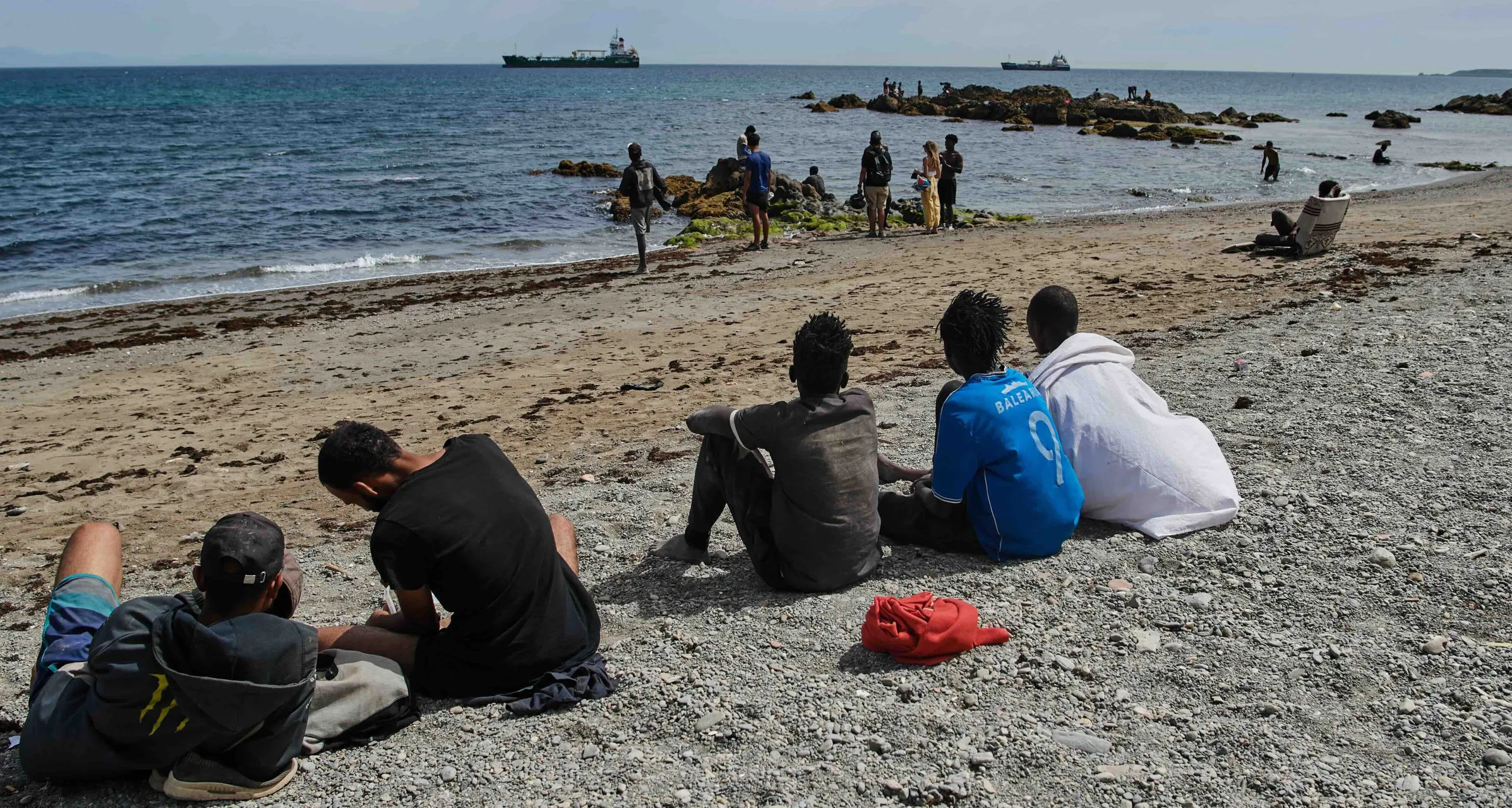

In late July, an unprecedented influx of thousands of individuals reached the Spanish enclave of Ceuta, sparking suspicions of a centrally coordinated campaign via social media. However, recent investigations by CORRECTIV have revealed a lack of concrete evidence supporting this theory.
The unusually high number of migrants arriving in Ceuta during this period fueled speculation that their movement was orchestrated through social networks, with claims suggesting a hybrid attack on the EU. Three weeks post the mass arrival, Ceuta is still home to thousands of refugees, including many minors. CORRECTIV engaged with several asylum seekers on-site and analyzed social media posts and external reports, but found no solid evidence of a coordinated campaign. Nonetheless, the research indicates that social media played a significant role in disseminating information.
Among those interviewed was Salim, an 18-year-old from Fes, approximately 200 kilometers away, who expressed that he had long intended to leave Morocco. With four younger brothers and limited means to provide for his family, he turned to Instagram, where he discovered posts indicating an open border. Similar accounts were shared by other refugees in Ceuta. Some asylum seekers confirmed that they had verified information through contacts who had already crossed the border into Ceuta. Indeed, the number of crossings had begun to rise in the days leading up to July 30 and 31. Refugees recounted to CORRECTIV that many had arrived days before the mass crossing event. A spokesperson from the Spanish Ministry of the Interior noted that there had been an increase in migration pressure since the onset of spring, but emphasized that there had been no prior warning of the mass influx that occurred on the 30th.
A video shared by Salim garnered over 50,000 likes, depicting dozens of individuals rushing through an entry gate on the Spanish side of Ceuta. CORRECTIV verified the location, confirming it as a gate directly at the border crossing. However, alongside authentic footage, misleading and false information circulated. Comprehensive analyses have yet to uncover any substantial proof of a centrally coordinated campaign. According to the Spanish fact-checking organization Maldita, in collaboration with the Arab Fact-Checking Network, over 200 posts with identical Arabic text were published on social media on July 30, which included a misinterpretation of a court ruling that seemingly contributed to the rumors of an open border. However, the mass crossing had already commenced by that point.
Spanish law permits so-called "hot returns" at the borders of Ceuta and Melilla, meaning that refugees can be expelled immediately upon attempting to cross without undergoing an asylum review process. The law states: "Foreigners found at the territorial border of Ceuta or Melilla while attempting to overcome border security measures and cross the border irregularly may be turned away to prevent their illegal entry into Spain." Following the law's mention of “border security measures,” the Spanish Supreme Court ruled on June 29 that this practice is unlawful for those crossing the border by water, as they are not attempting to overcome a physical barrier.
No evidence of a coordinated campaign has emerged thus far. Even before the Supreme Court ruling on June 29, individuals in various Facebook groups, which CORRECTIV reviewed, were discussing ways to cross the border and offering assistance for escape. Whether these offers were genuine or fraudulent remains unverified. Maldita analyzed over a thousand Arabic messages on Facebook, Instagram, and WhatsApp, identifying multiple instances of misinformation and calls for another crossing attempt on August 15. However, no centralized coordination could be discerned from the plethora of messages.
In response to CORRECTIV's inquiry, Maldita stated, "We have not identified a consistent pattern among the social media profiles involved, nor could we pinpoint a single source for all these messages." Due to their methodology, it remains unclear what was discussed in WhatsApp groups prior to July 30. Additional analyses by the French newspaper Le Monde and the Austrian broadcaster ORF, in conjunction with teams from other European media outlets, reached similar conclusions: no evidence of a coordinated campaign influencing the significant migration surge in late July was found. Le Monde suggested the possibility of a snowball effect.
Furthermore, a report from the private Spanish company Golden Owl, which specializes in AI-driven digital analysis, claimed to reveal "evidence" that the migration movement to Ceuta in late July was an "organized operation." Several media outlets reported on this. However, CORRECTIV's investigations indicate that the analysis does not support such a conclusion. When confronted, Golden Owl clarified: "We found no evidence that every participant was centrally coordinated. We identified a decentralized organization." The Spanish military police, Guardia Civil, described the situation similarly, stating in a report provided to Spanish broadcaster RTVE that calls for another crossing attempt on August 15 were organized in a decentralized manner, and the responsible individuals could not be identified.
A spokesperson for the Spanish Ministry of the Interior, when asked about indications of a coordinated campaign, stated: "This ministry does not speculate on the reasons that drive people to undertake the perilous journey of irregular migration." Meanwhile, reports from the Moroccan Foreign Ministry indicated that the Supreme Court ruling in June had diminished the "deterrent effect." The ruling's implications were reportedly amplified by social media and human traffickers.
Speculation persists that Morocco may have engineered the crisis to exert pressure, although the country has denied such accusations in media reports. Migration researcher Gerald Knaus informed CORRECTIV that Morocco appeared to have temporarily relaxed border controls for unknown reasons. In 2021, following a diplomatic dispute, Morocco allowed several thousand individuals to cross the border into Ceuta by sea, although the numbers were significantly lower than during the mass crossings in July 2026.
EU Commissioner for Home Affairs and Migration, Magnus Brunner, cited smuggler gangs and misinformation on social media as factors contributing to the mass crossings during a press conference on August 4. A spokesperson for EU internal affairs had not responded to inquiries regarding possible investigations and evidence by the time of publication.
A group of refugee boys described to CORRECTIV how a mass panic ensued during the border crossing, causing individuals to be submerged in water. In the Facebook groups where discussions about the crossing took place, many are now searching for missing persons.
Reports indicate that over 140 individuals lost their lives attempting to cross the sea border at the end of July.
Since the mass crossing, Morocco has significantly bolstered security at the border. Refugees and residents in Ceuta have begun to express frustration, as no further mass crossings have occurred. New calls and discussions are circulating for another attempt on August 15. How will such messages manifest?
As reported by correctiv.org.