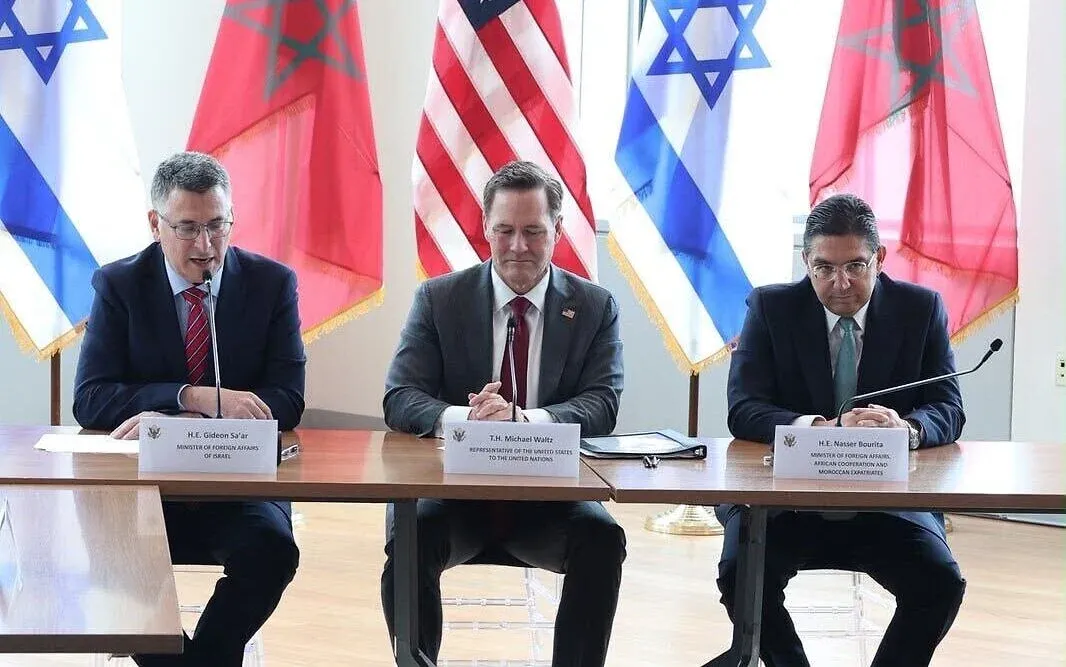
In a significant diplomatic advancement, Israel and Morocco have agreed to elevate their diplomatic missions to full embassy status and exchange ambassadors. This development marks a notable progression in relations nearly six years after Morocco participated in the U.S.-facilitated normalization initiative that transformed Israel's interactions with various Arab nations. The agreement was reached during a trilateral meeting in New York, attended by U.S. Ambassador to the United Nations Mike Waltz, Moroccan Foreign Minister Nasser Bourita, and Israeli Foreign Minister Gideon Sa’ar, coinciding with the sixth anniversary of the historic Abraham Accords.
The original Abraham Accords were officially signed on September 15, 2020, by Israel, the United Arab Emirates, and Bahrain, with Morocco subsequently joining through a separate U.S.-Morocco-Israel Joint Declaration on December 22, 2020. This declaration restored official diplomatic contacts and set forth a commitment to full diplomatic relations, direct flights, and enhanced economic collaboration between the nations.
On Wednesday, the agreement made tangible strides toward fulfilling those commitments. Both Israel and Morocco agreed to the establishment of full embassies and the mutual exchange of ambassadors. Additionally, they plan to reinstate direct flights operated by their respective airlines before the end of 2026, alongside finalizing agreements on investment protection and the avoidance of double taxation. The two countries also committed to broadening their cooperation across various sectors, including trade, finance, technology, tourism, water management, agriculture, food security, energy, telecommunications, and regional security, as outlined in a joint statement released on September 16.
The statement also reiterated the recognition by both the U.S. and Israel of Moroccan sovereignty over Western Sahara, supporting Morocco's autonomy proposal as a framework for resolving the territorial dispute. This recognition reflects a deeper geopolitical context that shapes regional relations and acknowledges Morocco’s strategic position.
Discussions during the meeting extended beyond Morocco, contemplating the potential for the normalization framework to incorporate Saudi Arabia in the future. When questioned by Fox News Digital regarding Saudi Arabia's possible accession to the Abraham Accords, Ambassador Waltz emphasized the pressing regional threats posed by the Iran-backed Houthis, who have been increasingly active against international shipping interests. “The scourge of terrorism from them is unacceptable to the entire region,” Waltz asserted, underscoring the need for cooperative security measures among nations facing similar challenges.
The Bab el-Mandeb Strait, a crucial maritime passage linking the Red Sea to the Gulf of Aden, has become a focal point of concern as Houthi forces have made significant territorial gains along Yemen's coastline. The strait is vital, carrying approximately 7% of global oil output. Recent Houthi attacks have compelled major shipping companies to reroute their vessels, resulting in increased costs and longer transit times, thus drawing attention to the imperative for collaborative security frameworks among nations.
Foreign Minister Sa’ar highlighted the importance of cooperation among countries sharing common interests, particularly in light of the threats posed at key maritime chokepoints. He articulated the necessity for nations committed to safeguarding freedom of navigation and international trade to unite against contemporary threats. While he refrained from detailing any specific operational collaborations with Saudi Arabia, he conveyed Israel's desire to expand the normalization framework to include additional partners.
On the humanitarian front, Bourita emphasized that Morocco's engagement with Israel could yield practical benefits for the Palestinian people. He pointed out that during the Gaza conflict, Morocco leveraged its relations with Israel to facilitate the delivery of humanitarian assistance into northern Gaza. Bourita argued for a proactive approach, questioning the effectiveness of merely engaging in rhetoric while advocating for tangible initiatives that can aid those in need.
In conclusion, both Bourita and Waltz affirmed Morocco's commitment to humanitarian efforts and its role in fostering stability in Gaza and the broader region. The dialogue underscored a shared belief that meaningful cooperation and initiatives are essential for achieving lasting peace and security.
As reported by wfmd.com.