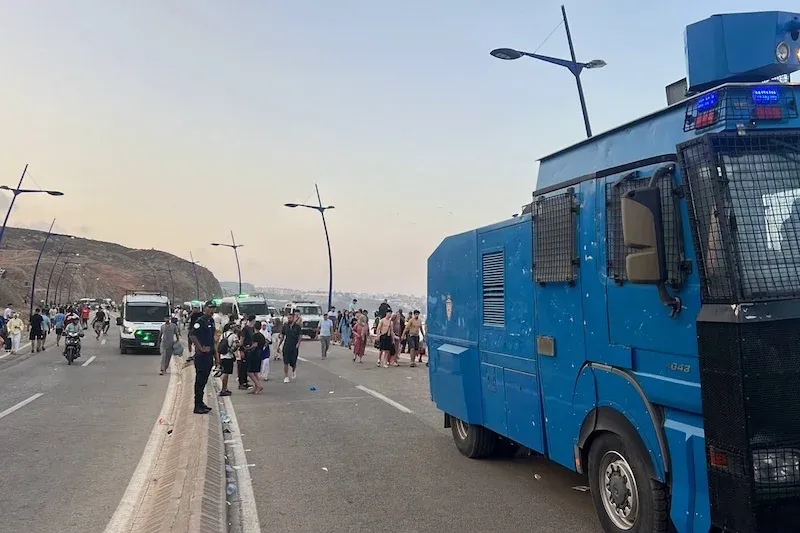

The Italian Minister of Foreign Affairs, Antonio Tajani, has adopted a firmer tone regarding Morocco against the backdrop of ongoing tensions between Rome and Madrid concerning the management of migration issues. This shift in rhetoric comes as Italy has decided to enhance border controls in response to a crisis involving mass attempts to cross into the occupied city of Ceuta, alongside security warnings from Spain about the potential for a new wave of arrivals.
In an interview with the daily newspaper Corriere della Sera, which was later published in the archives of the Italian Ministry of Foreign Affairs, Tajani defended his country's measures, denying any notion that Rome is engaged in a 'battle' against Spain. He clarified that Italian authorities are merely reinforcing checks on individuals arriving in Italy, having already turned away some who did not meet the entry requirements.
Tajani's remarks were prompted by concerns over the implications of the Ceuta situation for Italy. He referenced what he termed alerts from Spanish intelligence regarding the risk of a new influx of migrants, specifying that these alerts also hinted at terrorism threats. He asserted that these factors warranted a serious approach to the situation, emphasizing the need to monitor developments closely in the coming days.
In this context, Tajani directed a clear message to Madrid, stating that instead of worrying about Italy's measures, Spain should focus on Morocco, indicating that the root of the issues lies there. This assertion was made in light of the migration challenges faced by Ceuta. The Minister also connected this topic to the necessity of preventing irregular migrants and those he termed 'potential terrorists' from reaching Europe.
Regarding the suspension of the Schengen Agreement's application, Tajani clarified that this decision is not aimed at Spain. He noted that Rome would await a thorough evaluation of the alerts before deciding to maintain or revise this measure. He also stressed that the situation must not deteriorate into a diplomatic crisis, recalling that the suspension of Schengen at the border with Slovenia has been ongoing for more than two years, with that border considered one of the entry points posing risks to Italy and Europe.
These statements indicate that Tajani's comments concerning Morocco extend beyond merely defending Rome's border policies; they constitute a direct challenge to Rabat. The Minister has attributed part of the responsibility for the challenges related to migration waves toward Ceuta to Morocco, linking them to Spanish security alerts. His words bear a notably aggressive political undertone, especially in a context marked by the sensitivity of migration issues between Rabat and Madrid and their repercussions on Morocco's relations with its European partners.
Moroccan Condemnation
In response, Sidati Benmassoud, the president of the municipality of Dcheira in Laâyoune, condemned Tajani's statements regarding Morocco in the context of the migration crisis linked to Ceuta. He characterized the accusations as irresponsible, suggesting they overlook the complexities of the situation and do not reflect the nature of relations between Morocco and several of its European partners.
In a statement to Hespress, Benmassoud indicated that any attempt to link Morocco to the security and migration problems faced by Ceuta represents a partial interpretation of the facts. He emphasized that Morocco has consistently rejected the exploitation of irregular migration as a means of pressure and that the mass crossing attempts observed in the region are primarily tied to the activities of networks and human trafficking gangs that exploit migrants' situations and expose them to risks.
The political figure from the southern provinces reaffirmed that managing migration issues falls within the framework of shared responsibility and security coordination with partners. He dismissed any effort to place the blame on Morocco for a transboundary phenomenon involving regional factors and organized criminal networks. According to him, effectively addressing the consequences of migration necessitates cooperation, information sharing, and combating human trafficking networks, rather than unilateral political accusations.
Rejection of Accusations
Ramadan Massoud Arabi, a member of the Royal Advisory Council for Saharan Affairs (Corcas), also weighed in on the matter, suggesting that Tajani's remarks reflect a narrow understanding of the Ceuta crisis by reducing it solely to migration issues while neglecting the complexities of the Spanish situation and the broader context surrounding this phenomenon. He added that attributing current problems to Morocco lacks a precise analysis of political realities and on-the-ground conditions.
In his comments to Hespress, Massoud highlighted that Morocco has consistently demonstrated clarity in managing irregular migration, both through security cooperation with Spain and by implementing measures at its borders to combat smuggling and human trafficking networks.
He also pointed out that mass crossing attempts toward Ceuta cannot be simplified to a bilateral issue between Morocco and Spain, considering the presence of transnational criminal networks that exploit migrants' situations and social and security tensions for their own benefit.
Drawing from his residence in Spain and direct observations of the Spanish political and media landscape, the Corcas member explained that Tajani's approach overlooks the nature of the internal Spanish debate surrounding Ceuta. Migration, security, and border issues are closely tied to local political considerations and relations between Spain and its European partners. He opined that treating these matters through the lens of mutual accusations does not contribute to addressing the root causes of the phenomenon but may instead complicate it further and undermine coordination between the involved countries.
Massoud emphasized that Morocco's stance is grounded in responsible cooperation in combating irregular migration while firmly rejecting the idea of the Kingdom serving as a 'scapegoat' for Europe's multifaceted crises. He concluded that the situation in Ceuta requires dismantling human trafficking networks, cutting off their funding sources, and enhancing security and intelligence coordination across the two shores, rather than political accusations directed at Morocco. According to him, any effective approach must respect the existing partnership between Morocco, Spain, and other European partners.
As reported by fr.hespress.com.