
José María Aznar, the former President of the Spanish Government, is set to return to Ceuta almost two decades after his last visit, amid renewed discussions regarding Morocco's ambitions over the autonomous city. Aznar's visit is not merely a ceremonial affair; it is a demonstration of his support for Ceuta's current president, Juan Jesús Vivas, as well as a reaffirmation of the Spanish identity of Ceuta in the face of Rabat's expansionist plans.
This situation is not unfamiliar territory for Aznar. During his tenure at La Moncloa, he faced some of the most significant tensions with Morocco in recent decades, including pressures surrounding the sovereignty of Ceuta and Melilla, as well as the crisis surrounding the Perejil islet. Aznar was the only president who openly defied Rabat during these conflicts. In his memoirs, he recounts a private meeting with then-Crown Prince Mohamed VI in 1997, where the Moroccan leader articulated his aspirations regarding the two Spanish cities.
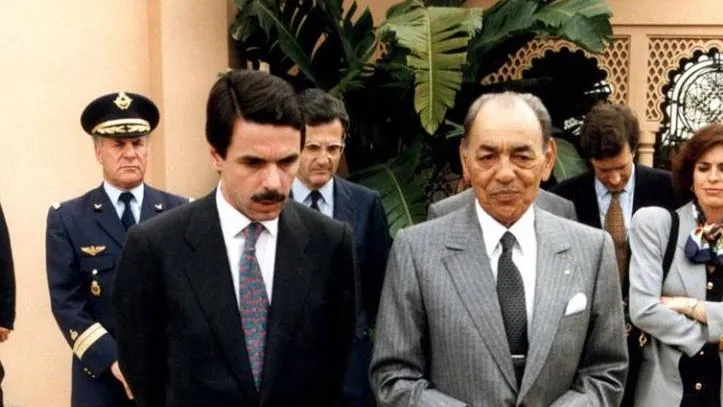
In the second volume of his memoirs, titled The Commitment of Power, Aznar reflects on that conversation, stating that it was a challenging experience. A year later, he met with King Hassan II in Rabat, who candidly expressed his desire to annex the two Spanish cities. During this meeting, Hassan even mentioned the possibility of war, albeit to assert that Morocco would not declare it over this matter. Aznar's response was forthright: he asserted that should Morocco engage in warfare against Spain, it would ultimately lose.

Following this encounter, Aznar would not meet with Hassan II again, as the king passed away three months later from a heart attack. However, the claim over the Spanish cities persisted under the reign of Hassan's son, Mohamed VI. Aznar notes in his writings that Morocco had the backing of France, which he accuses of adopting a "paternalistic" approach towards the Moroccan kingdom. In a tense exchange, then-French President Jacques Chirac urged Aznar to "start giving everything back," to which Aznar firmly responded, "I have nothing to return." Despite these diplomatic challenges, Aznar never visited Ceuta and Melilla as the sitting President; his only visits occurred during his candidacy for the PP in the 2000 elections, emphasizing his political role rather than any official capacity.
Despite his political maneuvers, the situation escalated in 2001 with an influx of irregular immigrants arriving by boat, leading Spain to demand greater control from Morocco. The Spanish government even summoned the Moroccan ambassador due to a perceived inaction from Rabat regarding this new phenomenon that was shocking Spanish society.
The Perejil Crisis: A Defining Moment
The crisis reached its peak in July 2002 when a contingent of the Moroccan Gendarmerie landed on the uninhabited Perejil islet, placing two Moroccan flags on it, just eight kilometers from Ceuta. When a Civil Guard vessel detected the Moroccan flag, its agents disembarked and were confronted by Moroccan soldiers wielding AK-47s, who ordered them to leave, claiming the land was not Spanish. This incident rapidly escalated, drawing international attention and placing both nations on the brink of war.
In response, Aznar reached out to Moroccan Prime Minister Abderrahman Youssoufi, who denied any knowledge of the operation, which many suspected was orchestrated from the Moroccan royal palace as a supposed "wedding gift" for Mohamed VI, who had recently married Salma Bennani. Amidst this chaos, Spain's new Foreign Minister, Ana Palacio, acted swiftly, garnering support from both the EU and NATO. Madrid issued an ultimatum to Rabat to withdraw from Perejil while simultaneously reinforcing military presence in Ceuta and Melilla, even deploying the frigate F-101, fearing the islet might be a precursor to broader Moroccan aggression.

As the ultimatum deadline approached and Moroccan troops remained on the island, Spain launched a counteroffensive. Five helicopters were dispatched to reclaim Perejil, and Defense Minister Federico Trillo later stated that the military acted despite objections from the then Chief of Defense, Antonio Moreno, who had expressed reservations about a military response. Aznar later reflected that this operation was a crucial test for Spain's willingness to react to threats against its sovereignty.
In the days that followed, through U.S. mediation, Morocco's Foreign Minister Mohamed Benaissa conceded that they would not return to the islet, but insisted that Spain vacate it "immediately," while subtly indicating that the issue of Ceuta and Melilla remained unresolved. Gradually, tensions eased, and relations began to normalize, leading to Spain lowering its flag and Perejil returning to its status as an uninhabited islet, home only to goats. Yet, these episodes of territorial claims and the use of immigration as a pressure tactic foreshadowed the ongoing political dynamics that continue to shape Morocco's approach to Spain, even 24 years later.
As reported by elespanol.com.