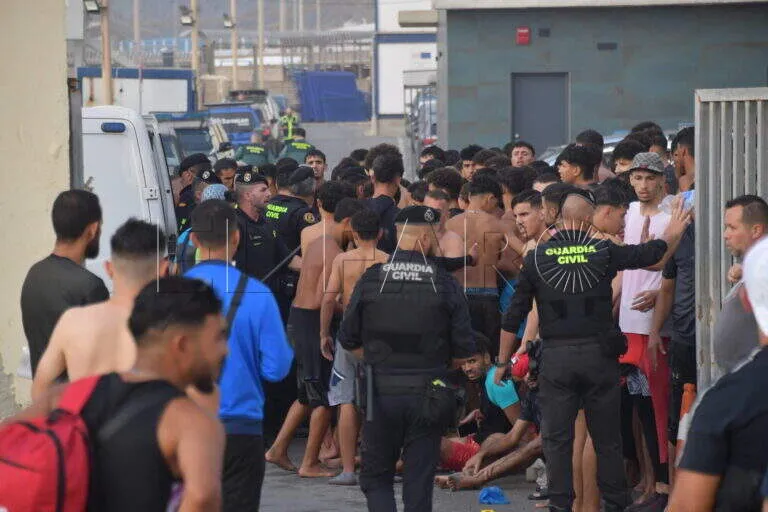

The investigative judge of the National Court, María Tardón, has meticulously outlined several pivotal elements crucial for uncovering the truth surrounding the events of July 30th in Ceuta. This investigation is not merely a procedural formality; it represents a fundamental right for the people of Ceuta, for all of Spain, and for those who have faced scrutiny throughout this tumultuous process. The initiation of a formal investigation, particularly with implications directed towards Morocco, marks a bold and significant step forward, reinforcing the theories posited by intelligence services and the National Intelligence Center (CNI), which had previously warned of potential unrest and found themselves unjustly thrust into the political and media crosshairs.
Judge Tardón has highlighted critical insights in her ruling, emphasizing that the investigation requires essential cooperation from Morocco. Her experience, particularly with the notorious narcotunnel discovered in Tarajal, has provided her with a profound understanding of the challenges posed by Morocco's lack of response to requests for judicial assistance. There has been an alarming absence of movement from Moroccan authorities, who have shown little willingness to engage with new inquiries into a criminal organization involved in drug trafficking. The same reluctance is anticipated concerning efforts to elucidate the tragic circumstances surrounding one of the most significant migratory disasters at a border, which resulted in over 140 fatalities. Interestingly, Morocco has announced its own investigation into the incident, as it did with the narcotunnel case.
What transpired on that day in July extends beyond tragedy; it was, in fact, an orchestrated attack against Spain, executed through the Tarajal pier that demarcates the border between Ceuta and Morocco. Actions occurring on the Moroccan side of the border are not taken lightly; they require the explicit consent and facilitation of Moroccan authorities, thus raising critical questions about their role in this crisis.
In the aftermath of Tardón's ruling, the Spanish government under Prime Minister Pedro Sánchez has expressed discomfort with her conclusions. Transport and Sustainable Mobility Minister Óscar Puente has openly questioned Tardón's impartiality, suggesting that her previous actions have raised doubts about her objectivity. He stated in an interview that there is no evidence suggesting that the mass migration event was a coordinated operation by the Moroccan government. Conversely, Judge Tardón contends that there is clear and undeniable evidence of Moroccan authorities facilitating the entry of migrants into Ceuta, pointing to the involvement of Moroccan agents who allegedly played an active role in guiding individuals across the border illegally.
Minister Puente further criticized the evidence presented by Tardón, implying that if her case relies solely on a controversial police report—complete with unrelated photographs—it undermines her argument. In stark contrast, Tardón maintains that there is compelling evidence of a systematic and supportive management of the migratory process from Moroccan territory, bolstered by documented behavior from Moroccan security forces.
The operational dynamics observed during this crisis depict a scenario where many Moroccans crossed the pier only to return shortly thereafter, suggesting a lack of oversight and control. This situation spiraled into chaos, with unaccompanied minors wandering the streets until their parents retrieved them, and young people crossing the pier amidst a tidal wave of human activity designed to overwhelm and destabilize Ceuta.
As Judge Tardón notes, the events of July 30 resulted in a "collapse of the response capabilities" of Spain's border control system, alongside a massive violation of the nation's territorial sovereignty. This mobilization also included two critical elements: a relatively organized and high-volume departure alongside a substantial number of migrants whose exact count remains undetermined but is certainly significant and who continue to reside in Ceuta.
Ultimately, the intention behind this orchestrated movement appears to be one of destabilization aimed at Ceuta. The statements from former UCRIF chief Ramón Caudevilla lend increasing credence to this narrative, as he emphasized in an interview that Morocco has consistently utilized civilian pressure as a lever of influence. He expressed skepticism toward narratives blaming criminal organizations or social media for these occurrences.
In light of these findings, the Spanish government has announced its intention to join the ongoing legal proceedings. Minister Ángel Víctor Torres has confirmed that they will seek to ensure their participation in the case to ascertain whether external circumstances have affected national security, indicating their commitment to addressing the implications of these events.
However, these developments have not gone unnoticed, as criticism continues to mount against Judge Tardón. PSOE spokesperson Montse Mínguez has voiced her concerns about the judge's objectivity, suggesting that her initial actions raise significant doubts. While she upholds the principle of judicial independence, she has expressed apprehension regarding Tardón's past affiliations and the implications they may have on her current role.
As reported by elfarodeceuta.es.