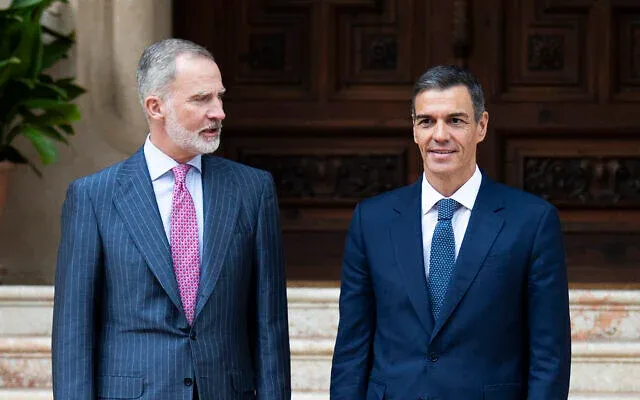

Understanding the Significance of the Royal Visit
The announcement of King Felipe VI and Queen Letizia's visit to the Spanish enclaves of Ceuta and Melilla on October 13 and 14 has been framed by the Spanish Royal Household as a royal duty. However, the timing of this visit carries deeper implications. Following the largest border crisis in Ceuta's recent history, this marks Felipe's first trip to these territories since his ascension to the throne, signaling a deliberate assertion of Spanish sovereignty over regions that Morocco has historically claimed.
The backdrop of this visit is a remarkable crisis, during which over 72,000 migrants surged into Ceuta from Morocco on July 30 and 31, as reported by Spanish authorities. Tragically, more than 100 lives were lost during this perilous crossing. The aftermath left thousands stranded in Ceuta, overwhelming local reception facilities and exposing Madrid's struggle to maintain control over its borders. This situation sparked protests, heightened tensions with local residents, and ultimately led to the resignation of Government Delegate Miguel Ángel Pérez Triano on September 28, following intense scrutiny regarding the government's handling of the crisis. Spain's declaration of the situation as one of National Security Interest underscores the gravity of the issue, marking the first time this mechanism has been invoked in democratic Spain.
The Broader Geopolitical Context
For Israel, the situation in Ceuta is not merely a localized Spanish-Moroccan dispute. The strategic importance of Gibraltar as a nexus between the Mediterranean and the Atlantic, coupled with Morocco's position at the southern gateway to the Mediterranean, renders the dynamics of this region significant for any power aiming to exert influence across North Africa and the Mediterranean. Morocco's geographical position grants it strategic relevance that extends well beyond its borders, making Felipe's visit a crucial moment in this geopolitical landscape.
Historically, King Juan Carlos's last visit to Ceuta and Melilla in November 2007 provoked a serious diplomatic crisis with Morocco, and Felipe has notably refrained from visiting during his twelve-year reign until now. His arrival follows a border incident that has not only exposed administrative weaknesses but has also strained Spain's relations with Morocco and compelled Europe to reassess the limitations of its southern border management. At a recent gala dinner for French President Emmanuel Macron, Felipe labeled the ongoing situation in Ceuta as "unacceptable," calling for greater solidarity from Europe. This appeal was directed as much towards Brussels as it was to Rabat, as Spain seeks to assert that Ceuta is not only a Spanish responsibility but also a European frontier that requires shared burdens among EU member states.
Additionally, Spain's relationship with the United States complicates matters further. Spain's refusal to allow U.S. forces to utilize bases in Rota and Morón for offensive operations during the Iran conflict, coupled with resistance to increased defense spending, has led to tensions with Washington. While President Donald Trump issued threats of economic repercussions, suggesting that Spain might face suspension from NATO, these actions do not imply a complete abandonment of Spain by the U.S. However, they do signify a shift away from the expectation of automatic American diplomatic support.
Ceuta and Melilla occupy a unique position within NATO's legal framework, as Article 6 does not clearly encompass these territories within the geographical purview of Article 5. This creates uncertainty regarding NATO's obligations in the event of an attack on the enclaves, although NATO officials have suggested that the Alliance would likely respond if Spain invoked Article 5. The crux of the matter for Madrid is not the absence of allies but rather the distinction between political support and formal treaty obligations.
Morocco's claims to Ceuta and Melilla are further complicated by the fact that Washington has not recognized Moroccan sovereignty over these territories. The discourse surrounding this issue has expanded beyond Rabat and Madrid, with influential voices in the U.S. urging for acknowledgment of the enclaves as Moroccan territory. This includes comments from Representative Mario Díaz-Balart and a House appropriations report that described the Spanish-administered cities as situated in Moroccan territory, advocating for diplomatic discussions regarding their future status. While this does not amount to formal recognition, it indicates a shift in the political landscape, suggesting that the status quo may be open for discussion in Washington.
Israel, too, has vested interests in the evolving dynamics, especially as its relationship with Morocco deepens beyond symbolic gestures. The recent signing of a joint military work plan for 2026 between Israel and Morocco underscores the strategic partnership that has emerged, with both nations recognizing Morocco as a key player in regional stability. This security partnership provides Jerusalem with a solid stake in Morocco's strategic positioning across North Africa.
The ramifications of this ongoing debate have already influenced Israel's diplomatic stance. Following the border crisis, Israel's UN ambassador, Danny Danon, accused Spain of maintaining "colonial enclaves in Africa," igniting tensions with Madrid and prompting clarifications from Israel's ambassador in Spain. While Danon's remarks were controversial, they highlighted an issue that Israel can no longer overlook: the intertwining of Spain's territorial disputes with Morocco and Israel's arguments about European double standards.
Rather than positioning itself as a mediator in Spanish sovereignty, Israel has several avenues to support Morocco without escalating tensions with Madrid. Firstly, Israel can assert that Morocco's longstanding territorial claims warrant serious diplomatic consideration, without necessarily endorsing an immediate transfer of sovereignty. Secondly, Israel can advocate for Morocco's strategic importance within U.S. foreign policy, emphasizing that closer U.S.-Moroccan ties bolster security in the western Mediterranean. Lastly, Israel can push for consistency from European nations, arguing that while Spain retains the right to defend its sovereignty, it should not expect other states to dismiss territorial disputes when European governments frequently emphasize sovereignty and international law in discussions about Israel.
The strategic dilemma lies in whether Europe can continue to regard Ceuta and Melilla as frozen exceptions while insisting that territorial disputes elsewhere be resolved through diplomatic negotiations. With Ceuta and Melilla having been under Spanish control since the 15th and 17th centuries, respectively, Madrid's attachment to these territories is understandable. However, this historical context does not invalidate Rabat's claims nor eliminate the ongoing dispute.
Morocco has demonstrated its capacity to leverage geographical advantages without resorting to military confrontation, utilizing its role in migration management, counterterrorism, and diplomatic relations to maintain favorable ties with European governments. Moreover, its longstanding security partnership with the United States, as the oldest treaty partner, reinforces its strategic importance.
For this reason, Israel should refrain from adopting a confrontational stance. Instead of asserting a territorial doctrine against Spain, Israel stands to benefit more by bolstering Morocco's position through security cooperation, discreet diplomacy, and coordination with Washington. By supporting discussions about the future of Ceuta and Melilla, Israel can engage without committing to an outcome it cannot deliver.
King Felipe VI's visit to the enclaves following the recent border crisis serves to highlight their geographical significance, disputed status, and reliance on European and transatlantic partnerships. For Israel, recognizing the existing crisis rather than manufacturing one is essential. The western Mediterranean is evolving into a more interconnected strategic arena, with Morocco at its center. If Israel aims to transform the Abraham Accords from mere normalization into a sustainable security framework, it must acknowledge that Morocco's northern frontier is not merely a Spanish issue.
While Felipe's visit will not determine the ultimate sovereignty of Ceuta and Melilla, it can play a pivotal role in placing the sovereignty debate at the forefront of European and transatlantic strategic discussions. The royal palace seeks to project permanence, yet the surrounding circumstances indicate a shift. For Israel, this shifting landscape is significant, as Morocco transitions from being a symbolic partner within the Abraham Accords to an essential defense ally at the western gateway of the Mediterranean. The border crisis has unveiled vulnerabilities in Spain, prompted Washington to reconsider long-held assumptions, and granted Rabat increased strategic weight. It is crucial for Jerusalem not to remain a passive observer as this new balance unfolds.
As reported by blogs.timesofisrael.com.