

Lamine Yamal has emerged as one of the most watched young footballers in the world, but it is not only his on-field prowess that captivates the public; his life off the pitch also sparks tremendous interest. His family background, the neighborhood where he grew up, and his cultural roots contribute to a narrative that has generated a myriad of discussions. As the forward for FC Barcelona and the Spanish national team, Yamal's family origins have been a particularly debated topic since he began making headlines. His father hails from Morocco, while his mother is from Equatorial Guinea, a blend of backgrounds that coexist with a significant reality: Lamine was born and raised in Spain and has chosen to represent this nation.
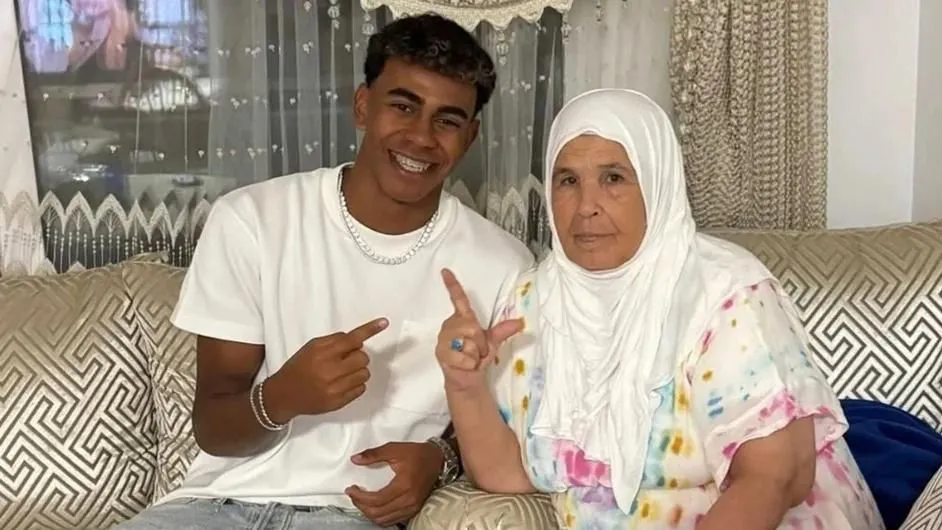
Integral to Lamine's story and the identity he strives to preserve is his paternal grandmother, Fátima. She emigrated to Spain from Morocco in the 1990s at the age of 40, embarking on a new life far from her homeland to provide for her five children. Lamine was born in Esplugues de Llobregat and spent his formative years in Rocafonda, a neighborhood in Mataró that has become synonymous with his identity as a footballer.
His father, Mounir Nasraoui, carries Moroccan roots, while his mother, Sheila Ebana, is of Equatorial Guinean descent. These familial origins form part of Lamine's narrative but do not solely define who he is as an athlete. Fátima's perspective sheds light on this, as she emphasizes Lamine's personal journey: he was born in Spain, raised in Catalonia, and it is here that he began his football training, eventually reaching the youth levels of the Spanish national team. The discourse surrounding his heritage has followed Lamine throughout his rise to prominence, with his name, physical appearance, and parental origins often igniting debates about what it means for a player with foreign ancestry to be considered Spanish.
Social media has fueled this ongoing conversation, intertwining nationality, familial origins, and identity—three concepts that do not necessarily equate. A prominent example arose when the president of the Moroccan Football Federation recently remarked that he had never encountered a Spaniard named Yamal, indirectly questioning Lamine's decision to play for the Spanish national team instead of Morocco. Although Lamine faced such remarks during his time at FC Barcelona, the scrutiny intensified when he opted to represent Spain in the 2026 World Cup. "I did consider the possibility of playing for Morocco, but when the moment of truth came, I had no doubts, with all my love and respect. It is also my country, and it wouldn't have been strange or wrong to play for them. However, I have that handicap that Spain has played in the Euro Cup, I grew up in Spain, and I feel that it is my country," he explained.
Rocafonda holds a special significance in Lamine's story. He has made the postal code 08304, representing the Mataró neighborhood, one of his most recognizable celebrations. Each time he showcases this after scoring a goal, he proudly reclaims a specific place and a part of his history. It is not merely a geographical reference but a reminder of his roots.
The narrative surrounding Fátima also offers deeper insight into the family history behind this football star. Although she is publicly acknowledged as the grandmother of one of the world's greatest football talents, her life began long before her grandson graced the pitches of professional football. Fátima arrived in Spain alone in the 1990s at the age of 40, with the aspiration of working and gradually reuniting her five children. First came Abdul, the eldest, followed by Mounir, Lamine's father, who was still a child at the time.
Like many others who emigrated during those years, Fátima had to start almost from scratch. She worked at a camping site in Llavaneres, then in a senior residence in Vilassar de Mar, eventually settling in Rocafonda, where she built a significant part of her family's life and witnessed her grandson's growth. Thus, when Fátima speaks about Lamine's roots, she does so from a personal experience that transcends sports. She understands the meaning of leaving one country, relocating to another, and forging a new life while maintaining ties to her homeland.
Her story also illustrates that familial roots can be multifaceted. Mounir maintains his connection to Morocco, and Sheila to Equatorial Guinea, yet Lamine belongs to a generation that has grown up in Spain, shaped by a different environment. There is no inherent contradiction between recognizing and honoring one's familial origins and feeling fully connected to the place where one was born and raised.
As reported by elespanol.com.
