Morocco's New Employment Initiative for Non-Degree Holders
The Ministry of Economic Integration, Small Enterprises, Employment, and Skills, in collaboration with the National Agency for Employment and Skills Promotion, officially launched the "Integration" program on Friday in Rabat. This initiative is specifically designed for individuals who do not hold any formal qualifications, aiming to enhance professional integration for youth and ensure equal opportunities in the job market.
During the launch event, which was chaired by Minister Younes Skouri, the minister highlighted the positive dynamics currently shaping the job market in Morocco. He reported that there are nearly 100,000 job vacancies projected until the end of 2025, emphasizing the government's commitment to improving mediation mechanisms to better align local skills with the demands of the economic landscape.
Addressing the situation of 900,000 job seekers without degrees, along with 280,000 youth who have dropped out of school, the minister stressed the importance of creating tangible integration prospects for these individuals. In this context, the government has introduced a program focused on learning, with the goal of increasing the number of beneficiaries to 100,000 annually, covering approximately 200 professions in traditional industries, manufacturing, and textiles.
Minister Skouri detailed that participants will receive qualification training lasting between three to six months. The National Agency for Employment and Skills Promotion will support these individuals, expanding its reach to accommodate 400,000 beneficiaries each year, including seasonal workers. Drawing from the experiences of integration programs that followed the COVID-19 pandemic—benefiting around 235,000 individuals—the minister noted that employers have observed a high level of commitment and stability among this group of non-degree holders within companies.
Strategic Approach to Employment Policies
Abdallah Achouikh, the Director General of the National Agency for Employment and Skills Promotion, reiterated that this program embodies principles of equity and equal opportunity. He articulated that this approach is not merely a technical adjustment but a clear strategic choice grounded in economic realism, directing public policies towards the groups that require the most support.
The primary objective is to provide enthusiastic youth with their first professional experience while offering a suitable solution for businesses seeking to develop their human resources directly. Achouikh also highlighted the engagement of the national economic fabric, citing encouraging preliminary results, particularly with approximately 10,000 integration contracts recorded by the end of February 2026.
Furthermore, he mentioned that this dynamic will be bolstered through partnerships established with various professional federations, aiming to create around 30,000 job opportunities annually in strategic sectors, including construction, public works, manufacturing, trade, and restaurants. The Director General affirmed that the ambition of this initiative extends beyond merely creating an additional mechanism; it aims to establish a new generation of employment policies that are more inclusive and aligned with the needs of the national economy.
Through this initiative, Moroccan enterprises are positioned not only as centers of production but also as venues for training, knowledge transfer, and socio-economic integration. The program aims to facilitate the professional integration of non-degree-holding youth by providing them with the opportunity for their first work experience within companies, alongside structured support.
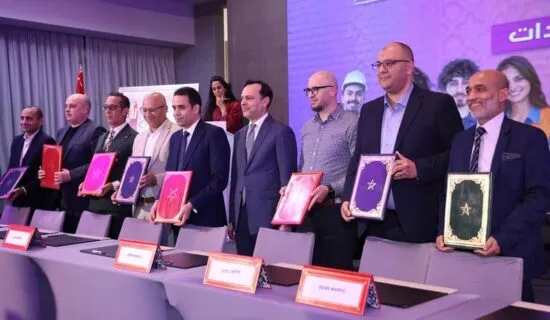
At the conclusion of the event, several partnership agreements were signed with the represented professional federations, marking the official commencement of this new integration mechanism on the ground.
As reported by agadirinfo.ma.