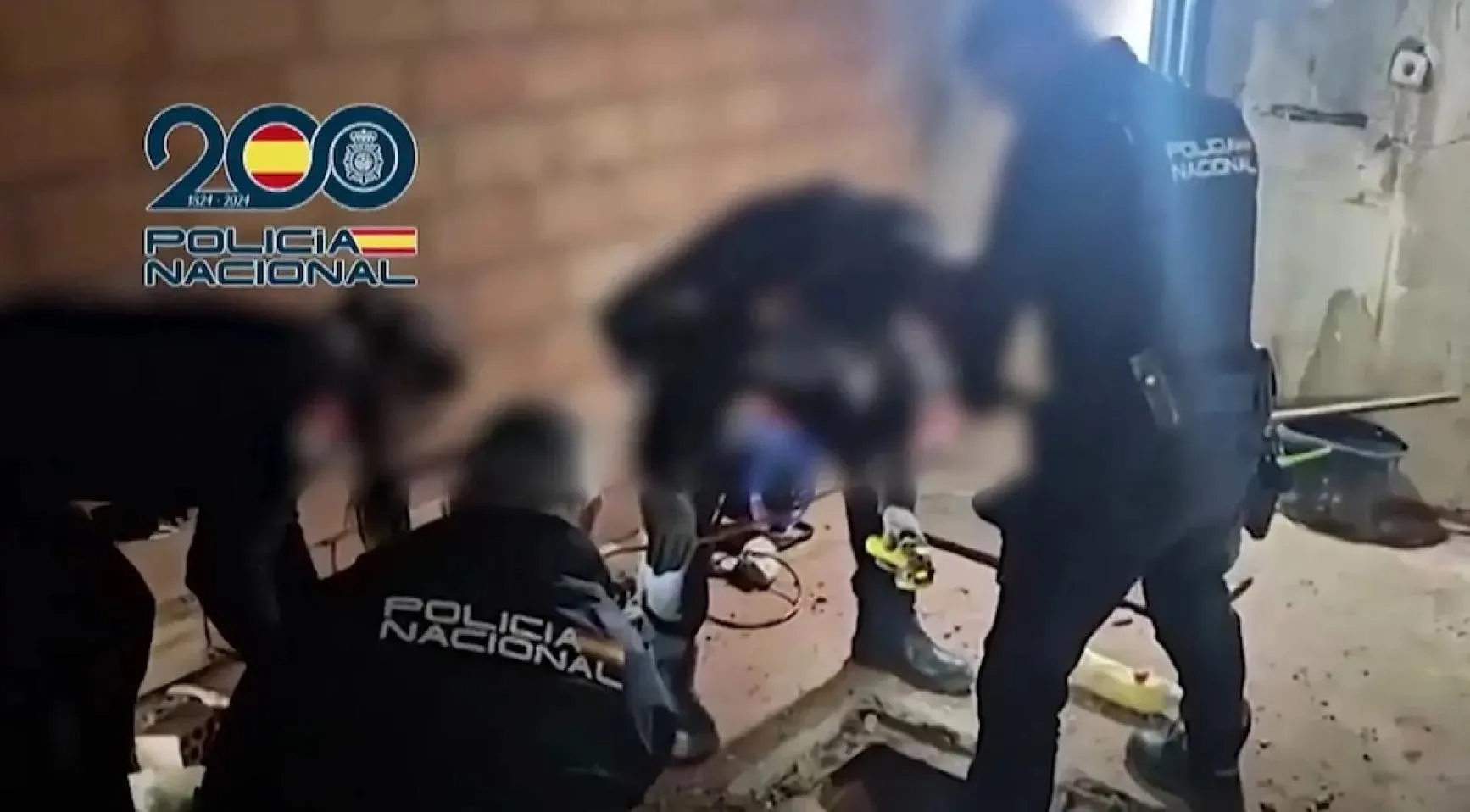

Authorities Dismantle Sophisticated Drug Tunnel in Ceuta
In a significant operation carried out by the Spanish National Police at the end of March 2026, law enforcement officials successfully dismantled a highly sophisticated drug trafficking network that utilized an elaborate underground tunnel in Ceuta to transport hashish. The operation, which culminated on March 31, resulted in the arrest of 27 individuals and the seizure of approximately 17 tons of hashish, along with €1.4 million in cash and 15 luxury vehicles. This extensive operation required the collaboration of over 250 officers who conducted coordinated raids across Ceuta and various regions of Spain.
The tunnel, which was discovered in Ceuta—a Spanish enclave located in North Africa—was ingeniously concealed behind a large soundproof refrigerator within an industrial warehouse. It featured a complex structure comprising three levels: a vertical shaft for descent, a central storage chamber for packaged drugs, and a lower passage leading directly towards Morocco. The tunnel was equipped with advanced features such as rails, wagons, pulley systems, and small cranes, all designed to facilitate the efficient movement of drugs underground. Investigators noted that this sophisticated system formed part of a larger, meticulously organized logistics network that also employed fishing vessels, high-speed boats, and trucks to transport narcotics between North Africa and Europe. Furthermore, reports indicated that corrupt officials and port workers had been bribed to ensure the smooth flow of shipments.
Key Players and Operational Details
According to investigators referenced in Spanish media, this criminal network had the capacity to transport around 2,000 kilograms of hashish weekly through the tunnel alone. Although the group primarily operated from Ceuta, it maintained connections throughout Spain and other parts of Europe. Police identified two principal leaders of the organization. The first was a Moroccan businessman, known by an alias, who was described as the “architect” and the “boss of the tunnels.” This individual had previously been linked to another tunnel discovered the year before. The second leader was a Moroccan-born Dutch man, who was recognized by investigators as the co-leader of the network and owner of a pastry business.
Investigators reported that the Dutch-linked suspect played a crucial role in coordinating substantial shipments, including a notable transport from Tangier to Almería in southern Spain, where 15,000 kilograms of hashish were hidden within a truck loaded with watermelons and potatoes. During intercepted communications, the suspect expressed anxiety over the possibility of police intervention, urging that the transport be halted and abandoned. Despite his apprehensions, the shipment continued, ultimately leading to the interception of the drugs by Spanish authorities in Almería, resulting in the arrests of three individuals.
The organization had been under surveillance since early 2025, with a series of intermittent arrests and seizures preceding the tunnel's discovery. In November 2025, officers intercepted 480 kilograms of hashish during a vehicle pursuit in Málaga, while earlier operations included the seizure of 510 kilograms linked to a house fire in Ceuta and another 432 kilograms in a separate location in southern Spain. The tunnel was finally uncovered on March 26, following months of monitoring, and subsequent raids targeted 29 locations across Ceuta, Málaga (Marbella), Huelva (Villablanca), Cádiz (Los Barrios), and Pontevedra, yielding additional drugs and evidence.
Authorities have characterized this network as a “very powerful” and meticulously organized trafficking system, with the tunnel serving as a central artery within a broader smuggling empire connecting Morocco, Spain, and various parts of Europe.
As reported by nltimes.nl.