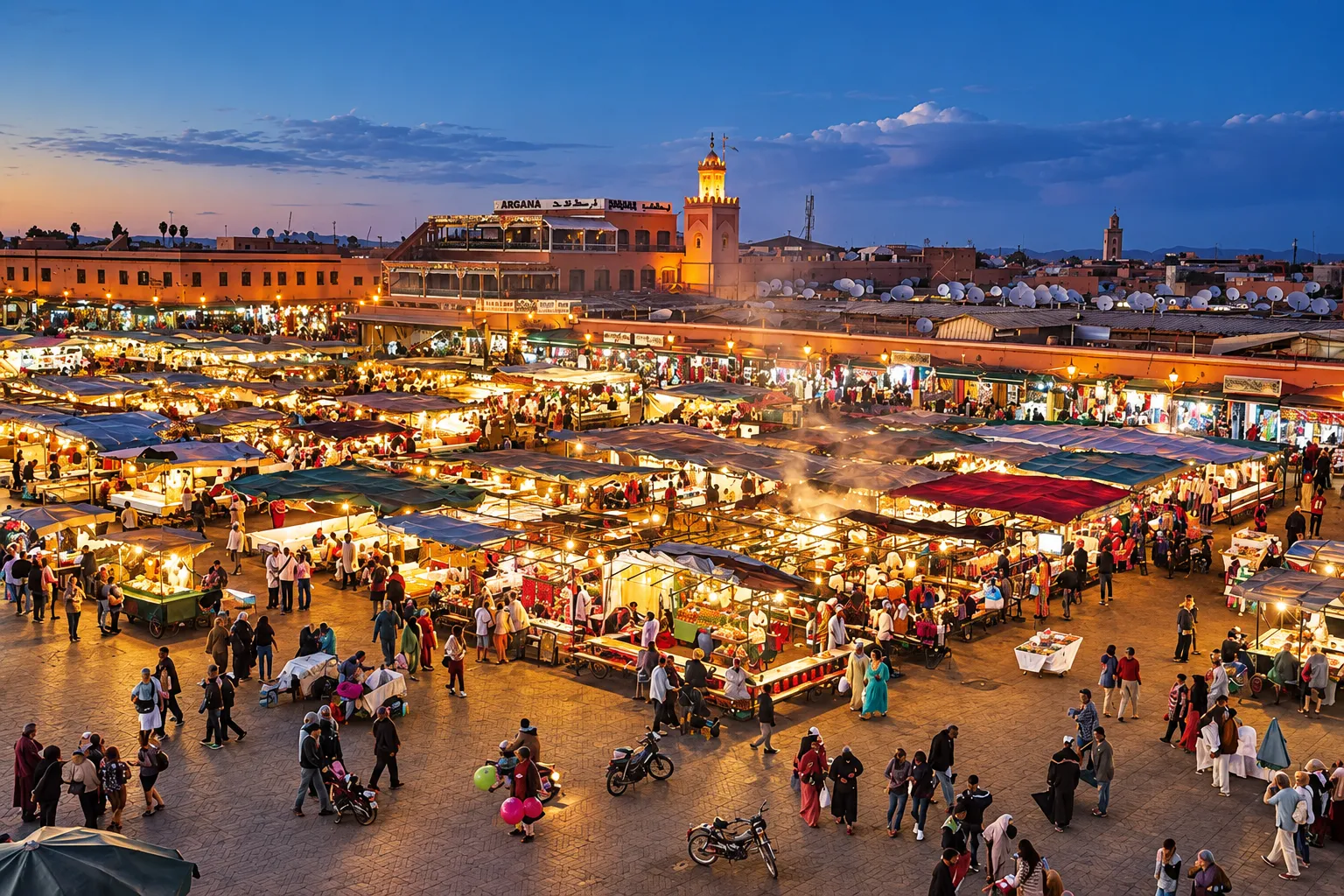

Massive Cancellations Impacting Travel to Morocco
Recent reports indicate that short-term cancellations of trips from Spain to Morocco have soared beyond 80%, a significant shift triggered by the crisis in Ceuta that unfolded at the end of July. Carlos Abella, the Secretary General of the Tourism Board, shared these findings with _El Confidencial_, highlighting data collected from various travel agencies associated with the organization. According to Abella, the situation has drastically altered the perception of Morocco as a tourist destination for Spaniards, stating, "From a tourism perspective, Morocco has collapsed." This downturn marks a stark contrast to the previous trends where Morocco was increasingly favored by Spanish travelers, thanks to its proximity, affordability, and rich cultural offerings.
In 2025, Morocco had welcomed approximately 3.8 million Spanish visitors, an increase from 3.5 million in the preceding year. Correspondingly, spending also witnessed a positive trajectory, with experimental data from the National Institute of Statistics (INE) revealing that Spanish travelers expended around 369 million euros in Morocco during 2025, compared to 280 million euros the year before, showcasing a remarkable increase of nearly 32%. Moreover, the average daily expenditure rose from 101.60 euros to 120.23 euros.
Uncertainty and Safety Concerns Affect Travel Plans
The crisis in Ceuta has now disrupted these optimistic projections. Members of the Tourism Board believe that the decline in bookings will not be confined to immediate cancellations, and they do not foresee a significant recovery in the Spanish market before the year concludes. Abella emphasizes the prevailing feelings of insecurity and uncertainty, explaining that tourists who perceive tensions between two countries are likely to explore alternative destinations. José Luis Sánchez Ollero, a professor of Applied Economics at the University of Malaga and an expert on the Moroccan tourism sector, echoes this sentiment, asserting that vacation travelers tend to minimize risks and may postpone their plans until stability is restored. He also calls upon the Spanish government to provide clearer insights regarding the state of relations with Morocco to alleviate uncertainty.
However, travel agencies do not present a unanimous diagnosis of the situation. José Manuel Lastra, the president of the Spanish Confederation of Travel Agencies (CEAV), acknowledges a decline in bookings but refrains from labeling it as widespread cancellations. His data indicates that Agadir is experiencing a growth of 10%, while Marrakech has seen a decrease of 5.6%, and Rabat and Tangier-Tetouan are down by 1% to 2% compared to the previous summer. Additionally, prominent Spanish hotel chains currently do not report a corresponding collapse. Barceló, which operates nine establishments across Agadir, Casablanca, Fez, Marrakech, Rabat, and Tangier, maintains that their bookings remain consistent with typical levels. The group views Morocco as a strategic market and continues with plans for expansion, including four new openings.
Similarly, RIU has stated that the events in Ceuta have not directly impacted the occupancy rates or operations of its six hotels in Morocco, noting that the Spanish market constitutes a limited segment of its clientele in the country. Meliá, with a smaller footprint, operates two properties in Marrakech. Prior to the crisis, air connectivity between Spain and Morocco had reached significant levels, with Royal Air Maroc linking nine Spanish cities to five Moroccan destinations via more than 80 weekly flights, transporting around 480,000 passengers in 2025. Other airlines such as Iberia Express, Air Europa, Vueling, Ryanair, and EasyJet have also contributed to this connectivity. According to Aena, as cited by _El Confidencial_, passenger traffic from Spanish airports to Morocco rose by 16.7% last year.
As the tourism sector awaits to ascertain whether the downturn reported by some Spanish agencies will evolve into a prolonged trend or remain confined to the months following the Ceuta invasion, the erosion of confidence among Spanish travelers emerges as a critical risk for a tourism market that was thriving until July.
As reported by gaceta.es.