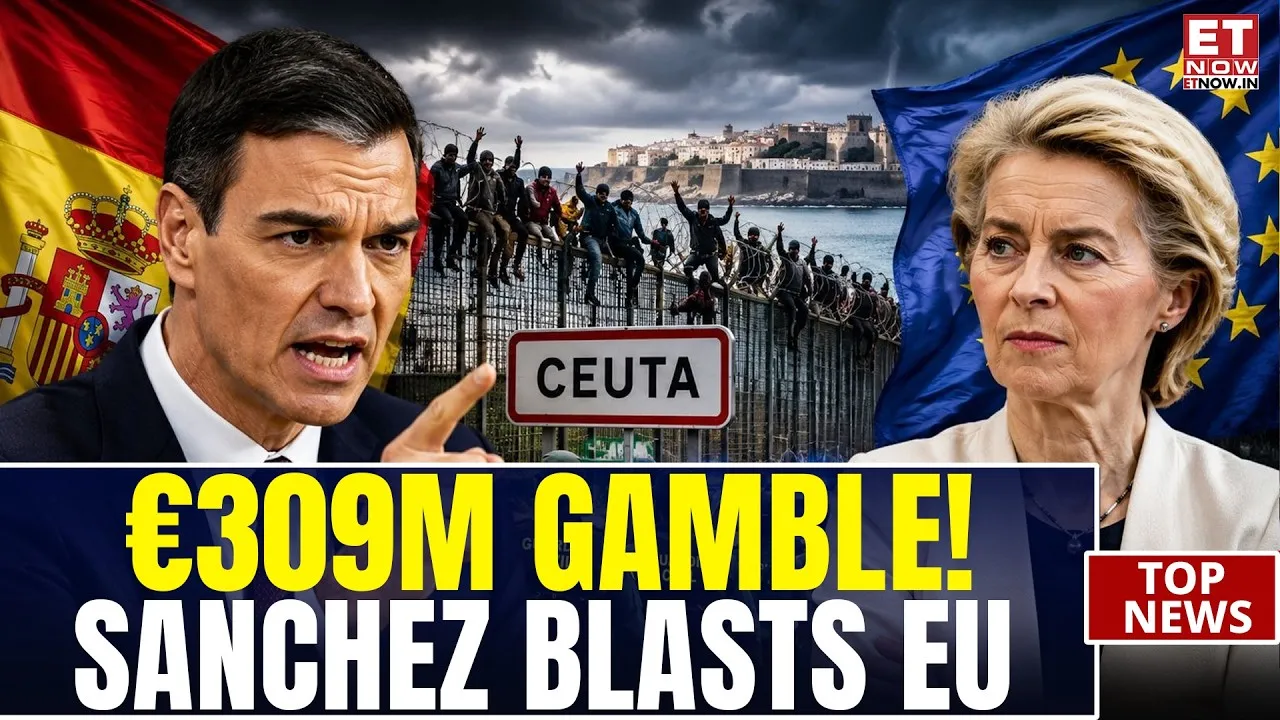

On Wednesday, hundreds of thousands of people across Spain demonstrated their solidarity with Ceuta, a city grappling with a migration crisis that has persisted for over a month following the arrival of more than 72,000 individuals from Morocco. The Spanish Federation of Municipalities and Provinces (FEMP) organized protests that took place in nearly 1,996 cities nationwide. In Ceuta itself, over 25,000 residents—approximately one-third of the local population—took to the streets to voice their concerns and frustrations.
In a show of unity, young Christians, Muslims, Jews, and Hindus in Ceuta came together to read a manifesto stating, "Ceuta has reacted, but Ceuta cannot do this alone." Even the government-aligned newspaper "El País" acknowledged that, unlike other protests, this movement has emerged organically from the grassroots level, highlighting the urgency and authenticity of the citizens' grievances.
The situation has escalated from a migration challenge into a deep-seated trust crisis between Madrid and Ceuta. Thousands of individuals remain in the city illegally, and the government currently lacks reliable figures on their numbers. Many are forced to sleep on beaches and in makeshift camps, while the local Chamber of Commerce estimates that losses in trade, hospitality, and tourism have exceeded 33 million euros. This economic downturn has been exacerbated by a significant rise in insecurity, with reported cases of sexual assault skyrocketing. Reports from Euronews indicate that the victims are predominantly homeless, underage female migrants from Morocco, and many local women and children now feel unsafe venturing outdoors. Furthermore, the start of the school year has been indefinitely postponed, leaving parents and students in uncertainty.
Religious leaders have echoed the sentiments of fear and concern within the community. Archbishop Luis Argüello, the head of the Bishops' Conference, referred to the situation in Ceuta as an "invasion" and labeled it a "test," cautioning that "demography is a weapon." Caritas also condemned the "instrumentalization of migrants" as a geopolitical tool while demanding their protection. Ceuta's vicar, Francisco Fernández Alcedo, expressed that the local population possesses a "fearful soul and a broken heart." Following the protests, Archbishop Jesús Sanz Montes juxtaposed the solidarity with Ceuta against "Moroccan claims" and what he termed a "failed governance" by the Spanish government.
The internal contradictions within the government have further fueled public discontent. Interior Minister Fernando Grande-Marlaska stated on August 4 that he had received "no report or warning" from the CNI intelligence agency regarding the situation. In stark contrast, Defense Minister Margarita Robles told Parliament that CNI agents had already informed the government's representative in Ceuta on July 29 about calls to breach the border the following day. Reports have since revealed that military intelligence had categorized a massive influx on July 30 as "highly likely." This inconsistency has prompted Prime Minister Sánchez to attempt to craft a defensive narrative, stating that while there were indications of a potential crisis, no one could predict its scale or likelihood. On August 1, he claimed that "practically all" illegal entrants had returned to Morocco, yet a month later, thousands still remain in Ceuta. During a prolonged state of emergency in Ceuta, Sánchez spent four weeks on summer vacation, leading many residents to perceive his promise to support the city until it regained its normalcy as a mockery.
According to a report from the National Center for Immigration and Borders to investigating judge María Tardón, the migration action was "planned" rather than spontaneous, using the migration purpose as a "formal cover." Uniformed Moroccan officials and alleged members of Moroccan security forces actively guided people to the border. While Sánchez has acknowledged that the Moroccan gendarmerie allowed border crossings for hours, he insists that there is no "solid evidence" of planning by Rabat. Even his leftist coalition partner, "Sumar," has criticized Sánchez's reluctance to confront Morocco.
The crisis has now attracted the attention of the judiciary. Interior Minister Grande-Marlaska expressed concern over Judge Tardón's decision to prohibit the authors of the police report from informing their superiors. In response, the President of the Supreme Court, Isabel Perelló, called for "maximum respect" for the judge's authority. The city of Ceuta has decided to participate as a joint plaintiff in a case against the Spanish government before Spain's central criminal court, Audiencia Nacional.
As reported by die-tagespost.de.