
U.S. Recognition of Ceuta and Melilla: A Shift in Geopolitical Dynamics
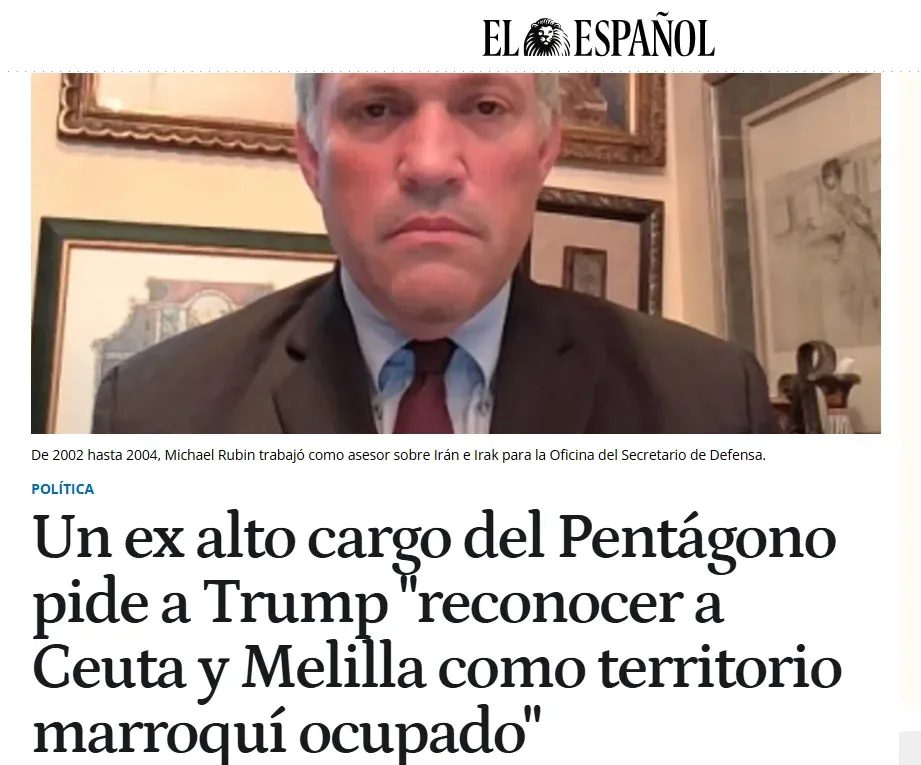
Michael Rubin, a prominent American researcher and former Pentagon official, has ignited a significant debate regarding the sovereignty of the Spanish enclaves of Ceuta and Melilla. In a thought-provoking article published in the Middle East Forum, Rubin suggests that the United States should formally recognize these cities as "occupied Moroccan territories." This proposal aligns with a growing influence of pro-Moroccan lobbying within strategic circles in Washington, signaling a potential shift in U.S. foreign policy towards Spain and Morocco.
Rubin's analysis argues that Spain’s control over Ceuta and Melilla represents the last remnants of its colonial presence in North Africa. He contends that Spanish sovereignty over these territories contradicts the United Nations' principles of decolonization. Drawing parallels to the U.S. recognition of Morocco’s sovereignty over Western Sahara in 2020 under the Trump administration, Rubin posits that Washington could employ a similar diplomatic strategy to address what he perceives as an "historical grievance" by formally acknowledging Morocco's claims to Ceuta and Melilla.
The Growing Influence of Morocco in U.S. Strategic Circles
This proposal comes at a time of heightened political tension regarding Spain's international positioning. Rubin is particularly critical of the Spanish government led by Pedro Sánchez, suggesting that its foreign policy is increasingly at odds with the interests of the United States and its allies. Beyond his specific recommendations, Rubin's assertions reflect a broader trend that experts have noted for years: Morocco's rising prominence in U.S. strategic discussions, evidenced by increased research and analysis from various think tanks such as the Atlantic Council, Wilson Center, Carnegie Endowment, and the Middle East Institute.
In this evolving geopolitical landscape, Morocco has established itself as a crucial partner for the U.S. in areas such as counter-terrorism, migration management, military cooperation, and energy transition. This enhanced relationship reinforces Morocco's standing in debates concerning the Maghreb and the African Atlantic, showcasing its ability to influence U.S. policy discussions significantly.
Rubin's proposition highlights how think tanks can serve as platforms for anticipating geopolitical debates, which may eventually shape official foreign policy decisions. Historically, analyses from such organizations have preceded significant diplomatic movements, including the U.S. recognition of Moroccan sovereignty over Western Sahara in 2020.
However, it is essential to note that the sovereignty of Ceuta and Melilla remains a firmly defended position within Spain, recognized by its constitutional framework. Conversely, the status of Western Sahara is classified by the United Nations as a non-self-governing territory, with its future to be resolved through the exercise of the Sahrawi people's right to self-determination. This juxtaposition further emphasizes how the Western Sahara issue has become a central element in the geopolitical rivalries of the Maghreb and the African Atlantic.
In recent years, Morocco has engaged in an aggressive diplomatic strategy aiming to solidify its narrative on the conflict, as evidenced by proposals such as Rubin’s. This highlights the intertwining of regional debates with broader global strategic balances and the political agendas of external actors.
As reported by noteolvidesdelsaharaoccidental.org.