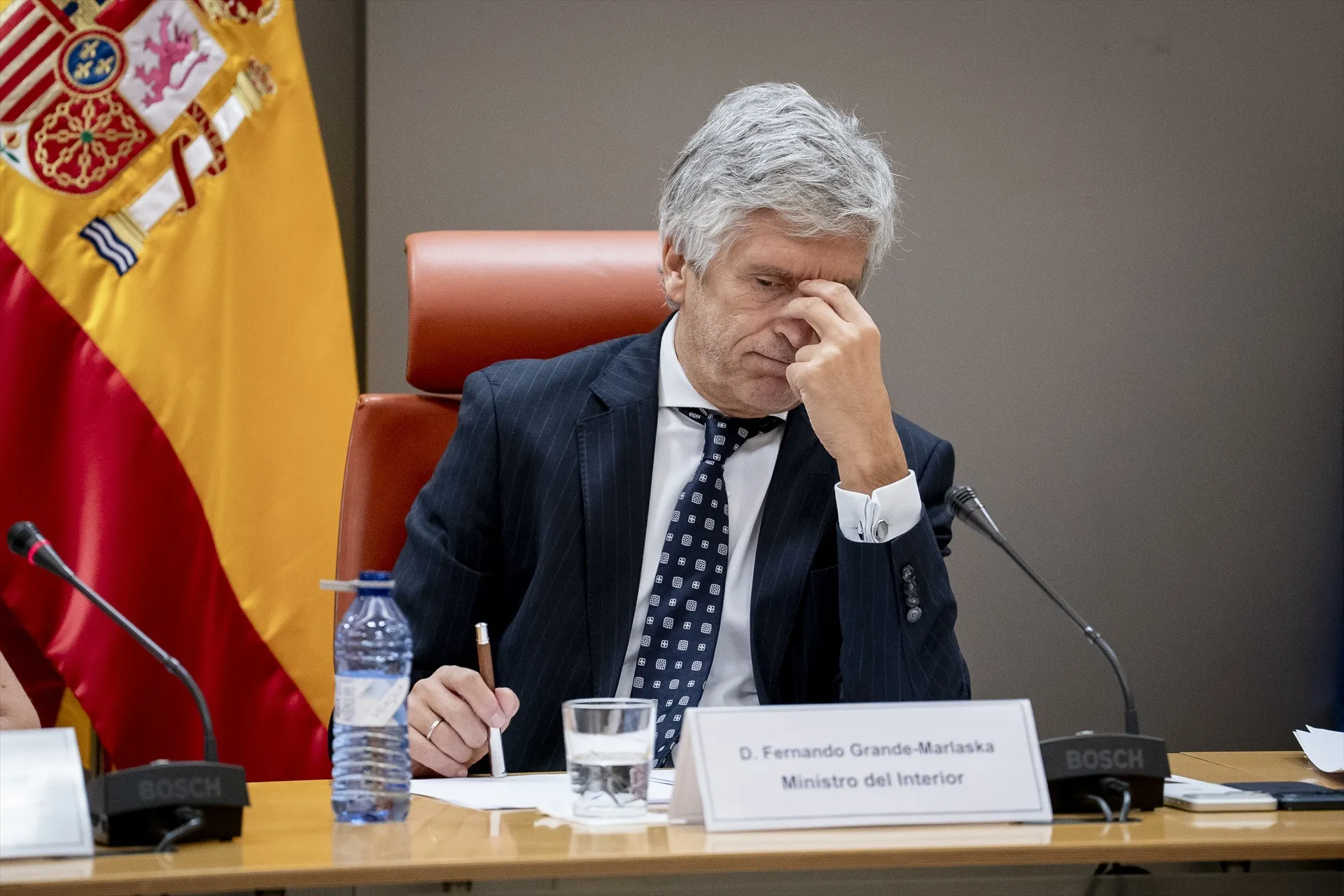

The Spanish Minister of the Interior, Fernando Grande-Marlaska, has firmly stated that no reports currently exist that can definitively identify the mastermind behind the invasion of Ceuta that occurred at the end of July, which saw over 72,000 individuals enter the city. Despite this situation, the minister reiterated his unwavering confidence in Morocco, even as the National Court has taken on the investigation and noted a 'clear and undeniable facilitating management' from Moroccan territory.
According to Europa Press, Marlaska made these remarks during the traffic accident report for the summer held at the General Directorate of Traffic (DGT), where he was questioned about the reports submitted to the National Court regarding the events in the autonomous city. "I want to reiterate my trust in Morocco and the excellent cooperation and coordination we have across all areas," Marlaska emphasized.
Minister Dismisses Credible Author Identification
The minister referred to a report from the National Intelligence and Border Center (CENIF) of the National Police, which suggests the involvement of Moroccan gendarmes, as well as a report from the Civil Guard indicating that the warnings received before July 30 did not allow for the anticipation of the massive influx of thousands of individuals. Marlaska maintained that none of these factors point to a responsible party behind the events. "To date, there is no substantiated element based on any minimally logical, reasonable, and objective fact indicating intervention from Morocco or any other state, nor from any specific agent or individual as the intellectual author of the Ceuta crisis," he stated, aligning with comments made by Pedro Sánchez in Congress.
The minister urged respect for the judicial investigation and insisted that the police analysis should consider "all images and data" in a contextual manner. In this regard, he warned that "there are elements that have different interpretations."
National Court Takes Charge of the Investigation
Marlaska's statements coincided with the ruling in which Judge María Tardón has accepted the jurisdiction of the National Court to investigate the mass entry of immigrants from Morocco that took place on July 30 and 31, 2026. The ruling, which has been accessed by Libertad Digital, indicates the behavior of Moroccan security forces as facilitating the process. "There has also been clear and undeniable evidence of facilitating management from the territory of the Kingdom of Morocco, specifically on the beach of Fnideq and surrounding areas in the city of Castillejos, evidenced through the documented and graphically corroborated behavior of Moroccan security forces," the ruling states.
The judge considers that the investigated events could constitute a criminal act allegedly committed abroad that has severely attacked the "territorial integrity of Spain." Last week, Lieutenant Prosecutor Jesús Alonso had already deemed the National Court competent, pointing to the possible commission of at least four serious crimes and requested that the investigation be declared secret. Tardón has agreed to open a separate confidential piece for proceedings deemed confidential. The ruling also mentions the inadmissibility of the complaint filed by the party Se Acabó la Fiesta, led by Alvise Pérez, against Moroccan officials and institutions, accusing them of crimes against humanity.
Marlaska also defended General Luis Peláez, head of the Civil Guard's Information Service, when questioned about an alleged order to eliminate any reference to Morocco from the report submitted to Judge Tardón. "I see this as a rumor, a falsehood; it shows a lack of understanding of the DAO, General Peláez, and the Civil Guard," he responded.
The Interior Minister further criticized the leader of the PP, Alberto Núñez Feijóo, after he indicated that the president of Ceuta, Juan Jesús Vivas, "has thwarted a plan" that included some "concession" from the Pedro Sánchez Government to Morocco. "This country needs serious politicians," Marlaska asserted. "Those who are not here to help might as well stay home," he added.
In defending the cooperation with Morocco, the minister highlighted the return statistics. He reiterated that 90% of the individuals who entered Ceuta "returned within 24 hours," a statistic he considers "very clear and evident" of the collaboration between the two countries. Marlaska noted that Morocco continues to accept "all" immigrants who voluntarily approach the border to return to their country. Since August 10, he reminded, over 4,200 individuals have been returned.
Regarding those who remain in Ceuta, the minister assured that the government will enforce the legislation "in its literalness." "Anyone who does not have the right to international protection will be returned as soon as possible," he concluded.
As reported by libertaddigital.com.