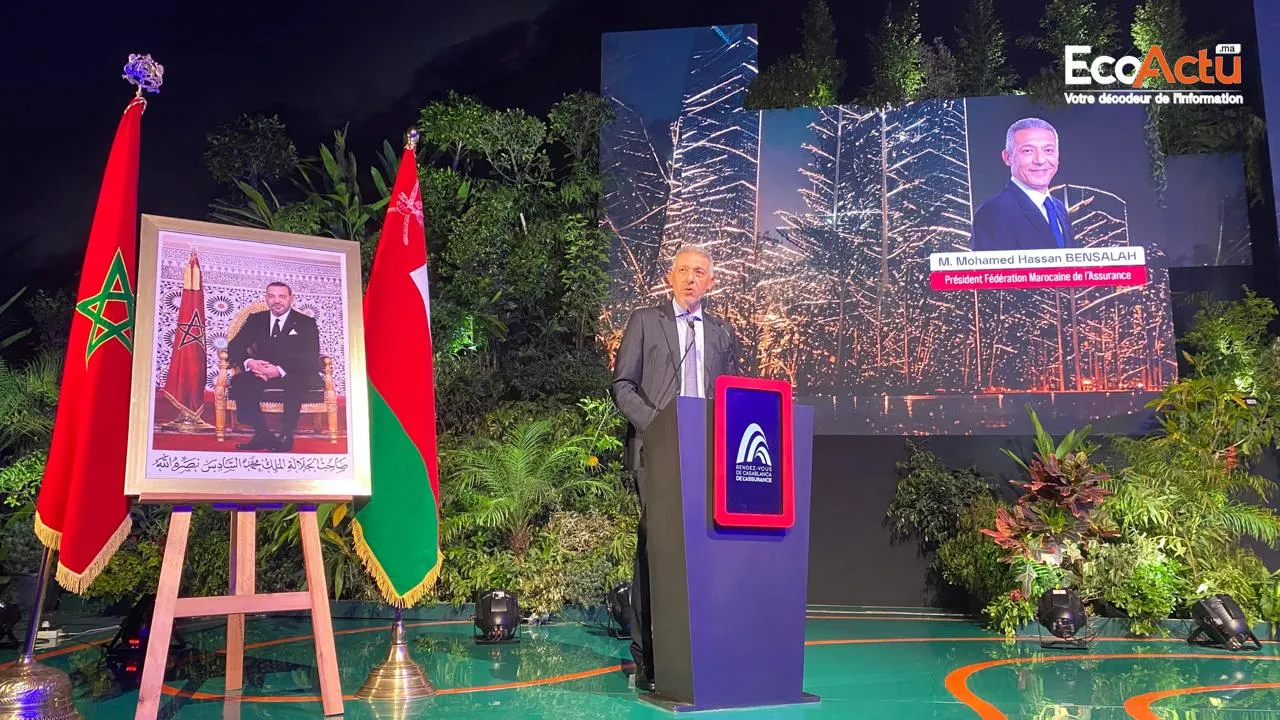
Mohamed Hassan Bensalah Discusses the Future of Insurance at the 12th Insurance Rendezvous
At the inauguration of the 12th edition of the Insurance Rendezvous in Casablanca, Mohamed Hassan Bensalah emphasized the pivotal role of this event in navigating the transformations within the insurance sector. "For the past twelve years, the Insurance Rendezvous has accompanied the significant changes in our field, decoding its challenges, illuminating its questions, and embodying its ambitions," he stated. Highlighting the international context, he raised concerns about a new phase of uncertainty arising from geopolitical tensions. With the recent escalation of conflict in the Middle East, Bensalah noted that we have entered a new era of uncertainty, with the World Bank forecasting a deterioration in regional economic prospects.
He elaborated on the already noticeable repercussions of this instability, such as rising energy prices, increased transportation costs, and inflation on basic goods. However, he pointed out that these visible effects obscure a deeper transformation: "There exists a more profound reality, a transformation of risk itself." When addressing the risks of war, he explained that they are typically excluded from insurance contracts. "In most agreements, damages related to war are excluded not by choice but because these risks are inherently massive, simultaneous, and challenging to pool," he clarified. Nevertheless, he acknowledged that specific sectors, such as maritime transport and aviation, utilize specialized mechanisms to cover what are termed 'war risks,' although these solutions are complex and costly.
In this context, he posed a critical question: "Are we on the brink of a more geopolitical insurance framework?" suggesting that economic players are now exposed to a new generation of risks. "What we observe today is not an isolated crisis; it is a profound mutation," he asserted, pointing to the emergence of political, climatic, cyber, and geopolitical risks. In light of these developments, he highlighted the limitations of traditional models: "These risks have the potential to impact everyone simultaneously, challenging the very foundation of our profession." Bensalah stressed the growing role of public authorities and partnerships, stating, "The role of governments, reinsurers, and public-private partnerships is becoming central." He further noted the evolution of insurers' roles: "We are no longer just claims managers; we are becoming contributors to economic and social resilience."
In a world characterized by uncertainty, he reminded attendees of the fundamental mission of the insurance sector: "To protect as many people as possible." This challenge is particularly significant in Africa, where "millions of citizens remain outside the insurance system." He highlighted the transformative potential of technology, remarking that with mobile connectivity, insurance can become simple, accessible, and immediate, noting that fintechs and insurtechs are now a tangible reality on the continent. However, he emphasized a crucial factor: "Digitalization must be accompanied by education, simplicity, and above all, trust." He added, "Trust cannot be decreed; it must be built." Therefore, he underscored the importance of regulation as a key lever to support and accelerate the transformations within the sector, aiming to protect policyholders while fostering innovation.
In this regard, he welcomed the ongoing reforms in Morocco: "The overhaul of Book IV of the Insurance Code represents a significant advance," reflecting a commitment to adapt to new realities. Addressing demographic challenges, he warned of a silent transformation: "The gradual aging of the population places pressure on pension systems." He cited various international examples illustrating innovative models: "In Kenya, mobile-based micro-retirement savings initiatives have successfully integrated informal workers," adding that India and several Latin American countries have also developed inclusive solutions. "These experiences demonstrate that an alternative model is possible: more inclusive, more flexible, and closer to reality," he asserted, calling for lessons to be learned from them.
Finally, he touched on the technological transformations within the sector: "Artificial intelligence, data, and automation are rapidly redefining our professions." Yet, beyond technology, he emphasized a fundamental principle: "Insurance remains, by its nature, a profession of trust. A trust that cannot be automated and relies primarily on human interaction." In this context, he highlighted the importance of attracting new generations: "Generations Y and Z will soon represent more than half of the active workforce," with new expectations regarding meaning and impact. "It is up to us to make our sector more attractive, to provide stimulating environments, and to sustainably nurture talent," he concluded, asserting that the success of this transformation ultimately depends on human capital.
As reported by ecoactu.ma.