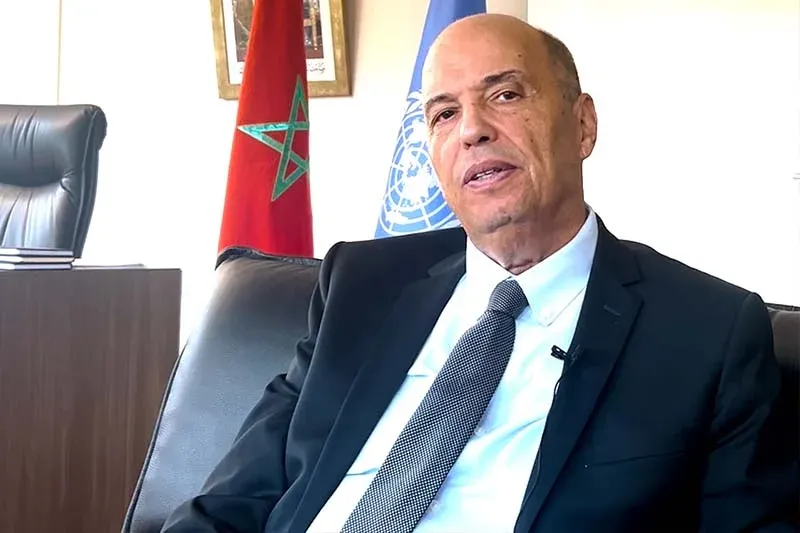

Omar Zenibari, Morocco's permanent representative to the United Nations Office in Geneva and former president of the Human Rights Council, emphasized that the issue of Western Sahara has not been on the agenda of the council or in the reports from the High Commissioner for Human Rights. He noted that this fact has become established 'session after session and year after year,' despite efforts from opponents of the kingdom to exploit the matter against it.
In an interview with Hespress during the opening of the 63rd session of the Human Rights Council in Geneva, Zenibari stated that Morocco addresses attempts to misuse the council concerning the Western Sahara issue with 'calmness' and through interventions that reveal, as he expressed, the positions of the kingdom's adversaries, while simultaneously presenting the realities of the southern provinces and their economic and social development alongside the enjoyment of rights and freedoms.
This conversation came on the heels of the opening of a new session of the Human Rights Council amidst a global landscape marked by escalating conflicts, wars, and humanitarian crises; the UN High Commissioner for Human Rights cautioned against the repercussions of these situations in his opening remarks. He also highlighted migration issues and the need to protect the rights of migrants, without reference to Morocco or the recent events related to the occupied city of Ceuta.
In this context, Zenibari argued that the omission of Morocco from discussions is indicative of the country’s policies and practices regarding migration. He stressed that 'Morocco is not prepared to be a gendarme for anyone' concerning this issue, and highlighted the kingdom's active role within the Human Rights Council in advocating for migrant rights and contributing to initiatives and decisions related to migration.
Zenibari noted that Morocco's position within the international human rights framework is 'very distinguished,' recalling its leadership in several pathways and initiatives, including the Universal Periodic Review and national human rights mechanisms, as well as initiatives linked to women's rights, equality, and cultural dialogue.
Regarding criticisms concerning double standards within the Human Rights Council, Zenibari acknowledged the existence of positions influenced by geopolitical considerations; however, he emphasized that the credibility of the UN council 'still holds,' and it remains a necessary space for dialogue and discussion. He urged the protection of the council from political and geopolitical confrontations so that it can fulfill its role in preventing conflicts and promoting human rights.
The Moroccan ambassador also discussed artificial intelligence, noting that Morocco was proactive in introducing this topic to the Human Rights Council during its presidency in 2024. He underscored the need to accompany the evolution of this technology with a legal and ethical framework that ensures respect for rights and freedoms.
In response to questions about the current state of global conflicts, Zenibari remarked that the escalation of wars and crises has dire global implications. He emphasized the human suffering caused by these conflicts and the resulting economic and social consequences affecting societies worldwide. Highlighting the current fuel prices, he noted their negative impact on social and economic life.
When asked if the Human Rights Council faces a credibility crisis due to double standards, Zenibari concurred that there are always sharp criticisms directed at some council members for positions perceived as based on double standards. Nevertheless, he maintained that the council remains a suitable venue for discussion and debate, even for confrontation through proposed resolutions that are voted on, acknowledging that there is no consensus on everything that happens within the council.
Concerning the outcomes of the recent Rabat retreat related to the Universal Periodic Review, Zenibari mentioned that the results would be presented in a special session organized by the Moroccan delegation with various partners, including the High Commissioner’s office and civil society organizations. He stressed the significance of this retreat for the council's work and the protection of human rights globally, noting Morocco's leadership in this area since the establishment of the Human Rights Council.
Zenibari also reiterated that the issue of Western Sahara is not included in the council's agenda or reports, and year after year, there are no references to it as a human rights concern. He pointed out that despite the efforts of Morocco's adversaries to spread lies and undermine the kingdom, they have been ineffective and without results. The Moroccan delegation continues to present matters as they are, highlighting Morocco's openness to dialogue and showcasing the developments in the southern provinces, including upcoming legislative elections as a further demonstration of the country's commitment to rights and freedoms.
In conclusion, Zenibari reaffirmed that Morocco’s approach to migration is positive and proactive, emphasizing that the kingdom is one of the most active countries in the Human Rights Council regarding migration issues and the protection of migrant rights. He underscored that Morocco has built a robust legal framework for the integration of migrants and has taken bold stances at the continental level while cooperating with neighboring European countries.
As reported by hespress.com.