
Criticism of the Spanish Police Report
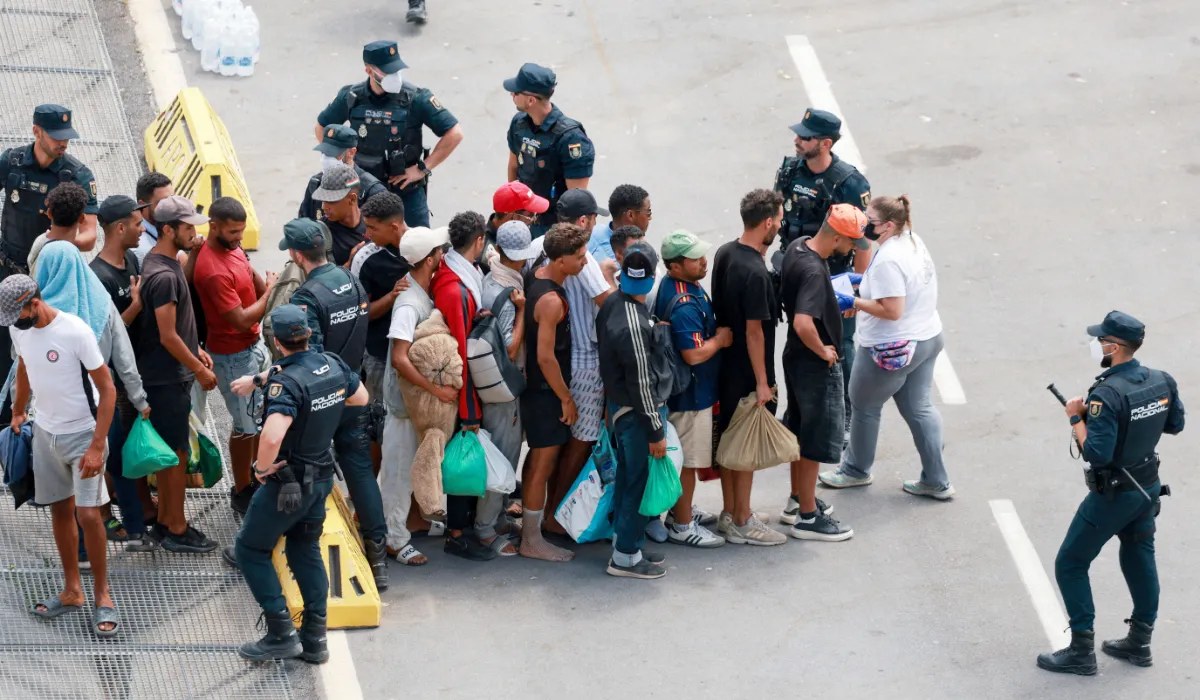
Recent reports from Moroccan media have taken issue with a Spanish police document that accused Morocco's security forces of inadequacies in managing a massive influx of migrants crossing into Ceuta, a Spanish enclave. Over the course of July 30 and 31, more than 70,000 migrants surged into Ceuta from Morocco, leading to a chaotic situation that resulted in numerous fatalities and ignited disputes within the European Union regarding the complex issue of migration. The Spanish police report, which was viewed by AFP, described Morocco's police response as one of 'total permissiveness,' suggesting that the approach taken by Moroccan authorities effectively facilitated the overwhelming rush of migrants, with some officers allegedly seen directing individuals towards the water.
According to the report, the Moroccan police presence at the border was notably diminished compared to usual levels, and it claimed that officers made no substantial efforts to control the situation. However, Spanish Prime Minister Pedro Sanchez has refrained from putting the blame squarely on Morocco, highlighting the absence of 'solid proof' that the North African nation orchestrated the migrant influx. Sanchez's leftist administration has been working for years to mend the historically fragile relations between Spain and Morocco, particularly concerning the status of Ceuta and another Spanish enclave, Melilla.
Moroccan Media Responses
In the wake of the report's release, Moroccan media outlets have been vocal in their rebuttal of its claims. The news site Hespress characterized the report as 'particularly weak,' noting that it lacked substantial evidence and was riddled with 'glaring contradictions.' Hespress further claimed that the document appeared to position Morocco as a 'scapegoat' amid Spanish political and judicial controversies. Meanwhile, Le Desk labeled the report as 'botched,' pointing out factual inaccuracies such as incorrectly referencing June 30 instead of the actual dates of July 30. Additionally, the publication TelQuel argued against claims made by some media that the report explicitly accused Morocco of 'planning and executing' the migrant surge, emphasizing that the allegations did not name any Moroccan officials as responsible for the incident.
Moreover, news outlet Medias24 challenged the assertion of Moroccan 'permissiveness,' arguing that it was based solely on a single satellite image, which they claimed was merely a momentary snapshot of the situation. A senior Moroccan official had previously conveyed to AFP, on the condition of anonymity, that there had been no failures on the part of Moroccan security during the influx, further underscoring the complex and multifaceted nature of the migrant crisis.
As reported by arabnews.com.