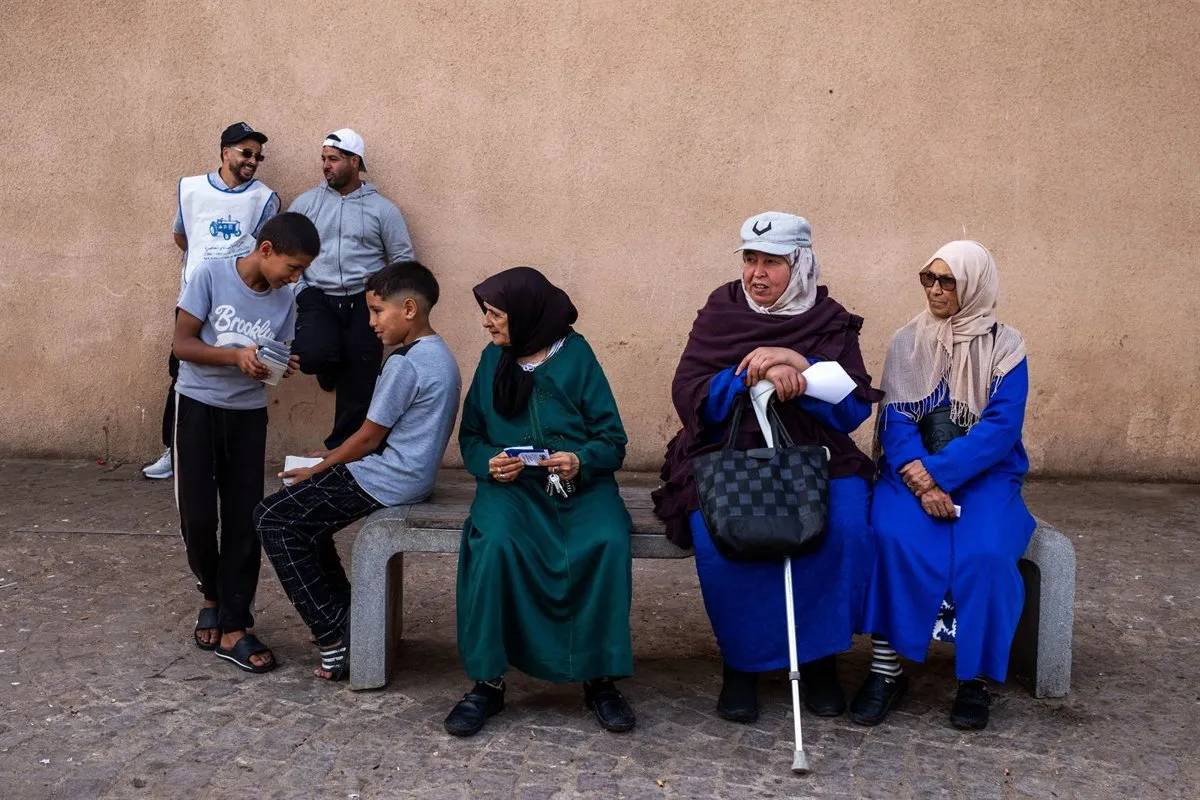

As Morocco prepares for its parliamentary elections scheduled for September 23, 2026, the nation finds itself at a critical juncture marked by widespread uncertainty regarding voter participation, particularly among the youth demographic. This disenchantment stems from a myriad of factors, including prevailing political and economic discontent and escalating tensions with Spain, exacerbated by the humanitarian crisis surrounding the irregular entry of masses into Ceuta in late July. The elections will see 27 political parties vying for 395 seats in the House of Representatives, the lower chamber of Parliament, where 305 representatives will be elected from local constituencies, while the remaining 90 will be allocated across the country's twelve regions, each receiving between three to twelve representatives.
The House of Representatives stands out as the only chamber where members are elected through direct universal suffrage, contrasting with the House of Councillors, which comprises 120 seats filled indirectly by electoral colleges made up of local authorities, professional associations, and worker and employer organizations. As such, the elections on Wednesday are anticipated to serve as a significant barometer of Moroccan society's pulse, particularly in light of the massive anti-government protests that erupted in 2025, driven by deteriorating public services. These demonstrations garnered the highest participation levels in Morocco since the notable protests in the Rif region between 2016 and 2017. Mobilized by groups such as GenZ 212 and Morocco Youth Voice via platforms like Instagram, TikTok, and Discord, tens of thousands of individuals rallied against corruption and criticized government expenditures on sporting events, including the upcoming 2030 World Cup to be co-hosted with Spain and Portugal, despite the fragile state of educational and healthcare sectors and alarmingly high unemployment rates.
This sense of disillusionment is particularly palpable among younger generations, as reflected in the aforementioned protests led by the so-called Generation Z, alongside the massive irregular influx into Ceuta, which tragically resulted in the deaths of around 140 individuals on both sides of the border. This incident has further strained bilateral relations, although the Spanish government has repeatedly stated that it does not hold Rabat responsible for the events. In this context, Miguel Hernando de Larramendi, a professor of Arabic and Islamic Studies at the University of Castilla La Mancha (UCLM) and a member of the academic council at the Center for Contemporary Arab Studies (CEARC), emphasized the significance of this youth disenchantment, highlighting that the events in Ceuta challenge the narrative presented during the Throne Day celebrations, where King Mohammed VI praised economic growth and development in an attempt to portray a more stable situation than that reported by various activist groups and Moroccan social organizations.
According to the results from Afrobarometer, a pan-African polling and social survey institute, published in March, 60% of Moroccans identified unemployment as one of the top three priorities the government should address. Interestingly, while 71% believe the country is moving in the right direction, only 44% consider the current economic situation to be "good." Hernando de Larramendi noted that it would be intriguing to observe the level of voter participation, although he pointed out that the percentage of young people registered on the electoral rolls is significantly low, with most registrants being over 35 years old, and a considerable proportion being over 65.
The Electoral Battle Among Major Parties
The electoral campaign has been characterized by the efforts of political parties to capture the youth vote to bolster their aspirations at the polls. The Islamist Justice and Development Party (PJD) seeks to recover from a harsh defeat in 2021, where it plummeted from leading the government with 125 seats to a mere thirteen. This decline was accompanied by the rise of a coalition of three parties led by the National Rally of Independents (RNI), currently headed by Prime Minister Aziz Ajanuch. The RNI has focused its campaign on the slogan "dignity and opportunity for all" for the upcoming five years, promising to create one million jobs, raise the minimum wage, and protect purchasing power through the establishment of a "social safety net," commitments made to counter criticisms aimed at the government.
Meanwhile, the Authenticity and Modernity Party (PAM), the second leg of the governing tripod, has adopted the slogan "Change of course," despite its significant role in the current administration. PAM aims to achieve this through a proposed agenda of "sustainable growth," which includes increasing pensions, creating a million jobs, and reducing unemployment to 7% by 2031. The Independence Party (Istiqlal) is also advocating for improved purchasing power for citizens, a crackdown on corruption, and the promotion of a conservative model centered around family values, encapsulated in the slogan "My homeland, my future." In contrast, the PJD aims to regain public support with a "dignity program" and a "restoration of trust" that focuses on Muslim identity and values, political and democratic reform, public service defense, and a productive economy geared towards addressing the main challenges faced by the populace.
In light of these dynamics, Riccardo Fabiani, the North Africa director at the International Crisis Group, remarked that significant changes in the coalition appear unlikely, as there are no opposition parties poised to unseat them, except for a PJD that seems lacking in the strength necessary to forge a new governing coalition. It is more probable that the same parties will form a similar coalition. The most interesting aspect will be which of the ruling parties emerges in the lead, as the king will select the next prime minister from among them. This perspective is echoed by Daniel Hernández, a senior non-resident researcher for the Middle East and North Africa at the Real Instituto Elcano, who emphasized that the situation remains dominated by parties closest to the Palace. He noted that the two main "variables" are the order of the leading political parties for institutional distribution and the anticipated low participation rates, which could reflect the discontent and disenchantment of segments of the citizenry. Therefore, voter participation may serve as a clearer indicator of the country's situation, especially considering the political system operates under the monarchy's aegis, which holds substantial sway over all decisions. This raises critical questions about whether the public endorses the country's direction and whether the economic advancements touted by the authorities are genuinely reaching society and translating into increased opportunities.
As reported by europapress.es.