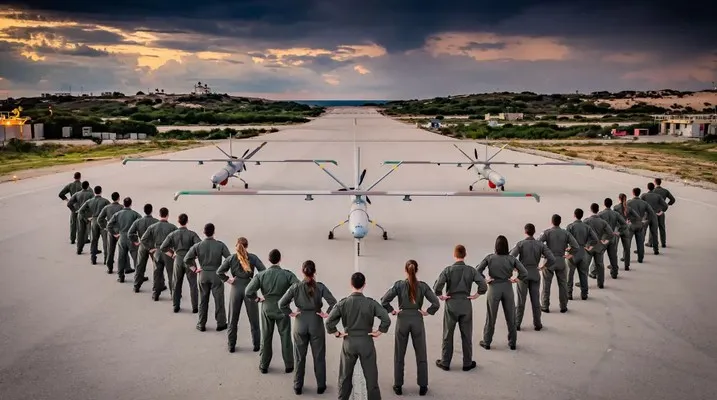

Morocco is rapidly enhancing its capabilities in unmanned systems, predominantly relying on Israeli drones. This development has raised alarms in Spain, as Rabat has acquired several types of Israeli UAVs, operates armed drones, and is establishing its own manufacturing capabilities. In response, Madrid is developing Counter-UAS systems, electronic warfare strategies, and initiating its own production of loitering munitions.
Despite these advancements, Spain maintains a military superiority over Morocco, boasting significant advantages in manned combat aircraft and naval forces, as well as being a NATO member. However, the balance of power regarding unmanned systems is increasingly tilting in favor of Morocco across the Strait of Gibraltar.
In recent years, Morocco has built an extensive fleet of Israeli UAVs, including the Heron from Israel Aerospace Industries (IAI) and the Hermes 450 and 900 from Elbit Systems, alongside various other unmanned systems, such as multicopters. The significance of this acquisition extends beyond mere numbers; Morocco possesses several years of operational experience with armed drones, whereas Spain operates American MQ-9 Reapers, which are currently unarmed.
Alongside its procurement strategies, Morocco is also working towards producing some of its unmanned systems domestically, establishing manufacturing capabilities through licensing agreements with Israeli companies. This shift could fundamentally alter the dynamics of Israeli-Moroccan defense relations, transitioning from pure imports to a degree of local production that could grant Rabat greater industrial autonomy and potentially higher quantities of available systems.
Since normalizing relations in 2020, military cooperation between Israel and Morocco has significantly expanded, with Israel now accounting for approximately 24% of Morocco's arms imports, making it the second-largest supplier to the country. Beyond unmanned systems, Morocco has acquired a substantial amount of Israeli military goods, including the Barak MX air and missile defense system, with the total value of such procurements estimated at around one billion US dollars.
This situation is particularly sensitive from Spain's perspective due to the presence of the North African cities of Ceuta and Melilla, which, while belonging to Spain, are located directly adjacent to the Moroccan coastline. The NATO alliance plays a role here, as Article 5 of the North Atlantic Treaty does not geographically refer to Ceuta and Melilla in the same unequivocal manner as it does to mainland Spain, making Spain's defensive capabilities in these enclaves especially critical.
Spanish media and defense analysts have frequently raised alarms about Morocco's kamikaze drones and loitering munitions, with several of these systems reportedly having ranges exceeding 50 kilometers, potentially allowing them to reach targets within the Spanish enclaves. Depending on the system and its range, some areas in southern Spain's mainland could also be within reach. However, technical capabilities do not necessarily imply concrete Moroccan operational planning or political intent.
A recent incident highlighted the implications of Morocco's increasing use of unmanned systems on the airspace surrounding Melilla. A Moroccan drone near the border interrupted the approach of an Iberia flight to Melilla Airport, causing delays. Following this incident, Madrid officially requested Rabat to adjust the altitude of its drone flights in that area.
Although this event did not escalate into a military confrontation, it illustrates the intricate interactions between manned civilian aviation, militarily utilized airspaces, and the increasingly prevalent unmanned systems in the region.
Spain's perception of this development is further complicated by the contrasting relationships both countries maintain with Israel. While Morocco has significantly expanded its military collaboration with Israel since 2020, Spain has imposed a permanent arms embargo against Israel and annulled contracts worth over 1.2 billion euros. This could also affect existing Israeli systems in Spain, particularly concerning the long-term supply of spare parts for items like Spike missiles.
Conversely, Morocco has embraced Israeli technology as a critical component of its military modernization strategy. In response to the growing prevalence of unmanned systems across the Strait of Gibraltar, Spain is taking targeted measures. Counter-UAS systems and electronic warfare capabilities have been deployed in southern Spain to cover the airspace around the Strait of Gibraltar. Such systems are essential for drone defense, as their relatively small size, low altitude, and potentially large numbers present different challenges compared to traditional manned aircraft.
Simultaneously, Spain is working to enhance its own industrial capabilities in unmanned weapon systems. In early 2026, Madrid supported a joint project worth 20 million euros between the Spanish defense firm Indra and the Emirati EDGE Group, aimed at establishing domestic manufacturing capabilities for kamikaze drones and loitering munitions. This initiative not only addresses a specific capability gap but also seeks to reduce industrial dependency on foreign suppliers in a category of weapons that has gained significant importance in recent conflicts.
Overall, while Spain remains militarily broader and more capable in key areas compared to Morocco, particularly in manned combat aircraft and naval forces, the situation shifts when it comes to armed UAVs and loitering munitions. Morocco has been operating such systems for several years, expanding its fleet with Israeli technology while simultaneously establishing its own industrial base. Meanwhile, Spain is just beginning to close this gap through new procurements, drone defense measures, and domestic production initiatives.
This dynamic does not signify a complete reversal of the military balance of power in the Strait of Gibraltar; however, the rapid development of unmanned systems is reshaping specific facets of this balance and compelling Madrid to recalibrate its capabilities regarding armed drones and their defense.
As reported by esut.de.