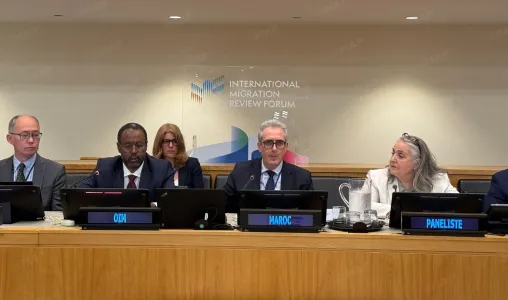

On Tuesday, Morocco made a compelling appeal at the United Nations Headquarters in New York, urging for an approach centered on "leadership by example" in the execution of the Global Compact for Safe, Orderly and Regular Migration. This compact was initially approved in Marrakech in 2018 and represents a significant international effort to address migration challenges.
During its participation in the second International Migration Review Forum, which took place from May 5 to 8, the Kingdom of Morocco showcased its notable achievements and best practices in migration management. These initiatives are built upon a proactive and voluntary strategy that emphasizes the effective fulfillment of commitments made under the Marrakech Compact on Migration. In this context, Morocco presented comprehensive publications detailing its accomplishments, which are structured around the 23 objectives outlined in the Compact.
Morocco's initiatives encompass a wide array of areas, particularly focusing on the humanization of border management, ensuring migrants' access to essential health and education services, and facilitating their socio-economic integration and employment opportunities. This approach is in direct alignment with the directives of King Mohammed VI, who, in his Royal Message delivered at the Intergovernmental Conference in Marrakech for the adoption of the Global Compact for Migration in December 2018, stressed that "The Global Compact is not an end in itself. It will be meaningful only if it is effectively implemented." This forward-thinking perspective reflects Morocco's commitment to not only adhere to international standards but also to lead by example.
In recognition of this tangible approach, the International Organization for Migration (IOM) has acknowledged over one hundred best practices that have been established by Morocco. This recognition has encouraged the Kingdom to share its experiences within the framework of the Forum, thereby solidifying its role as a proactive actor and a source of innovative proposals for international migration governance.
Furthermore, Morocco's economic landscape continues to evolve with significant developments. Recently, the German software giant SAP inaugurated its new office in Morocco, marking a pivotal expansion in the African market. The new SAP platform is set up in Casablanca's CasaNearShore Park, a hub dedicated to companies specializing in software development, infrastructure management, and customer relationship management.
Additionally, King Mohammed VI presided over the inauguration ceremony of the French PSA group’s ecosystem in Kenitra, a project that has attracted a substantial investment of €280 million, further underscoring the burgeoning automotive industry in Morocco. On this occasion, the Sovereign inaugurated the new PSA plant, which is anticipated to play a vital role in the Kingdom's industrial landscape.
In a separate event, Queen Letizia of Spain and Princess Lalla Meryem, Chairwoman of the National Observatory of the Child’s Rights (ONDE), visited a “second chance school” in Salé, specifically the École Nationale de Cirque Shems’Y. This institution is recognized as a crucial instrument for fostering inclusion and social justice, contributing to equitable development in the region. During their visit, ONDE's executive director, Lamia Bazir, provided an overview of the school’s mission and impact.
Lastly, Omar Hilale, Morocco’s Permanent Representative to the United Nations and President of the UN Peacebuilding Commission, updated UN Secretary-General António Guterres on the priorities and progress made during Morocco's leadership of the 31-member body. This engagement highlights Morocco's active role in high-level dialogues and its commitment to promoting peace and stability within the international community.
As reported by northafricapost.com.