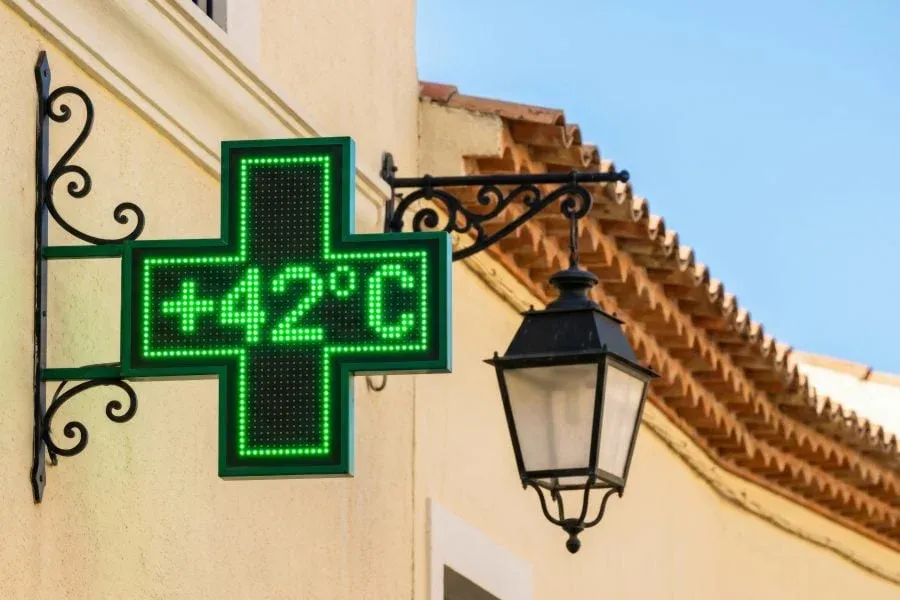

Record Temperatures Sweep Across Morocco
Temperatures soaring above 45 °C are typically indicative of a scorching summer, and this September is no exception, as numerous cities in Morocco have shattered monthly heat records, reflecting the exceptionally high conditions persisting throughout the country. According to Houcine Youabed, director of communication at the General Directorate of Meteorology (DGM), this weather phenomenon is attributed to atmospheric configurations that push Saharan heat northward. The extension of the Saharan depression, coupled with the Chergui winds from the south and southeast, is bringing warm air to several inland regions, raising temperatures by 5 to 12 °C above seasonal norms.
This intense heat has already led to record-breaking temperatures in the early days of September. On September 3, Kénitra recorded a staggering 45.1 °C, surpassing the previous September record set in 2006. Meanwhile, Salé hit 44.3 °C, exceeding its monthly record from 2021, and Sidi Slimane reached a scorching 47.1 °C, marking a new high for the month.
For the time being, the heat is expected to persist, particularly in inland regions. The DGM forecasts maximum temperatures ranging from 41 to 46 °C in various parts of the southern provinces, southeastern regions, the Souss interior, Tadla, and Chaouia. Concurrently, thunderstorms and localized showers may develop in mountainous areas and inland zones. However, a gradual decrease in temperatures is anticipated starting Tuesday across much of Morocco, although “relatively warm to hot” conditions will remain in the southeast, Souss, and the interior of southern provinces.
Despite this expected decline, it should not be interpreted as the definitive end of the heat. Temperatures are projected to rise again towards the end of next week, remaining above seasonal averages throughout the second week of September. Youabed describes this temporary cooling followed by another warm spell as a “fluctuating configuration,” typical of this transitional period, before cooler air masses from the Atlantic and northern regions make their way in with the approach of autumn.
Increasing Frequency and Intensity of Late Heat Waves
The persistent high temperatures in September fit into a larger climate trend. Long-term observations in Morocco indicate that extreme heat periods are increasingly extending beyond the traditional summer months, with late-season heat waves becoming more frequent and intense than in the past. However, the DGM warns that this does not imply that every September will experience exceptional temperatures; rather, the window for such occurrences appears to be lengthening.
Climate change partially accounts for this evolution, although Youabed emphasizes that no single weather event can be exclusively linked to global warming. What scientists are observing, he adds, is that “the persistence of high temperatures later in the year is consistent with documented climate trends.” These trends are already evident in temperature readings across Morocco, with most stations recording an increase in average monthly maximum temperatures, though the rate of change varies by season. In some months, the observed warming has at times exceeded “2 °C per decade,” Youabed noted.
Morocco is situated in a region particularly sensitive to rising temperatures. North Africa and the Mediterranean basin are considered “hot spots” for climate change, where warming is accelerating compared to the global average. On a continental scale, recent temperatures in Africa have exceeded the 1981-2010 reference period by 1.3 °C, with anticipated heat waves and agricultural droughts unless global emissions are significantly reduced. Nevertheless, geography plays a role in how these effects are felt across Morocco. Inland regions, particularly in the east and southeast, are especially vulnerable, being far removed from the moderating influence of the Atlantic Ocean. Coastal areas generally benefit from this maritime effect, which mitigates extreme heat episodes, making them less intense and shorter in duration.
As reported by yabiladi.com.