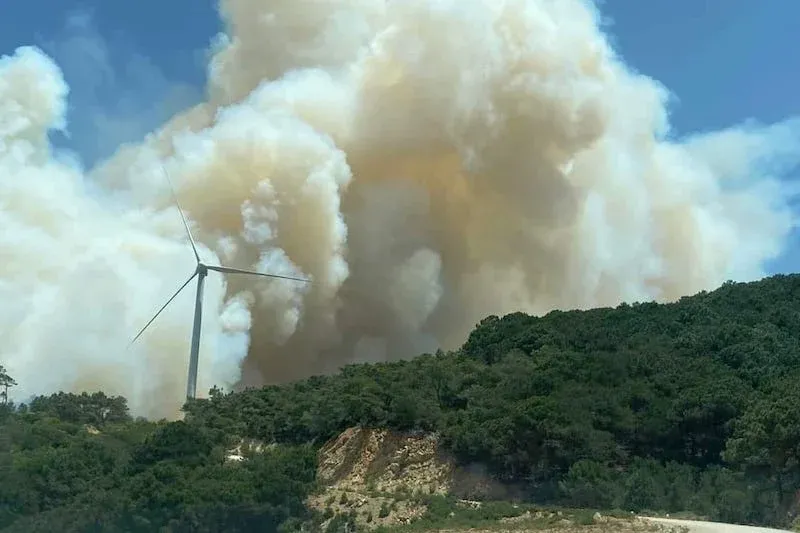

Rising Temperatures and Fire Warnings in Morocco
In recent days, various regions across Morocco have experienced a significant increase in temperatures, coinciding with international alerts concerning the potential for more intense heatwaves this year. These climatic shifts raise alarm over the escalating risks of wildfires in forests and agricultural areas. The National Agency for Water and Forests has issued a national warning bulletin regarding the risk of forest fires, urging residents and visitors to exercise caution, particularly in areas classified as having extreme and high risk levels.
The agency explained that risk forecasting maps were developed based on scientific data, which includes the nature of forest cover and its flammability, in addition to climate predictions and the topographical conditions of the areas concerned. Regions such as Kenitra, Khmissat, Rabat, Salé, and Skhirat-Témara have been classified under the “extreme risk” category, while areas like Chefchaouen, Fahs-Anjra, Tangier-Assilah, Ifrane, Taounate, Essaouira, and Agadir Ida Ou Tanane fall under the “high risk” level. The “medium risk” category encompasses regions like Larache, Ouezzane, Tetouan, M'diq-Fnideq, and Taza.
Expert Insights on Climate Change and Fire Preparedness
Environmental expert Mustafa Al-Aissat emphasized that international reports, including those from the United Nations and the European Weather Observatory, have warned that the El Niño phenomenon this year will be more intense. This climate phenomenon is associated with warm winds from the Pacific Ocean, contributing indirectly to increased temperatures as its effects travel across the Atlantic towards Southern Europe and North Africa. Al-Aissat noted that such warnings should be accompanied by stricter preventive measures, especially as Morocco has experienced a significant rainy season that has led to dense growth of seasonal grasses and plants. These, in turn, become highly combustible with rising temperatures, creating favorable conditions for fires to ignite and spread.
Moreover, the influx of tourists and visitors to forested areas during the summer exacerbates the risks, especially with some irresponsible behaviors, such as discarding cigarette butts or glass bottles, which can directly ignite fires. Al-Aissat stressed the importance of enhancing awareness campaigns and improving readiness among vigilance and intervention committees, which include civil protection services, local authorities, the Royal Armed Forces, and the Royal Gendarmerie. He pointed out that Morocco has accumulated significant capabilities in combating fires in recent years, utilizing “Canadair” aircraft and satellite-based aerial monitoring tools, as well as early warning centers in areas identified as hotspots for recurrent fires.
Al-Aissat also noted that the northern regions, oases, and southeastern areas remain among the most vulnerable to these risks, urging a serious approach to the implications of rapid climate change. He warned about the environmental and economic repercussions of fires, particularly on biodiversity and food security. The fires that have affected agricultural fields in several regions of Chaouia highlight the potential losses that could impact the agricultural sector, especially in a year that has recorded positive agricultural production outcomes. He emphasized that losing a single hectare of forest not only means losing vegetative cover but also leads to the destruction of thousands of living organisms, including insects, birds, mammals, and reptiles, along with the damage inflicted on livestock and rural populations dependent on forest and agricultural resources.
Al-Aissat believes that addressing these challenges requires a collective mobilization involving authorities, institutions, civil society, and citizens to protect natural resources and mitigate the risks of what he describes as “environmental crime” resulting from negligence and irresponsible behaviors.
Meanwhile, environmental expert Abd Rahim Hindouf warned that the temperatures recorded in recent weeks are significantly higher than the usual averages for this time of year, indicating a clear reflection of the impacts of climate change that have become more pronounced in Morocco and the Mediterranean region. He explained that the normal temperature averages for May are considerably lower than the current readings, which have reached between 38 and 39 degrees Celsius in some areas—a level not typically seen during this season.
Hindouf added that several European countries are also experiencing unprecedented heatwaves not seen for decades, confirming that rising temperatures directly increase the risks of fires, particularly in grain fields. He noted that the causes of fires are not solely natural; they can also be linked to human behaviors or ordinary professional activities, urging extreme caution during heat periods.
He emphasized that prevention remains the most effective means of reducing these risks, asserting that addressing fire hazards during elevated temperatures is not solely the responsibility of civil protection and relevant authorities but fundamentally begins with raising awareness among citizens and promoting a culture of prevention.
Hindouf warned that certain flammable materials, including plastics and various waste, can become a danger when left under direct sunlight and high temperatures, necessitating increased caution and attention during this period. He reiterated that awareness and education serve as the first line of defense against fires, calling for intensive communication campaigns across various media platforms and social networks, involving relevant sectors, particularly the National Agency for Water and Forests and the Ministry of Agriculture, to instill preventive behaviors among citizens.
He proposed the continuous dissemination of awareness messages during high-risk periods through radio stations, television channels, and digital platforms, broadcasting regular alerts and guidelines to remind citizens of the necessary actions to prevent fires.
As reported by hespress.com.