
Morocco's Call for Global Attention to Security and Climate Issues
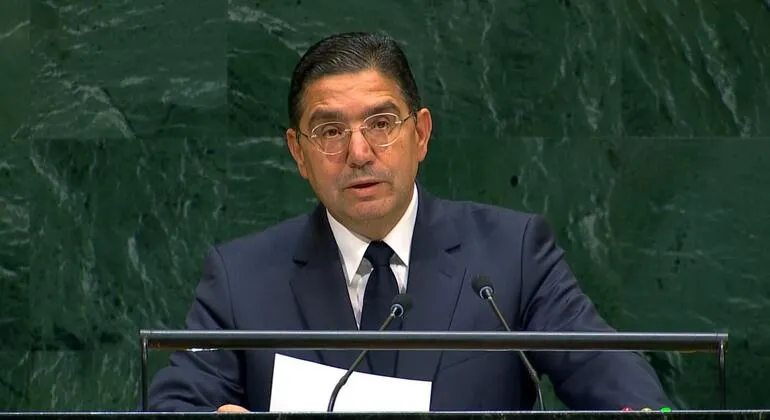
During the recent high-level general debate at the United Nations General Assembly, Moroccan Foreign Minister Nasser Bourita emphasized the urgent need for the international community to prioritize three critical issues. These include combating non-state armed groups, addressing climate change and its impacts, and tackling regional challenges, particularly in the Middle East and Africa. Bourita articulated that the threat posed by non-state armed groups has intensified, as they now seek to control maritime routes and straits, thereby jeopardizing freedom of navigation and targeting infrastructures across various nations. He noted that over one million people currently reside in regions dominated by armed groups or experiencing disputes over control.
Bourita urged for the implementation of strict sanctions against these groups and their backers, holding accountable anyone who provides support, funding, or arms to them. Transitioning to the topic of climate change, he underscored that achieving peace and development is unattainable without effectively addressing this pressing global challenge. He highlighted Morocco's vulnerabilities as one of the countries most affected by climate change, despite its minimal contribution to greenhouse gas emissions. The Minister referenced the proactive policies adopted by King Mohammed VI, which include the construction of dams, linking water basins, desalinating seawater, recycling treated wastewater, and optimizing water resource management.
Commitment to Peace in the Middle East
In discussing the Middle East, Bourita reaffirmed Morocco's belief that sustainable peace in the region hinges on the establishment of a sovereign and viable Palestinian state along the June 4, 1967 borders, with East Jerusalem as its capital, coexisting peacefully alongside Israel. He announced Morocco's decision to contribute to the international force aimed at stabilizing Gaza and to engage in humanitarian and security initiatives to foster an environment of peace and security. This includes training Palestinian police forces and deploying senior military officers to internal security forces, as well as establishing a field hospital and leading programs to combat extremism.
Bourita also expressed concerns about recent developments in the West Bank, particularly the passing of laws that affect the legal status of Palestinian territories and facilitate land seizures for settlement expansion, alongside the systematic violence perpetrated by settlers against Palestinian citizens. He voiced deep concern over Israel's unilateral actions and repeated violations of the sanctity of Al-Aqsa Mosque, describing these as grave transgressions that exacerbate extremism and hatred.
Notably, Bourita mentioned King Mohammed VI's ongoing efforts, as Chairman of the Al-Quds Committee, to preserve the historical, cultural, and spiritual identity of the holy city and to enhance the living conditions of its inhabitants. He also touched upon UN Security Council Resolution 2797, adopted in October 2025, which calls upon the parties to enter discussions "without preconditions based on Morocco's autonomy proposal, aiming for a definitive political solution accepted by the parties that ensures the right to self-determination for the people of Western Sahara."
In his remarks, Bourita stated, "Since that time, this regional conflict has taken an irreversible path towards breaking with the past and looking to the future for its final resolution." He added that this path is based on principles defined by the Security Council, including the absence of solutions "outside the framework of autonomy under Moroccan sovereignty."
As reported by news.un.org.