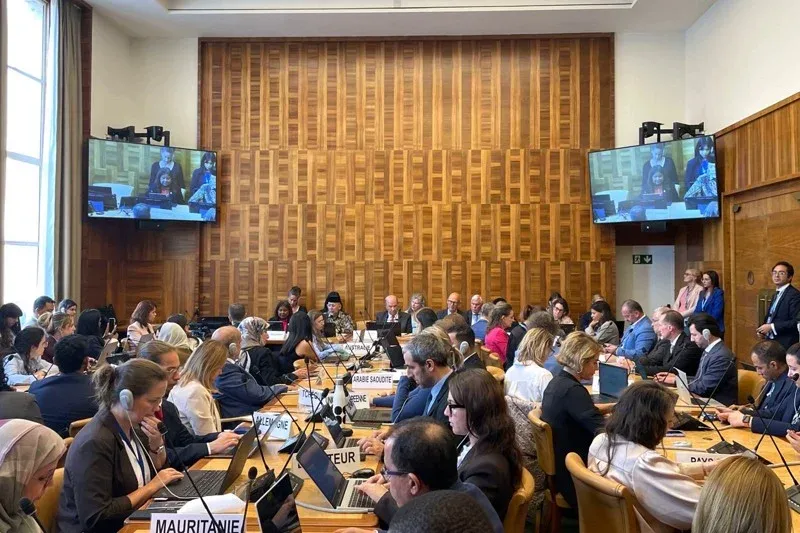

On Thursday, Morocco organized a parallel event at the Palace of Nations in Geneva, coinciding with the 63rd session of the Human Rights Council. This event was dedicated to enhancing the process of the Universal Periodic Review (UPR), marking the 20th anniversary of the establishment of this mechanism and approaching its fifth session.
The meeting, held under the banner "From Rabat to Geneva... Strengthening the Universal Periodic Review Process for Transformative Impact in Human Rights," was organized in partnership with the United Nations High Commissioner for Human Rights and the UPR Info organization. It witnessed substantial participation from permanent missions accredited to the United Nations, representatives of UN organizations, international experts, and civil society representatives.
In his opening speech, Omar Zineber, the Permanent Representative of Morocco to Geneva, emphasized that this gathering is a continuation of the international retreat held on June 5 and 6, 2026, in Rabat, which brought together the President of the Human Rights Council and 26 government representatives, along with representatives from UN agencies, civil society, academia, and independent experts.
Zineber explained that the work of the Rabat retreat aimed to achieve a dual objective: to assess the achievements and lessons learned from the UPR process and to contemplate ways to enhance its essential effectiveness as the fifth session approaches. He asserted that Morocco's interest in the UPR is neither superficial nor temporary, reminding attendees that this commitment aligns with the kingdom's dedication to multilateral cooperation based on dialogue aimed at producing tangible impacts on the ground.
The ambassador also recalled Morocco's pivotal role in the inception of this mechanism, particularly as a facilitator for its establishment in 2006, the formulation of its working methods in 2008, and the review process of the mechanism in 2021. In presenting key insights from the Rabat retreat, the ambassador stressed the necessity of placing implementation at the core of the fifth session, ensuring that recommendations are translated into legislation, public policies, and institutional reforms that lead to substantial improvements in the enjoyment of human rights.
He further highlighted the importance of the quality of recommendations, which should be specific, targeted, measurable, and actionable, as well as the need for national ownership through the involvement of ministerial sectors, parliaments, judicial actors, local authorities, national human rights institutions, and civil society. Zineber also underscored the critical role of national mechanisms for implementation, reporting, and follow-up as a vital link between Geneva and the reality of human rights on the ground.
Additionally, he discussed the potential contribution of digital tools in tracking recommendations, emphasizing the necessity of utilizing them in a transparent, inclusive manner that complies with international human rights law. Cooperation, technical assistance, capacity building, and peer exchange, along with South-South cooperation and triangular cooperation, were identified in Rabat as essential mechanisms to enhance the sustainable implementation of recommendations.
In this context, participants praised the two voluntary funds managed by the UN High Commissioner for Human Rights, dedicated to supporting participation and implementation efforts. The ambassador clarified that the outcomes of the Rabat retreat do not represent a "final plan"; rather, some proposals achieved broad consensus, while others require further discussion. He noted that the Geneva meeting aims to broaden the dialogue and share these outcomes with members of the international community to enrich the discourse about the fifth session.
The event featured significant contributions from the President of the Human Rights Council, Sidharto Raza Suryodibroto, the Ambassador of Indonesia, and ambassadors from Norway, Maldives, and Kenya, as well as Juliet De Rivero, Head of the UPR Branch at the UN High Commissioner for Human Rights, and Mona Mbikayi, Executive Director of UPR Info. They commended the extensive participation in this meeting, deeming it a testament to the relevance of the subject and the validity of the Rabat retreat.
As reported by hespress.com.