
Morocco's Economic Advancements Highlighted at OECD Council Meeting
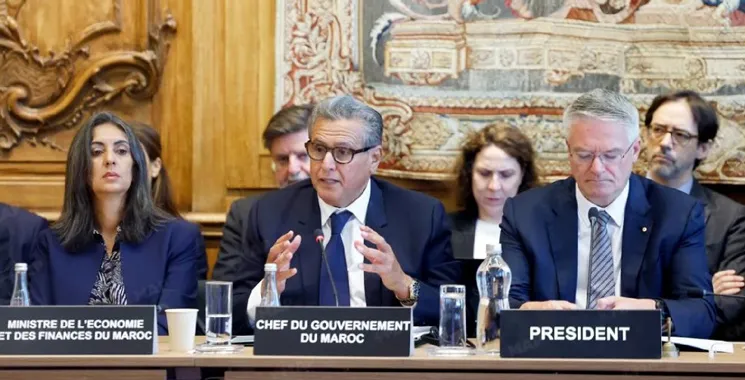
On September 8, 2026, Aziz Akhannouch, the Head of Government of Morocco, delivered an insightful presentation regarding the country’s macroeconomic and social achievements during a session of the Organization for Economic Co-operation and Development (OECD) Council held in Paris. This pivotal meeting underscored Morocco's ambition to enhance its economic competitiveness and to establish itself as a stable anchor within the region of Africa and the larger euro-Atlantic area. Accompanying Akhannouch was the Minister of Economy and Finance, Nadia Fettah, who collectively articulated the significant strides Morocco has made under the steadfast leadership of King Mohammed VI, who has been described as a fundamental pillar ensuring continuity in public policy.
Akhannouch emphasized Morocco’s commitment to maintaining its developmental trajectory even amid challenging global circumstances characterized by geopolitical unrest, rampant inflation, and a reconfiguration of international supply chains. He highlighted the nation's strategic efforts to fortify its social framework, invest in human capital, optimize its production capabilities, and uphold macroeconomic stability. According to the latest figures from the High Commission for Planning (HCP), Morocco's Gross Domestic Product (GDP) exhibited a robust growth rate of 4.9% in 2025, a notable increase from 4.4% in the previous year. Furthermore, the country successfully managed to lower inflation rates, achieving 0.9% in 2024 and an even lower rate of 0.8% in 2025.
In terms of fiscal health, the budget deficit was reported at 3.5% of GDP for 2025. Turning to social initiatives, Akhannouch lauded the significant expansion of social protection measures, which have provided monthly financial support to vulnerable families and facilitated the renovation of primary healthcare facilities alongside substantial educational reforms. Since the introduction of the new Investment Charter, a total of 381 projects have been greenlit, amounting to an impressive MAD 581 billion (approximately $58.1 billion), which are anticipated to create around 245,000 jobs, both directly and indirectly. Notably, the automotive sector was highlighted as a key beneficiary of these developments.
Additionally, Akhannouch pointed to Morocco's role as a co-host for the upcoming 2030 FIFA World Cup alongside Spain and Portugal. He framed this international sporting event as more than just a competition; instead, he argued that the infrastructural developments being undertaken must primarily serve the needs of Moroccan citizens, local communities, and the broader economy well beyond the year 2030. This proactive approach encapsulates Morocco's vision for sustainable growth and its aspiration to emerge as a leader in the region.
As reported by northafricapost.com.