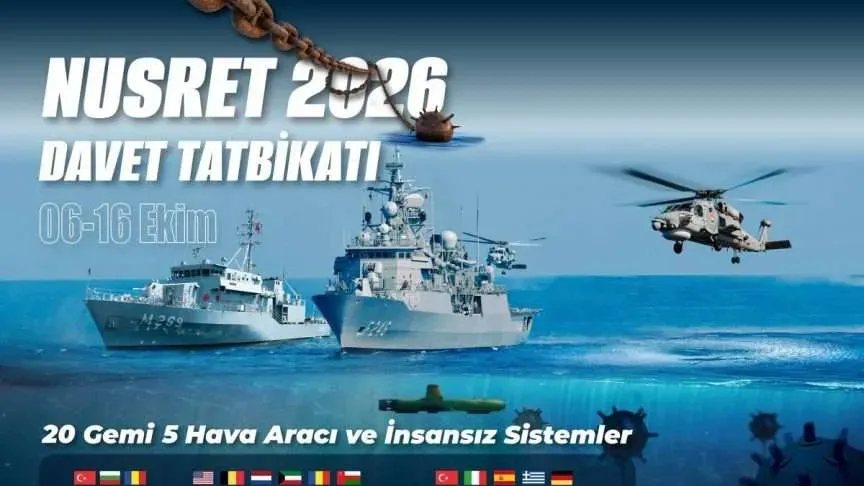

Morocco has been selected as one of the seventeen countries to participate in the upcoming Nusret-2026 international mine warfare exercise, scheduled to take place from October 6 to October 16 in the Izmir Gulf and off the coast of Ereğli in the Black Sea. This significant event will involve the collaboration of twenty naval vessels, five aircraft, and unmanned systems from twelve different nations, as announced on Sunday, October 4, by Turkey's Ministry of National Defense (MSB, Millî Savunma Bakanlığı). This marks Morocco's continued commitment to enhancing its military capabilities and international cooperation in maritime security.
Previously, Morocco had dispatched observers to the 2025 edition of the exercise, which occurred from October 24 to October 31 in the Saros Gulf, situated to the north of the Aegean Sea, where they were among 44 foreign observers. Additionally, Moroccan officers attended the Turkish underwater rescue exercise, Kurtaran-2026, held from April 15 to April 21 off the Aksaz naval base along the Aegean coast, alongside representatives from twelve other nations, including Egypt, the United Arab Emirates, and Indonesia. This year, with Gabon and Cameroon, Morocco stands out as one of the three African nations invited to participate in Nusret-2026, making it the sole representative from the Maghreb region.
The involvement of Moroccan observers aligns with the military rapprochement initiated in 2021, particularly with the Turkish industrial firm Baykar. Starting in September 2021, the Royal Armed Forces of Morocco (FAR) began receiving Bayraktar TB2 drones as part of a contract for thirteen units valued at approximately $70 million (around 650 million dirhams). Furthermore, in early 2025, Morocco is expected to receive its first batch of Akinci drones ordered in 2023. In addition, the Moroccan military has acquired Koral electronic warfare systems from the Turkish public group Aselsan for over 510 million dirhams. According to a study by the South Korean brokerage firm Mirae Asset Securities, the Royal Navy is considering the procurement of three submarines by 2027, although no contracts have been finalized to date.
International Collaboration in Mine Warfare
Turkey will deploy its naval vessels, air force aircraft, and coast guard units in conjunction with two multinational formations: NATO's Standing Maritime Mine Countermeasures Group 2 (SNMCMG-2), which comprises units from Germany, Spain, Italy, Greece, and Turkey, and the Black Sea Mine Countermeasures Group, formed by Bulgaria, Romania, and Turkey. Teams specializing in explosive ordnance disposal and autonomous underwater vehicles from the United States, Belgium, the Netherlands, Kuwait, Romania, and Oman will also contribute to this exercise. The scenarios will focus on detecting, identifying, and neutralizing mines in the maritime routes of the Aegean and Black Seas, as noted by the MSB. Observers will also come from a diverse array of countries, including Albania, Azerbaijan, Bahrain, Bangladesh, Belgium, Bulgaria, Cameroon, South Korea, France, Gabon, Iraq, Jordan, Kuwait, Malaysia, Singapore, and Ukraine, which has faced maritime mine threats since the early weeks of its conflict with Russia in February 2022.
The segment conducted off the coast of Ereğli addresses a pressing threat to commercial navigation, with the MSB reporting 275 suspicious objects in the Black Sea (including drifting mines, kamikaze drones, and unmanned surface vessels) since the onset of the war in Ukraine. On January 11, 2024, Turkey, Romania, and Bulgaria signed a memorandum in Istanbul to establish the MCM Black Sea group for a three-year duration. The commander of the Turkish mine fleet, Rear Admiral Birol Orak, indicated that the 2025 edition would feature training exercises aimed at addressing the threat of drifting mines and the removal of anchor mines in the Black Sea following the conflict between Russia and Ukraine. Mines detected by sonar from mine hunters and autonomous underwater vehicles will be neutralized by divers capable of operating at depths of up to 45 meters.
Historical Significance of Nusret Exercise
The annual exercise, organized by the Turkish navy, is named after the Ottoman mine layer Nusret, which famously laid 26 mines in the Dardanelles Strait on the night of March 7-8, 1915. This blockade resulted in significant losses for the Franco-British fleet, including the sinking of the French battleship Bouvet and the British battleships Irresistible and Ocean, along with damage to the battlecruiser Inflexible. This failure ultimately forced the Allies to abandon their plans to force the strait by sea and prompted preparations for the Gallipoli landing. The Turkish announcement did not specify the number of Moroccan observers, leading to the use of the general phrasing, and the Turkish list mentions South Korea twice (“Güney Kore” and “Kore Cumhuriyeti”), amounting to a total of seventeen distinct states.
As reported by barlamane.com.