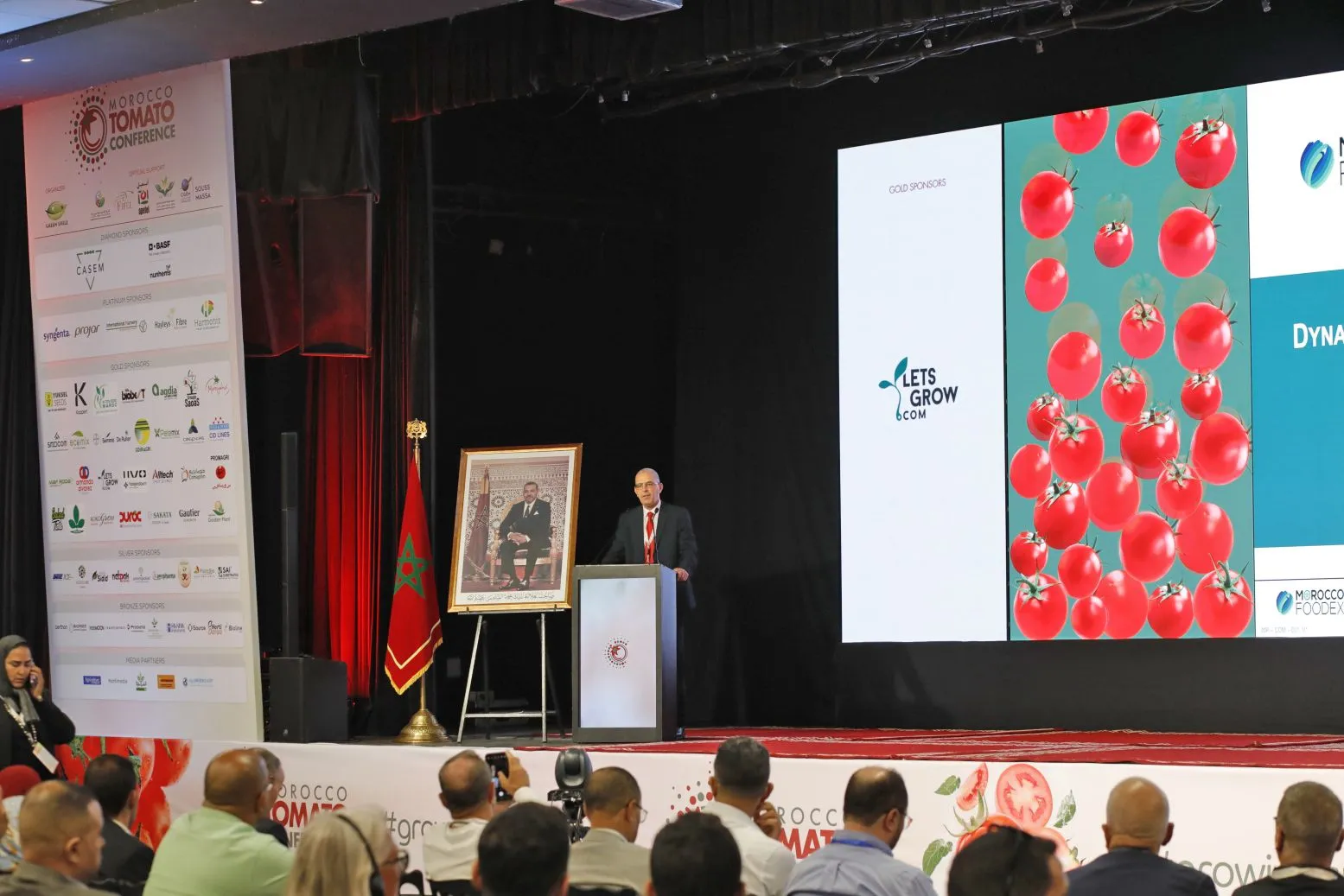

The 6th edition of the Morocco Tomato Conference took place on May 21, 2026, at the Dunes d'Or conference hall in Agadir, marking a significant milestone in the Moroccan tomato industry. The conference underscored Morocco's impressive rise to become the world's third-largest exporter of fresh tomatoes by value, trailing only Mexico and the Netherlands. However, it also highlighted the challenges faced during the 2025-2026 campaign and indicated that the sector is entering a phase where competitiveness will increasingly hinge not just on production volumes but also on carbon footprints and climate resilience.
On that day, over 700 participants from 22 countries gathered for this pivotal event, themed "Shaping a Sustainable Future for Tomato Trade." Organized by Green Smile in collaboration with the Interprofessional Federation of Fruits and Vegetables (FIFEL) and the Souss-Massa Agricultural Chamber, the conference featured 55 exhibitors representing the entire supply chain, from seed suppliers to traders.
Statistically, Morocco finds itself in a favorable position within the global tomato market, despite its production base experiencing one of the most challenging seasons in recent memory, compounded by increasingly stringent international trade regulations focused on environmental criteria. According to figures presented by Ali Rougui, head of strategic monitoring at Morocco Foodex, the public agency responsible for promoting agro-food exports, the global fresh tomato trade reached 7.2 million tons in 2025, valued at approximately $11.6 billion. Morocco has established itself as the third-largest exporter by value, claiming an 11.2% market share.
Moroccan tomato exports surged from $856 million in 2021 to $1.307 billion in 2025, showcasing an impressive average annual growth rate of 11%, in stark contrast to the 1% growth in Mexico and 3% in the Netherlands during the same period. Europe remains the driving force behind this growth, absorbing 93% of Moroccan exports, with shipments to the European Union hitting $1.4 billion in 2025, accounting for 23% of the EU's fresh tomato imports. In the UK market, Morocco now commands a 25% market share by value, surpassing Spain. This ascent coincides with a decline in European production; projections indicate that EU tomato production will decrease from 16.95 million tons in 2025 to 16.56 million tons by 2028 due to rising energy costs and environmental constraints.
Challenges Faced in the 2025-2026 Campaign
However, the outlook presented by Zakaria Hanich, president of FIFEL, painted a more sobering picture for the current campaign. By April 30, 2026, Moroccan exports had reached only 549,000 tons, reflecting an 11% year-on-year decline. Round tomatoes saw a 15% drop, while segmented varieties fell by 8%. The decrease was widespread, with a notable 46% plunge in exports to Gulf countries. Hanich cited adverse weather conditions, including storms, cold snaps, and heat waves, alongside persistent phytosanitary pressures and rising production costs. He noted that the cost of production has escalated from around 3 dirhams to 5 or 6 dirhams per kilogram, leading to a reduction of 5 to 10% in planted tomato acreage this season as several small producers pivoted towards less exposed crops like peppers.
Furthermore, the Tomato Brown Rugose Fruit Virus (ToBRFV) has emerged as a significant threat within the industry. Reports from various producers indicate that round and beef tomato varieties remain particularly susceptible, while new resistant cherry tomato varieties show promising results. A producer from Chtouka mentioned that about thirty varieties had been tested unsuccessfully in the region, underscoring the consensus that there is no miracle solution; success hinges on rigorous sanitary protocols and effective management practices.
Carbon Footprint and Future Prospects
The issue of carbon emissions was another critical topic discussed at the conference. The European Union is gradually implementing its Carbon Border Adjustment Mechanism (CBAM), which integrates the cost of emissions into trade. Data shared during the conference revealed that Morocco's net greenhouse gas emissions rose from 72.9 to 98.9 megatons of CO₂ equivalent between 2010 and 2022, with agriculture accounting for nearly 19% of this figure. John Alistair Clarke, former chief agricultural negotiator for the EU, posited that Europe will remain heavily reliant on Moroccan supplies, but emphasized that expectations regarding residues, carbon footprints, and traceability will continue to toughen. He cautioned against the rising tide of European agricultural protectionism and the effects of Ukraine's gradual integration into the EU agricultural space.
On the social front, Othman El Qacemi, president of the Moroccan Association of Agricultural Human Resources Directors, raised alarms about the structural nature of the agricultural labor shortage, exacerbated by urbanization, demographic decline, and inter-industry competition. The tomato sector requires between 80 to 100 workdays per hectare, compared to up to 250 for red fruits, intensifying the pressure on labor availability.
Furthermore, a comparative analysis with Mexico was presented by Jorge Flores Velázquez, a researcher at the Colegio de Postgraduados in Mexico. He highlighted the climatic similarities between certain Mexican regions and southern Morocco, stressing the importance of smart greenhouses, climate control, and automated irrigation in enhancing agricultural performance. Hicham Fatmassi, a researcher at INRA Avignon, noted that Agadir's climatic conditions provide a real advantage for protected agriculture. However, the territorial concentration of the model remains a concern, with 98% of Moroccan tomato exports originating solely from the Souss-Massa region, exposing the sector to water stress.
As reported by maroc-hebdo.com.