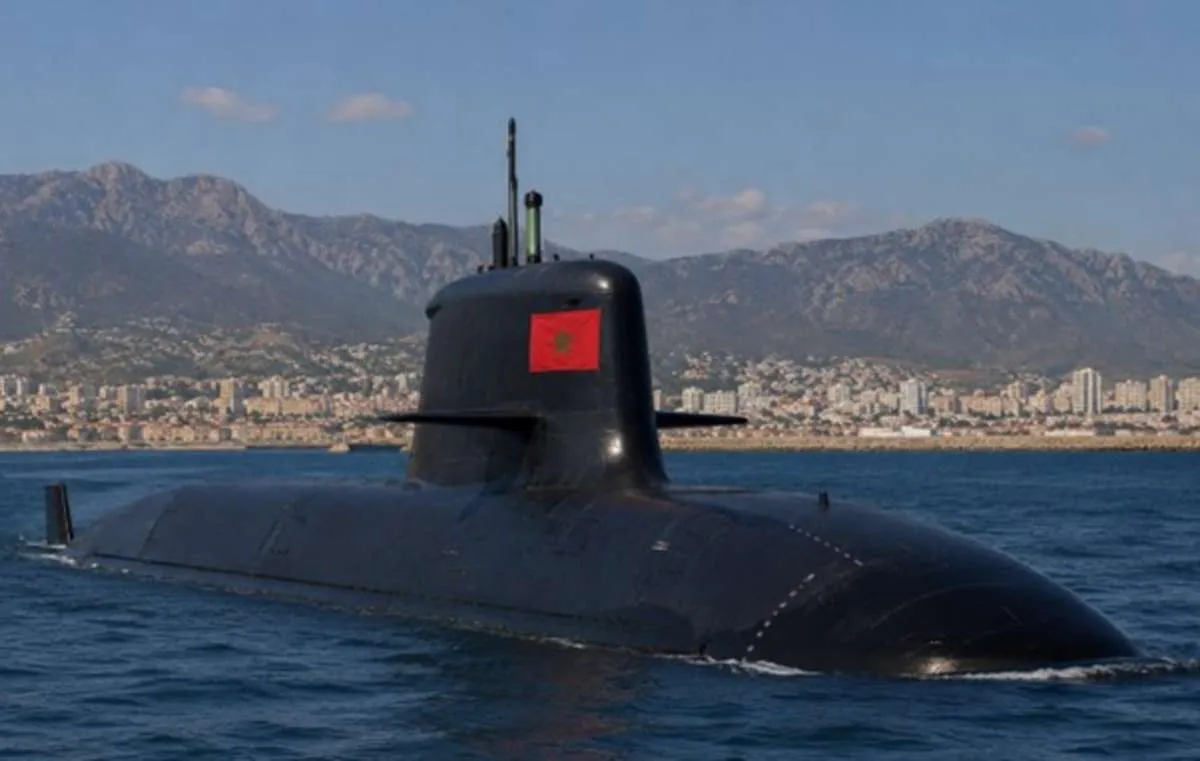

Morocco's Submarine Aspirations and the Geopolitical Landscape
Morocco is poised to enhance its naval capabilities by acquiring three submarines before the year 2027, entering a competitive bidding scenario involving France, South Korea, and Germany. While Navantia possesses the necessary technology, shipyard facilities, and a strong bilateral relationship, the reality is that its current fleet of four S-80 submarines is committed to the Spanish Navy until 2030, and an export-certified version has yet to be developed. This situation raises significant concerns: should Spain consider transferring its submarine technology to a neighboring country that it has historically viewed with suspicion?
Geographically, Morocco and Spain share the same strategic maritime corridor, but decades of mutual distrust complicate their relationship, and no arms contract has resolved this underlying tension. A critical question remains unaddressed: could a Moroccan submarine one day traverse the Strait of Gibraltar not for patrol purposes, but for potential offensive operations?
Challenges in Production and Political Implications
The Cartagena shipyard is currently busy with the simultaneous construction of the S-83 and S-84 submarines, scheduled for delivery in 2028 and 2030, respectively. The S-82 was launched in 2024 and must undergo several months of harbor tests before being integrated into the Navy. The Spanish Ministry of Defense is also contemplating expanding the series to six units, which would include the S-85 and S-86. Although Navantia has the technical capacity to overlap the construction of two hulls, it lacks available slots for external clients in the foreseeable future. Given that Morocco aims to finalize its plans by 2027, the timelines do not align.
Additionally, a recent agreement signed in April 2026 between Navantia and the German company TKMS to produce German-designed submarines in Spain further complicates the production timeline. The partnership acknowledges existing capacity bottlenecks in European shipyards, emphasizing the need for industrial integration rather than adding pressure to an already saturated production line.
Aside from scheduling issues, there is a significant product challenge. As it stands, the S-80 Plus is specifically designed and certified for the Spanish Navy, with no approved export version available. The necessary technology transfer processes, long-term support agreements, and combat system adaptations required for an international sale have not yet been established. The program has faced escalating costs over the decades, with initial estimates of €1.8 billion ballooning to €4.339 billion by 2025. Currently, the industry's efforts are focused on completing the original series rather than preparing it for market release. Developing an export variant from the ground up would take years and investment commitments that are yet to materialize.
Even if timelines and product availability were feasible, the political implications cannot be overlooked. Selling a submarine to Morocco transcends the mere transaction of a patrol vessel; it involves the transfer of denied access capabilities in the strategic Strait of Gibraltar, a critical maritime passage for both NATO and Spain. The prospect of a Moroccan submarine equipped with Spanish technology patrolling these waters presents a scenario that the Spanish Ministry of Defense would need to evaluate with considerations that extend far beyond industrial profitability.
The regional context further complicates matters, as Morocco justifies its submarine program, in part, as a countermeasure against Algeria, which currently operates six Russian-made submarines. Spain has energy agreements with Algeria that are crucial for its gas supply, and the balance of power in the Western Mediterranean is not a neutral playing field for Madrid. With Spain effectively sidelined in this strategic race, the competition narrows to the Scorpène from Naval Group, the advanced export variant Dolphin 2 based on the Class 212 built by TKMS, and South Korea's KSS-III, which Hanwha Ocean has been actively promoting in markets such as Canada and North Africa.
In a recent development, Moroccan observers and officials participated in the Turkish exercise Kurtaran-2026, focused on submarine rescue operations, indicating that Rabat is not only interested in acquiring platforms but also in building comprehensive operational capabilities from the outset.
In conclusion, Spain possesses the technology, shipbuilding capacity, and even a cooperative bilateral relationship; however, it lacks the available product, the open schedule, and possibly the political will to sell its southern neighbor the very tool that complicates control over the world's most monitored maritime corridor.
As reported by escudodigital.com.