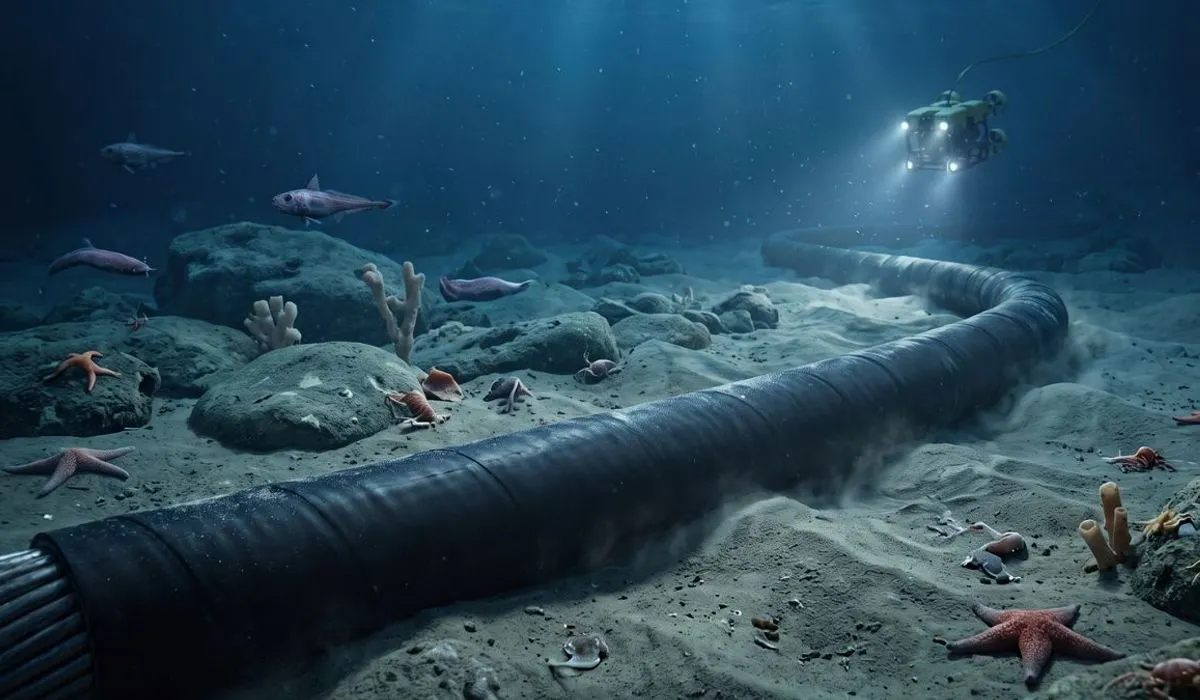

On September 23, 2026, Morocco unveiled its ambitious plan to establish an undersea cable that will supply affordable renewable energy directly to France, circumventing any connections that pass through Spain. This strategic move aims to position Morocco as a key player in Europe’s energy landscape, especially after a previous attempt to connect with the United Kingdom failed due to its exorbitant costs. The initiative is intended to eliminate reliance on the Spanish government while leveraging Morocco's abundant renewable energy resources.
The undersea cable project, named Qantara Med, is set to stretch approximately 1,400 kilometers from the northern port city of Nador to Marseille, France, effectively allowing Morocco to export its surplus energy production. This development places Morocco in direct competition with Spain, which has been a significant contributor to renewable energy supplies in Europe through its connections in the Pyrenees.
The Previous Attempt with the UK
Historically, Morocco had aimed to establish itself as Europe’s energy ally with the Morocco-UK Power Link, a project spearheaded by the British company Xlinks. This ambitious plan intended to construct a high-voltage direct current (HVDC) undersea cable that would transport electricity generated from solar panels and wind turbines located in Morocco's Agadir desert to homes in the UK, covering a staggering distance of around 3,800 kilometers. However, the estimated investment of £21.9 billion—equivalent to four times Spain's annual defense budget—was deemed unfeasible due to a lack of long-term price assurance contracts from the UK government. Consequently, Xlinks abandoned the project in 2024.
The new cable initiative, however, is not merely a reincarnation of the previous project but rather a strategically distinct endeavor. By focusing on a shorter route from Nador to France, the logistics become significantly more manageable, with the distance reduced by over 2,000 kilometers compared to the UK plan. The proposed HVDC technology remains the same, allowing efficient electricity transport with minimal losses.
Avoiding Spanish Waters
One of the most intriguing aspects of the new cable route is its deliberate avoidance of Spanish territory. The design circumvents the Iberian Peninsula entirely, bypassing the Strait of Gibraltar and not entering Spanish territorial waters. This strategic choice has profound political and economic implications, as Spain has long been a bottleneck for electricity and gas connections between North Africa and Central Europe. Currently, the limited capacity of interconnections between Spain and France restricts any substantial export ambitions from both Spanish and Moroccan renewable projects.
Morocco has been aggressively pursuing renewable energy expansion, aiming for renewables to account for 52% of its installed electrical capacity by 2030. The Noor Ouarzazate solar plant, with over 500 megawatts of capacity, stands as a continental benchmark. The country’s solar irradiance levels significantly exceed those of Germany or France, positioning Morocco as a natural exporter of clean energy to Europe, which is increasingly focused on decarbonizing its electricity mix before 2050.
However, the undersea cable project faces substantial challenges. Financially, constructing a 1,400-kilometer HVDC cable is expected to cost at least €3 billion under favorable conditions, a figure that can escalate based on geological difficulties or extended timelines. Furthermore, regulatory hurdles exist, including the need for the European Union to recognize Morocco as a third country integrated into the European energy market, a process that would require significant political negotiations.
Ultimately, Morocco's undersea cable project represents more than just an engineering endeavor; it illustrates the shifting dynamics within Europe's energy landscape. Should this cable materialize, Morocco would effectively achieve a direct electrical highway into the European market, a goal Spain has struggled to realize. As the geopolitical landscape evolves, Madrid must respond to these developments, as the new energy routes could diminish its influence and control in the region.
As reported by vozpopuli.com.