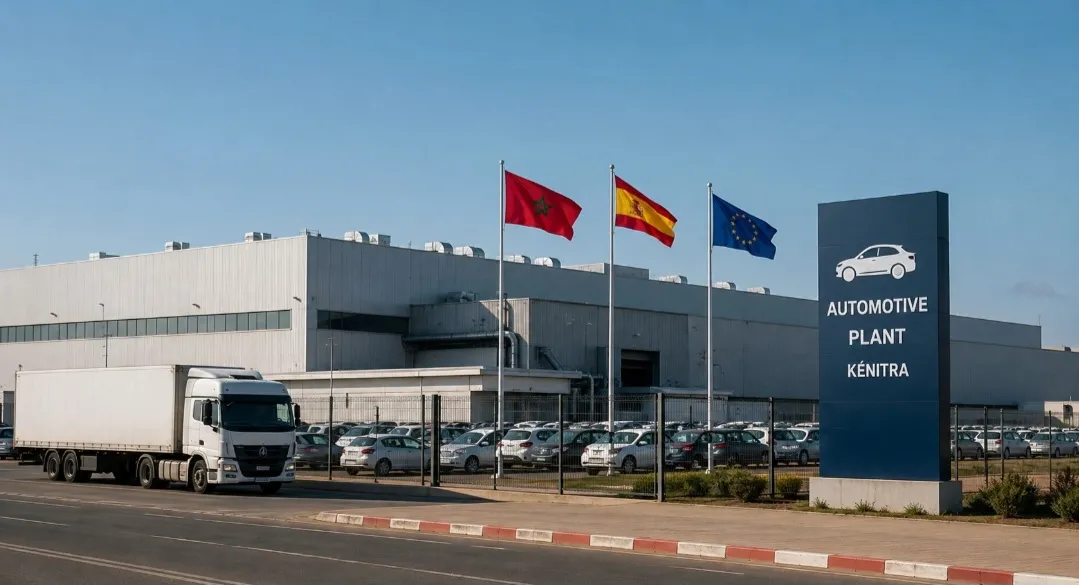

The Rapid Evolution of Morocco's Automotive Sector
The automotive industry in Morocco is undergoing a significant transformation, as the kingdom gradually shifts from traditional assembly and manufacturing processes to developing a comprehensive industrial ecosystem focused on electric vehicles and batteries. This change comes at a time when competition for global investments between Morocco and Spain is intensifying, particularly in light of the ongoing transition within the European automotive industry towards electric vehicles. According to a report published by RUSSPAIN, a site dedicated to Spanish news, Morocco has emerged as one of the most dynamic players in the global automotive sector in recent years. The country is capitalizing on its lower labor costs, a flexible regulatory environment, and its strategic geographic location that links the Atlantic Ocean to the Mediterranean Sea. These factors have attracted Chinese and European investments that were previously more concentrated in Spain.
The report highlights that Spain continues to maintain a strong position within the European automotive industry as the second-largest car producer in Europe, bolstered by a wealth of accumulated industrial expertise and an extensive network of factories belonging to major global companies. However, Morocco has begun to expand its presence within the new value chain associated with electric vehicles, particularly in the battery manufacturing sector. The production of batteries is being viewed as one of the most critical new arenas for competition in the automotive sector, coinciding with the European Union's accelerated push towards electric vehicles and reducing reliance on traditional combustion engines. Morocco aims to solidify its status as a regional hub for this industry, benefiting from foreign investments and government policies designed to develop the industrial sector.
Strategic Projects and Competitive Advantages
Among the projects highlighted in the report is the battery factory established by Chinese company Gotion High-Tech in Kenitra, partially linked to the Volkswagen Group. The investment in this project is around €3.2 billion, with expectations to create approximately 3,000 direct jobs. The production from this facility is intended to supply operations for Stellantis and Volkswagen in Europe. The attractiveness of Morocco for investors in the automotive sector is not solely tied to lower labor costs compared to Spain; it also encompasses a flexible regulatory environment that allows companies greater adaptability to rapid market changes, alongside access to competitively priced renewable energy, supported by European and Spanish investments in this area.
Furthermore, Morocco's geographic location is highlighted as a significant strength in this competition, with the country situated at a maritime crossroads connecting Europe with Africa and Atlantic and Mediterranean markets. This positioning provides its industrial sector with considerable potential for export and supply chains. The report also notes Morocco's advantage in raw materials related to battery production, especially in the Sahara region, describing the kingdom as a preferred partner for the United States in North Africa, due to its strategic location near the Strait of Gibraltar, one of the crucial maritime routes in global trade.
The importance of Moroccan ports, particularly the Tangier-Med Port and the Nador West Med Port, is emphasized, with the expansion of port infrastructure contributing to Morocco's capacity to receive and export vehicles and their components to European markets. The report indicates that vehicles and components manufactured in Morocco benefit from proximity to Europe and reduced transportation costs, linking this to European carbon emission regulations and their impact on supply chain competitiveness. Moroccan ports have thus become an integral part of the automotive export system to Europe.
Conversely, Spain still possesses undeniable strengths, including its extensive experience in the automotive industry, a skilled labor force, and a comprehensive industrial network comprising factories belonging to global companies such as Volkswagen, Stellantis, Renault, Mercedes-Benz, Ford, and Iveco. Furthermore, Spain benefits from its membership in the European Union and the single European market. The report notes that Spain is also working to enhance its position in the electric vehicle sector through massive battery manufacturing projects, including the PowerCo factory owned by Volkswagen in Sagunto and Stellantis's project in Zaragoza in partnership with the Chinese company CATL. Although commercial production at these factories has yet to commence, these projects are expected to bolster Spain's competitive capacity.
As reported by assahifa.com.