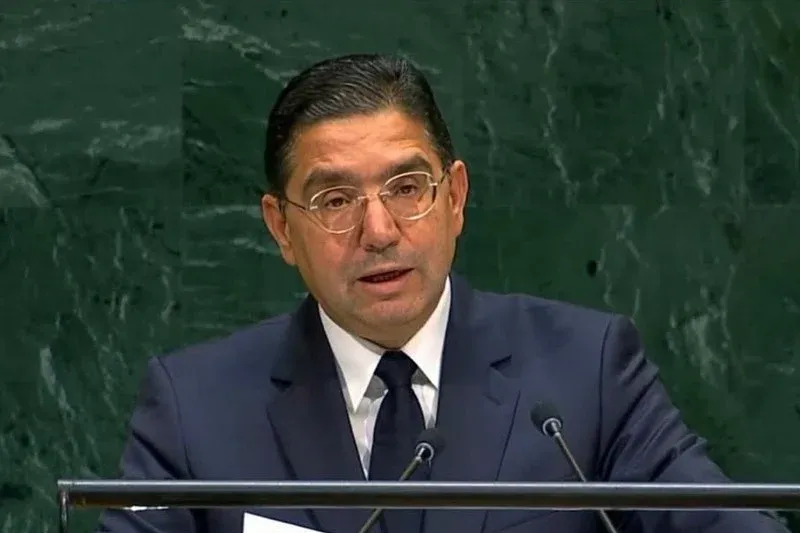

On Tuesday, Nasser Bourita, Morocco's Minister of Foreign Affairs, African Cooperation, and Moroccans Abroad, announced the country's candidacy for a non-permanent seat on the United Nations Security Council for the term 2028-2029. This announcement was made during a speech delivered on behalf of Morocco at the general debate of the 81st session of the UN General Assembly held in New York. In his address, Bourita emphasized that this nomination reflects Morocco's commitment to making a "responsible and effective contribution" to the maintenance of international peace and security, grounded in a realistic and collaborative vision for international cooperation, while fully respecting international law and national sovereignty.
Bourita linked this ambition to a rich Moroccan diplomatic legacy that spans centuries, along with King Mohammed VI's vision of a Morocco that plays an active role in promoting stability and sustainable development. He concluded that the candidacy embodies the kingdom's ongoing contributions to the three pillars of the United Nations: peace, development, and the rule of law.
This nomination comes at a time when several factors intersect: the regional rotation logic within the Arab group for the non-permanent seat, and the sensitive phase in the process of resolving the Moroccan Sahara dispute at the international level. Consequently, political analysts specializing in international relations have interpreted this move as a pivotal moment worthy of examination and analysis.
More Than Just a Diplomatic Achievement
Despite the differing perspectives derived from various articles, both Professor Khalid Chiyat and Professor Lahcen Aqrati, experts in international relations, converge on several key principles. They both assert that Morocco's presence within the Security Council is not merely a ceremonial or diplomatic entitlement but a strategic lever that aligns with a crucial phase in the quest for a final political solution to the Sahara issue.
Moreover, both analysts emphasize Morocco's humanitarian and field contributions (such as aid to Gaza and medical missions along the Jordanian border during the Syrian crisis) while recalling the foundational principles of Moroccan foreign policy, which is rooted in the respect for state sovereignty and the principles of the UN Charter. They both suggest that the seat would serve to fortify the council against "manipulations" from parties opposed to Morocco's sovereignty over its southern territories, directly referencing Algeria. This positioning would also enhance Morocco’s reputation as a reliable UN partner in major security issues such as combating terrorism, irregular migration, and transnational organized crime.
Khalid Chiyat, a professor of international relations at Mohammed I University in Oujda, views Morocco's candidacy as a logical and natural progression in line with the principle of rotation practiced within the Arab bloc for the non-permanent seat, particularly following Algeria's tenure, which he believes was used to voice opposition to Moroccan interests. He underscores the importance of the timing of this nomination, especially given the sensitivity surrounding the search for a definitive resolution to the Sahara issue, arguing that Morocco’s direct presence in the council will have a significant impact on this resolution process.
Chiyat also interprets this nomination as indicative of "implicit international support" for Morocco, stemming from the global community's recognition of the nature of the issue presented to the Security Council. This recognition, in his view, lends additional momentum to the Moroccan approach. He references Bourita’s remarks regarding Morocco's positive international reputation, citing its contributions to peacekeeping missions and its humanitarian role in Gaza through aid delivery to besieged populations, as well as medical missions and field hospitals along the Jordanian border for refugees.
Anticipated Stakes
Lahcen Aqrati, a geopolitical expert and university professor, describes Morocco's pursuit of this seat as a "vital strategic choice," emphasizing that when Morocco participates in international forums, it presents a comprehensive approach based on principles of international law, primarily defending state sovereignty as a fundamental rule for managing the international system. He believes that this presence will help safeguard the Security Council from attempts to undermine the territorial integrity of the kingdom, particularly from Algeria.
Aqrati argues that Morocco’s international standing will render this presence a qualitative addition capable of accelerating the final resolution of the regional conflict, while allowing for adjustments to the dynamics within the council that serve the kingdom's strategic interests. He also adds a geo-strategic dimension, asserting that Morocco, as a key regional player in North and West Africa, plays a pivotal role in securing global trade routes, whether by sea in the Mediterranean and Atlantic or through continental land crossings.
In conclusion, the overarching challenge remains transitional; the candidacy is still in its preliminary phase and will require a diplomatic campaign to garner two-thirds of the votes in the General Assembly during the anticipated election in 2027. Nevertheless, the commentators agree that the true gain extends beyond the seat itself; it offers Morocco a direct platform to advocate for its autonomy initiative, broaden its circle of international partners, and reinforce its image as a committed actor to the principles of the UN Charter at a moment considered the most sensitive in the resolution of the Sahara issue in decades.
As reported by hespress.com.