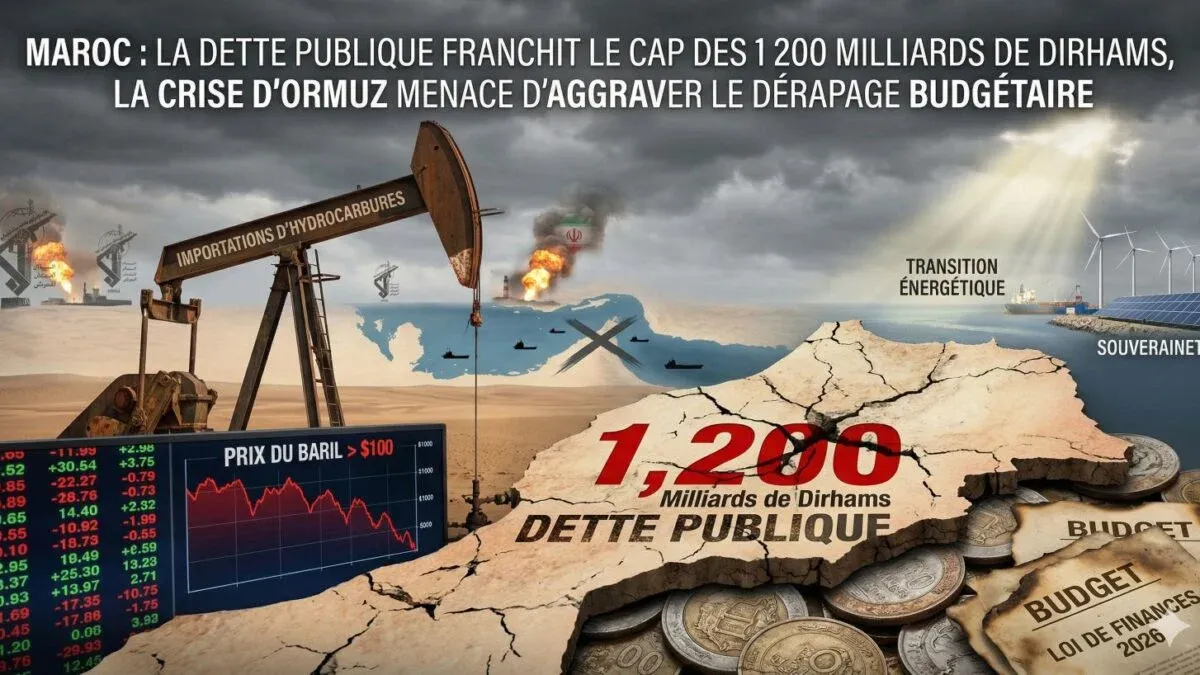

The Moroccan budget for 2026, which was originally based on the assumption of a $65 barrel of oil, now finds itself in a precarious position. The abrupt closure of the Strait of Hormuz has caused oil prices to surge past the significant $100 mark, plunging the Kingdom into a turbulent economic landscape. With an explosive energy bill, critical increases in agricultural input costs, and a staggering public debt nearing 1.211 trillion dirhams, Rabat faces the daunting challenge of navigating these financial waters to maintain fiscal balance and social peace.
The figures are staggering. According to projections from Attijari Global Research (AGR), published in their "Budget Focus" report for January 2026, the Moroccan Treasury's debt is expected to reach 1.211 trillion dirhams by the end of the current year, up from 1.156 trillion in 2025 (approximately €107 billion), marking an increase of nearly 55 billion dirhams within a year. By the end of January 2026, the total debt had already soared to 1.171 trillion dirhams, comprised of 863 billion dirhams of domestic debt and 308 billion dirhams of external debt.
Breaking it down, domestic debt is projected to grow by 4.5%, reaching 887 billion dirhams, while external debt is expected to rise by 5.7%, from 307 billion to 324 billion dirhams. The share of external debt in the total debt remains manageable at 27% by the end of 2026, a level that AGR considers to be within the cautious range of 25-30% typically used for emerging markets.
However, it is the debt service that raises the most concern. According to PCM Capital Global Research, Morocco will need to disburse a record-breaking 108.2 billion dirhams (10 billion euros) in 2026 to meet its obligations, including both interest payments and principal repayments. Capital repayments are set to increase to 64.2 billion dirhams, rising by 2 billion dirhams compared to 2025, due to the maturity of previous issuances in international markets.
The debt-to-GDP ratio, officially targeted at 65.5% under the 2026 finance law, is at risk of deviating significantly from this trajectory if the ongoing oil shock persists. The 2026 finance law was calibrated for a stable global environment, with macroeconomic assumptions including a $65 barrel of oil, an exchange rate of 1.17 euros to the dollar, and an inflation rate capped at 1.3%. This envisioned stability evaporated on February 28, 2026, when joint strikes by the United States and Israel against Iran prompted an immediate response from the Islamic Revolutionary Guard Corps, leading to the closure of the Strait of Hormuz, through which approximately 20% of the world's oil and a fifth of the planet's liquefied natural gas transit. Maritime traffic plummeted from an average of 24 oil tankers per day to virtually none, leaving over 150 vessels immobilized.
The impact on oil prices was immediate and dramatic. The price of Brent crude, which hovered around $60-70 at the beginning of 2026, surged by 20% within the first days of the crisis, exceeding $85 and crossing the psychological barrier of $100 on March 8 for the first time in four years. At the peak of tensions, the price reached $126 per barrel. Goldman Sachs predicts that in a scenario of prolonged disruption lasting five weeks, prices could sustain levels between $100 to $120. Economist Olivier Blanchard even suggests a central scenario of $150 to $200 should structural blockages occur.
For Morocco, the gap between the budgetary assumption of $65 per barrel and the reality of prices fluctuating between $90 and $120 is substantial. As a net importer of nearly all its hydrocarbon needs, the Kingdom's energy bill, estimated to range between $12 and $15 billion annually according to expert Mostapha Labrak, is set to balloon significantly. The early effects are already evident: since March 16, the price of diesel has risen by 2 dirhams per liter, while gasoline has increased by 1.44 dirhams.
Bank Al-Maghrib's governor, Abdellatif Jouahri, acknowledged the extent of uncertainty by stating that "the range of assumptions around oil prices now varies from one extreme to the other," with projections ranging from $79 to $140 depending on the institution.
The shock is not limited to hydrocarbons. The Strait of Hormuz is also a critical route for about one-third of the world's agricultural nutrient exports, including urea, ammonia, sulfur, and phosphates. The Middle East alone accounts for approximately 44% of the world's sulfur, a byproduct of oil refining essential for the production of phosphate fertilizers.
In just two weeks of crisis, the price of urea has surged by nearly 40%, according to market data. Nitrogen fertilizers, produced from natural gas, are seeing their production costs skyrocket due to both rising gas prices and logistical disruptions. Shipping costs have increased by 30% to 50%.
The Moroccan paradox is striking. The Kingdom is the world's leading phosphate producer but still relies on imports of sulfur and ammonia from the Gulf to transform its raw resources into exportable fertilizers (DAP/MAP). Disruptions to these supplies will slow the industrial production of OCP and affect its market share internationally, precisely when the Energy platform highlights that Morocco enjoys a logistical advantage over its Gulf competitors, as it is not dependent on high-risk shipping lanes.
For Moroccan agriculture, already weakened by years of recurring drought, the rise in input costs poses a direct threat. This is particularly concerning given that this year precipitation has been adequate, and 2026 was anticipated to be favorable, with a projected grain harvest of 82 million quintals and a rebound in agricultural added value of 14.4%. However, this positive outlook could be partially offset by rising fertilizer and agricultural fuel costs.
The domino effect is classic yet formidable: rising energy costs drive up agricultural input prices, which in turn elevate food prices, ultimately impacting the purchasing power of the most vulnerable households. Inflation, originally forecasted at 1.3% by the finance law, may prove to be significantly underestimated.
The central question now revolves around how public finances will absorb this shock. The budget deficit, targeted at 3% of GDP (55.4 billion dirhams) by the finance law, already appears untenable if oil prices remain above $100 for several months.
The dilemma facing the government of Aziz Akhannouch is one of transmission. Governor Jouahri poses the question bluntly: "When the barrel reaches $100, will the government pass on the total increase? And what if it reaches $130?" The experience of 2022 remains fresh in memory: the post-Ukraine surge forced the Kingdom to implement a fuel price subsidy, which deepened the compensation burden.
Currently, national stocks of petroleum products cover only about 30 days of consumption, which is half the legal threshold of 60 days. The margin for maneuvering is narrow.
However, Morocco does possess certain advantages. Its sovereign rating of BBB-, obtained in September 2025, grants access to the "Investment Grade" category and more favorable financing conditions than most African economies. The Kingdom can also rely on its flexible credit line with the IMF, termed a "safety net" by Jouahri in the event of an explosion in oil prices. Its debt remains predominantly domestic (73%), fixed-rate (89%), and of long maturity (7 years and 3 months for the domestic component), which limits exposure to refinancing shocks.
Yet, these safeguards may prove inadequate if the Hormuz crisis escalates into a structural energy shock. Each 10% increase in oil prices leads, according to the IMF, to a 40 basis point rise in global inflation and a 0.1 to 0.2% decrease in production. For a country that imports nearly all its fossil energy, the multiplicative effect on the budget deficit, current account deficit, and ultimately public debt could quickly exceed even the most pessimistic assumptions.
On March 12, the new Iranian supreme leader Mojtaba Khamenei declared that the regime would keep the Strait closed. On the same day, reports surfaced of a dozen mines being deployed in the passage. The International Energy Agency released 400 million barrels from strategic reserves, equivalent to four days of global consumption, a historic move but one with limited impact.
For Morocco, the equation is now clear: each additional week of closure of the Strait of Hormuz deepens the chasm between budget forecasts and market realities. The public debt, already on an upward trajectory at 1.211 trillion dirhams, could significantly increase if Rabat is forced to borrow to cushion the energy shock while maintaining social peace. The Kingdom’s economic sovereignty, a key mandate of the 2026 finance law, is increasingly at stake in the waters of the Strait of Hormuz.
As reported by afrik.com.