
Morocco's Strategic Move in Defense Autonomy
The Moroccan defense industry is making significant strides towards achieving strategic autonomy, as evidenced by a recent contract signed between the Moroccan Armed Forces and the local startup, Aerodrive Engineering Services (AES). This agreement, disclosed by the Africa Intelligence platform, symbolizes a pivotal shift in Morocco's defense doctrine, emphasizing the necessity for local capabilities and the consolidation of the military industry within the nation. The contract, executed by General Mohammed Berrid, the Inspector General of the Moroccan Armed Forces, and Soufiane Amagi, the founder of AES, marks the startup's first such agreement, opening up new opportunities for future innovative armament projects.
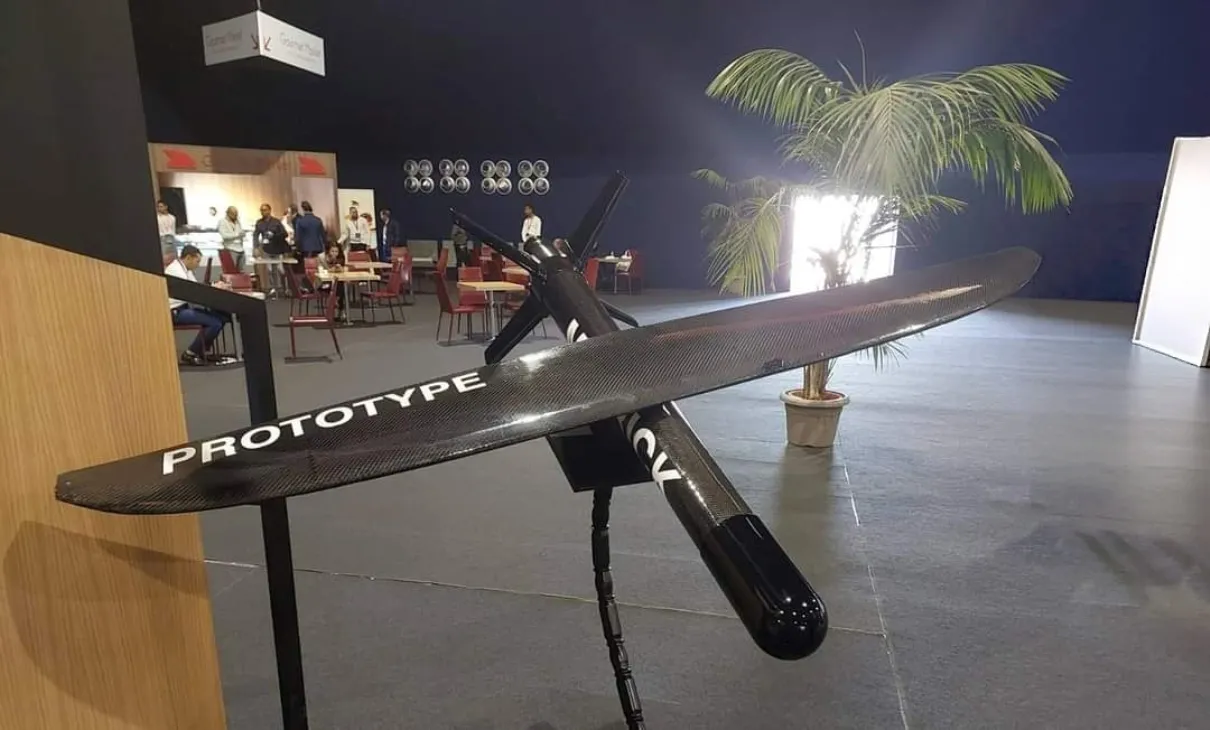
Founded in 2017, AES showcased prototypes of its unmanned aerial vehicles (UAVs) intended for military use at the 2024 Marrakech Air Show. Among these was the Mavrick loitering munition, whose initial prototype was developed at a cost of approximately 370,000 euros, funded through an investment round in 2021. With a flight endurance of up to 90 minutes, the drone currently boasts a radio link range of 25 kilometers, with aspirations to double this in the future. Notably, it can carry a 5-kilogram warhead to execute precision strikes against sensitive tactical targets.
The Mavrick prototype is constructed from carbon fiber and features a fixed-wing aerial platform with a rear push-propeller configuration and X-shaped tail fins. The visible "Prototype" markings on the wings and fuselage indicate that this model is experimental, designed to demonstrate structural design and platform capabilities, as the sensor dome at the front has yet to be integrated.
Transforming Morocco's Defense Landscape
Drones with similar flight capabilities, such as the Israeli SpyX, typically cruise at speeds ranging from 100 to 150 km/h and can exceed maximum acceleration while descending, surpassing 200 km/h. In combat scenarios using GPS-guided autonomous targeting in a fire-and-forget mode, and assuming an average cruising speed of 100 km/h with a maximum flight time of 90 minutes, the drone can dynamically cover distances between 135 and 180 kilometers under stable weather conditions.
The announced range of 25 kilometers is constrained by line-of-sight data link limitations, which represents the maximum distance at which the ground station can receive high-definition video transmission and manually guide the drone through human intervention to ensure strike accuracy and mitigate GPS interference.
In autonomous combat scenarios using GPS coordinates in a fire-and-forget mode, the total physical distance the drone can travel frees it from radio communication limitations with the ground control station, enabling it to act as a long-range projectile capable of striking deep into enemy territory with doubled destructive efficiency, considering that the Mavrick carries a 5 kg warhead—twice the payload of the Israeli SpyX, which only carries 2.5 kg.
What gives this contract its strategic dimension are the stringent conditions set by the Moroccan Armed Forces, which mandated the establishment of a production plant in the Benslimane region, set to commence operations in 2027. This requirement is not an exception but rather reflects a consistent approach adopted by Rabat in all recent military transactions aimed at fostering the emergence of a national defense sector and achieving industrial autonomy to reduce foreign dependency for military supplies.
The Benslimane region, located between Casablanca and Rabat, is evolving into a military industrial hub due to these investments, creating a geographical and industrial cluster capable of absorbing advanced technologies. Furthermore, this contract does not represent the first collaboration between the two parties. In 2024, AES had already signed a funding agreement with the Ministry of Industry and the General Confederation of Moroccan Enterprises (CGEM) to produce 1,000 units of the "Atlas ISTAR" model, specifically designed for real-time intelligence, precise terrain surveillance, and target acquisition in critical missions (ISR/ISTAR). This model features a range of up to 800 km via satellite link, with the same production unit establishment condition applied, this time south of Marrakech in the city of Benguerir, where construction began in 2024.
While evaluating the industrial landscape of these newly announced Moroccan UAVs, it is essential to move beyond media narratives and scrutinize the supply chain structures. It’s incorrect to assert that Morocco has achieved absolute independence; rather, it is in a transitional phase between domestic production of certain components and reliance on the global market—a natural stage for any emerging industry aspiring for technological sovereignty.
This reality encompasses three interconnected industrial levels. Despite AES's competitive advantage due to its local presence and solid relationships with civil and military actors, such as Managem (part of the royal holding Al Mada) and the OCP Group (Office Chérifien des Phosphates), this advantage might face significant challenges with the arrival of major international corporations.
The Turkish company Baykar plans to establish a subsidiary in Morocco named Atlas Defense in 2025, with an investment of $250 million to launch its first production facility on the African continent in the Benslimane region. Additionally, Israeli company BlueBird Aero Systems, a subsidiary of Israel Aerospace Industries (IAI) and the manufacturer of the SpyX drones, is emerging as another competitor, having set up its factory in Benslimane by late 2025. French company Delair has also announced the establishment of a subsidiary in Rabat called Delair Afrique, relocating its logistical and technical hub from Toulouse to Morocco to serve as a launch platform for its drones in the African market.
This foreign dynamism does not overshadow the role of other local startups, which prominently showcased domestically manufactured models reflecting advanced engineering aspirations during the 2024 Marrakech Air Show. Among the standout models was the suicide drone "B2" from Ballistic Defense Systems (founded in 2023), which boasts a range of up to 1,500 kilometers and carries a 40-kilogram warhead, categorizing it as a heavy loitering munition. The same company also presented the drone B1, with a 50-kilometer range and a 6-kilogram payload, equipped with artificial intelligence systems for precise target detection and tracking. Additionally, the kamikaze drone Saqr Al Sahra, manufactured by Moroccan company Ksar Aerospace, which received government funding for research and development, has a range of up to 500 kilometers and can carry 20 kilograms of explosives.
These developments indicate that loitering munition production in Morocco has transitioned from conceptual stages into actual manufacturing and contracting, supported by direct government funding. The integration of the military's urgent need to develop capabilities, an academic structure providing skilled talent, and a legislative framework that opens doors for the private sector is transforming the Kingdom into a real laboratory for the development of unmanned defense systems. Through a blend of local funding, international partnerships conditioned on technology transfer, and competition between national and foreign companies, Morocco is building a defense ecosystem aiming to manufacture an entirely Moroccan drone by 2030—a timeframe that appears feasible considering the current investment flow, infrastructure, and political and military will steering this strategic sector towards technological sovereignty.
As reported by defensa.com.